
AIIMS Delhi NO - 2018
Medical Surgical Nursing
Easy
In which surgery is the following mesh used?
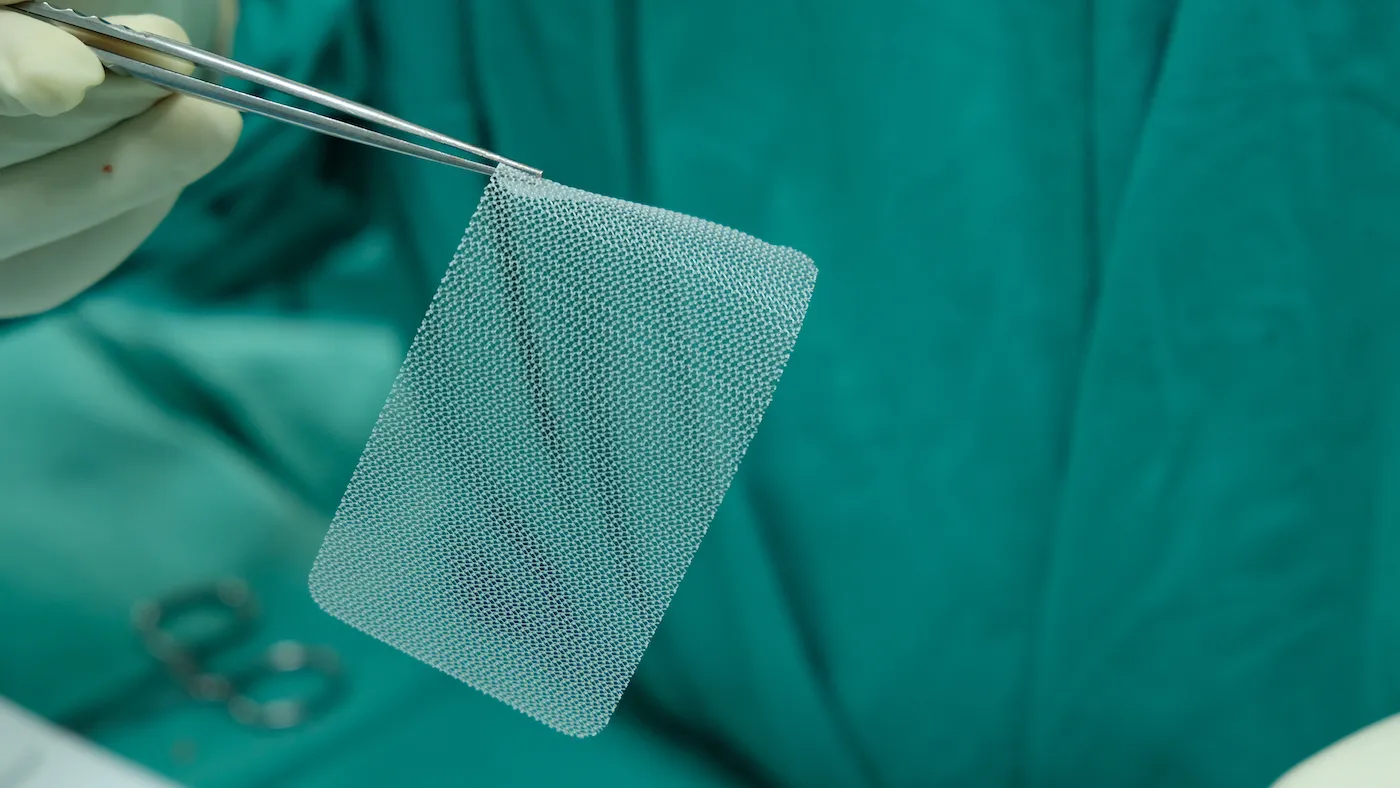
Appeared in: AIIMS Delhi NO - 2018
Explanation
- The image shows a synthetic surgical mesh, which is a medical implant designed to support and reinforce weakened tissue.
- Hernia repair (herniorrhaphy or hernioplasty) is the most common surgery that utilizes this type of mesh.
- The mesh acts as a scaffold, allowing the body's own tissue to grow into it, creating a stronger repair and significantly reducing the risk of hernia recurrence.
- This technique is often referred to as a 'tension-free' repair because it bridges the defect without pulling the native tissues together under tension.
Why Other Options Were Wrong
- Option B: Cleft palate repair is a reconstructive plastic surgery that involves repositioning and suturing flaps of tissue in the roof of the mouth. It does not use large sheets of synthetic mesh for reinforcement.
- Option C: A stoma is a surgically created opening to allow waste to exit the body. It must remain open and accessible. Covering it with mesh would block its function.
- Option D: An ileostomy is a specific type of stoma created from the ileum (small intestine). The same principle applies as for any stoma: the opening itself is never covered with mesh.
Related Visual

Clinical Relevance
- Nursing practice connection: This is primarily an exam-oriented knowledge point with limited direct bedside application, so retain Application of Surgical Implants as background academic context rather than a clinical decision trigger.
- Post-operative nursing care for a patient with a mesh repair includes monitoring the surgical site for signs of infection (redness, swelling, warmth, pus), seroma/hematoma formation (fluid collection), and signs of mesh rejection (chronic pain, non-healing wound).
- Patient education is critical. The nurse must instruct the patient to avoid heavy lifting, straining, and strenuous activity for a period specified by the surgeon (often 4-6 weeks) to prevent mesh displacement and ensure proper healing.
- What if? If a patient post-hernia repair reports a new, sharp, localized pain and a palpable lump near the incision site after a coughing fit, the nurse should suspect a possible early recurrence or mesh displacement and notify the surgeon immediately for further evaluation.
How to Approach the Question
- First, identify the object in the image. The image clearly shows a woven, net-like material, which is recognizable as surgical mesh.
- Next, recall the primary function of surgical mesh. Its purpose is to provide a strong, supportive scaffold for weakened or damaged tissues.
- Then, evaluate the given options. Consider which of the listed surgeries involves reinforcing a weak tissue wall.
- Hernia repair directly addresses a weakness in the abdominal wall, making it the most logical application for a reinforcing mesh.
- Eliminate the other options. Cleft palate repair involves different techniques, and covering a stoma would obstruct its function, making these choices incorrect.
Concept Tested & Keywords
- Concept Tested: Application of Surgical Implants
- Stem keywords: surgery, mesh
- Lead-in keywords: In which
Question ID
Qo2-7yH2aNOXdaNGw0j45s
Reference Book
E6 Gynecology Williams p. 139-164
Practise the full AIIMS Delhi NO - 2018
Attempt every question from this paper in a timed mock, then review the full solution for each one.
More Peri-operative Nursing Questions
- A female patient has a laparoscopic cholecystectomy this morning she is now complaining of right shoulder pain. The nurse would explain to the patien…
- The suture shown in the image is:
- A patient has just returned from the post anesthesia care unit (PACU) after hemorrhoidectomy. His postoperative orders include sitz bath every mornin…
- The priority nursing intervention for a patient during the immediate post-operative period is?
- During ongoing surgery under general anesthesia, which parameter is the first priority?
- An opening of surgical wound edges is called?
- Lead rubber aprons are used in OT when following equipment is used?
- Which of the following is the best response by the nurse regarding paralytic ileus after abdominal surgery?
- Nursing care of the patient after thyroid surgery includes all of the following EXCEPT
- Pre-operative nursing care includes
More AIIMS Delhi NO - 2018 Questions
- Another tentative diagnosis made for the client is Wernicke's Encephalopathy. If the client has this, the nurse anticipates that the first physician'…
- A 35-year-old man was in an automobile accident with an admitting diagnosis of a head injury. He has a Glasgow Coma Scale score of 4. Upon MRI and CT…
- A 28-year-old male client is admitted to the hospital for a suspected brain tumor. While assessing this client, the nurse would keep in mind that the…
- Following admission to the hospital, a diagnosis of increasing intracranial pressure was made. The nursing intervention appropriate in the care of th…
- The nurse has orders to administer phenytoin (Dilantin) 100 mg IV as an anticoagulant. The priority action while administering this drug is to:
- The client is to take lithium regularly after she is discharged from the hospital. The nursing care plan includes discharge planning. The most import…
- A patient is taking a proper diet as prescribed for bulimia nervosa, but the patient's weight is not gaining. Which nursing action is appropriate?
- Identify the size of the cannula shown here?& x20;
- Identify the following image? & x20;
- Identify the instrument below?& x20;