
MP CHO -2019 (Shift-2)
Obstetrics & Gynaecology
Easy
How low does hemoglobin level in a pregnant woman lead to severe anemia?
Appeared in: MP CHO -2019 (Shift-2)
Explanation
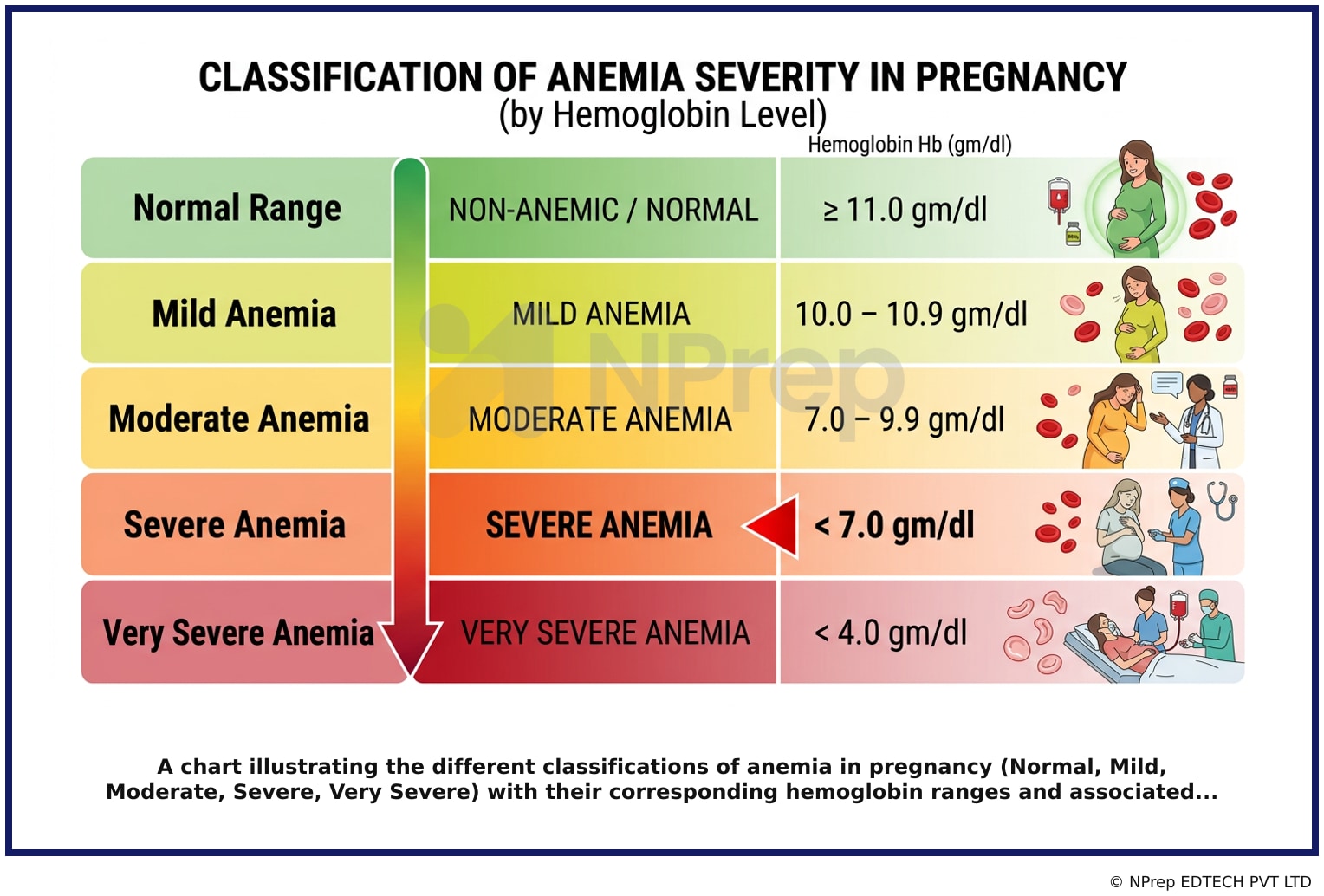
- According to the World Health Organization (WHO) guidelines, severe anemia in a pregnant woman is defined by a hemoglobin (Hb) concentration of less than 7.0 gm/dl.
- This level indicates a significant reduction in the oxygen-carrying capacity of the blood, posing serious health risks to both the mother and the fetus.
- This threshold is used universally to identify high-risk pregnancies that require immediate and intensive medical intervention, which may include hospitalization, parenteral iron therapy, or blood transfusions.
Why Other Options Were Wrong
- Option A: A hemoglobin level of 9-11 gm/dl in pregnancy is classified as mild anemia (10.0-10.9 gm/dl) or the lower limit of normal (11.0 gm/dl). It does not meet the criterion for severe anemia.
- Option B: A hemoglobin level between 7-9 gm/dl (specifically 7.0-9.9 gm/dl) is classified as moderate anemia in pregnancy. While it requires medical attention, it is not categorized as severe.
- Option D: A hemoglobin level of 12-14 gm/dl is considered a normal and healthy range for a pregnant woman. A level above 11 gm/dl is generally considered non-anemic during pregnancy.
Related Visual
Clinical Relevance
- Nursing practice connection: This is primarily an exam-oriented knowledge point with limited direct bedside application, so retain Classification of anemia severity in pregnancy based on hemoglobin levels as background academic context rather than a clinical decision trigger.
- Nurses must be vigilant in screening for anemia at the first antenatal visit and subsequent visits (e.g., at 28-32 weeks) as it is a common and high-risk condition in pregnancy, especially in India.
- Recognizing the cutoff for severe anemia (<7 gm/dl) is critical for timely escalation of care, which may involve parenteral iron or blood transfusion to prevent adverse maternal and fetal outcomes like heart failure, PPH, preterm birth, and low birth weight.
- Patient education is a key nursing role, involving dietary counseling on iron-rich foods (e.g., green leafy vegetables, meat, jaggery), the importance of taking prescribed iron and folic acid supplements, and avoiding substances that inhibit iron absorption like tea and coffee with meals.
How to Approach the Question
- First, identify the key terms in the question: 'hemoglobin level', 'pregnant woman', and 'severe anemia'.
- The question asks for a specific value or threshold. This indicates it's a factual recall question based on established clinical guidelines.
- Recall the WHO classification for the severity of anemia in pregnancy. Mentally picture the ranges for mild, moderate, and severe anemia.
- Evaluate each option against the recalled classification: 9-11 gm/dl (mild/normal), 7-9 gm/dl (moderate), <7 gm/dl (severe), and 12-14 gm/dl (normal/healthy).
- Select the option that correctly matches the definition of 'severe anemia' in pregnancy, which is a hemoglobin level less than 7 gm/dl.
Concept Tested & Keywords
- Concept Tested: Classification of anemia severity in pregnancy based on hemoglobin levels.
- Stem keywords: hemoglobin level, pregnant woman, severe anemia
- Lead-in keywords: How low
- Clinical cues: Age/sex group narrows the expected diagnosis, intervention, or normal reference range.
- Negative lead-in flag: false
Question ID
Q-phZb_4hj7WCQzay_csEJ
Reference Book
E6 Comprehensive Textbook of Community Health NursingShyamala D part 1 (pp 26-389 of 389) p. 207-209
E6 Midwifery Obstetrics and Gynecology Nursing Sandeep Kaur p. 27-35
E6 Ghai Essential Pediatrics(pp 26-904 of 913) p. 351-353
Practise the full MP CHO -2019 (Shift-2)
Attempt every question from this paper in a timed mock, then review the full solution for each one.
More Medical and Surgical Illness Complicating Pregnancy Questions
- An antenatal mother came to OPD with Hb-8.5 g% which of the following is true?
- The vaccine that is contraindicated in pregnancy is (OBG):
- Which vaccine is used for the pregnant woman?
- Which immunization is contraindicated during pregnancy?
- Which of the following is commonly seen in fetus with congenital CMV infection?
- Most common type of Anemia in pregnancy?
- Assertion (A): Infants born with Intra Uterine Rubella Infection may have cardiac malformation and deafness.Reasons (R): Rubella Infection increases…
- Which vaccine is contraindicated in pregnancy?
- A pregnant woman has an Hb level of 8.5 gm%. What stage of anemia is this?
- Gestational diabetes increases risk for the following, EXCEPT
More MP CHO -2019 (Shift-2) Questions
- Which part of the pancreas secretes insulin?
- How high is the body temperature in hyperpyrexia?
- What is it called when the pulse rate is less than 60 per minute?
- Which of the following vertebrae is made up of 7 bones?
- How many lobes are there in the liver?
- By what other name is collar bone known?
- What does the central nervous system (CNS) consist of?
- When was India declared polio free by WHO?
- What is the sex ratio in M.P.?
- What is the life expectancy at birth in India?