
BSF Staff Nurse - 2021
Obstetrics & Gynaecology
Easy
How long can a woman get pregnant after IUCD is removed?
Appeared in: BSF Staff Nurse - 2021
Explanation
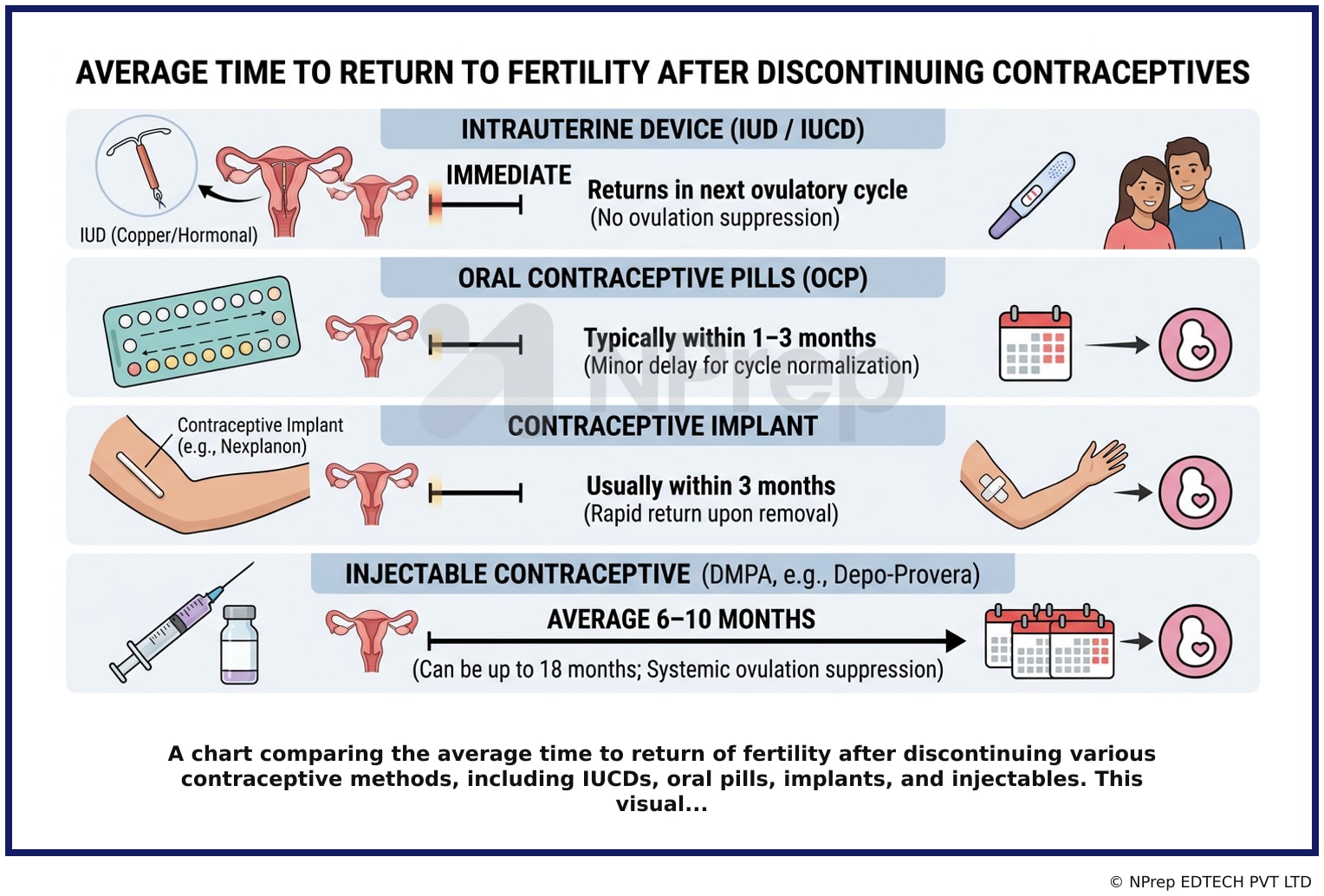
- A woman's ability to become pregnant returns immediately after the removal of an Intrauterine Contraceptive Device (IUCD).
- The contraceptive effect of an IUCD is localized to the uterus and does not systemically suppress ovulation.
- Once the device is removed, the uterine environment normalizes, and conception can occur in the next ovulatory cycle.
- This rapid return to fertility is a key advantage of IUCDs as a reversible contraceptive method.
Why Other Options Were Wrong
- Option A: This option suggests a one-month delay. While pregnancy might occur within the first month, fertility itself returns immediately, not after a waiting period.
- Option B: This option suggests a two-month delay, which is incorrect. There is no physiological reason for fertility to be delayed for two months after IUCD removal.
- Option C: This suggests a significant delay of nine months. This is incorrect for IUCDs. A long delay in the return of fertility is characteristic of depot medroxyprogesterone acetate (DMPA) injections.
Related Visual
Clinical Relevance
- Nursing practice connection: This is primarily an exam-oriented knowledge point with limited direct bedside application, so retain Return to fertility after Intrauterine Contraceptive Device (IUCD) removal as background academic context rather than a clinical decision trigger.
- Accurate patient counseling is a critical nursing responsibility. Informing a woman that she can conceive immediately after IUCD removal is essential for family planning.
- Conversely, if a woman is having her IUCD removed but does not wish to become pregnant, she must be counseled to start another form of contraception immediately.
- What if? If the patient had been using DMPA (Depo-Provera) injections instead of an IUCD, the nurse's advice would be very different. The nurse would need to explain that fertility could be delayed for an average of 6 to 10 months, and sometimes longer, after the last injection.
How to Approach the Question
- First, identify the core of the question: it asks about the timing of fertility return after stopping a specific contraceptive method (IUCD).
- Recall the mechanism of action for IUCDs. Remember that they primarily work locally in the uterus and do not stop ovulation.
- Contrast this with systemic hormonal methods that do suppress ovulation (like some pills or injections).
- Since the effect is local and ovulation is ongoing, the contraceptive effect should cease as soon as the device is removed.
- Therefore, select the option that reflects an immediate return to fertility.
- Eliminate options that suggest a delay, especially long delays which are characteristic of other methods like DMPA injections.
Concept Tested & Keywords
- Concept Tested: Return to fertility after Intrauterine Contraceptive Device (IUCD) removal.
- Stem keywords: IUCD, pregnant, removal, get pregnant
- Lead-in keywords: How long
- Clinical cues: Age/sex group narrows the expected diagnosis, intervention, or normal reference range.
- Negative lead-in flag: false
Question ID
Q_w30yIK_-goakTsVkxSBF
Reference Book
E6 Parks TextBook of Preventive & Social Medicine part 1 — Subpart C (pp 404-604 of 604) p. 191-193
E6 Gynecology Williams p. 119-147
Practise the full BSF Staff Nurse - 2021
Attempt every question from this paper in a timed mock, then review the full solution for each one.
More Population Dynamics and Control of Conception Questions
- What is the best time of insertion of Intrauterine Contraceptive Devices (IUCD)?
- DMPA contraceptive protection up to?
- Which of the following Emergency contraceptive methods, except?
- Which assessment was done by LARC?
- How long is Copper T 380 A effective?
- DMPA is supplied under govt of India free of cost, the brand name is?
- Cu IUCD 380A is effective up to how many years to prevent conception?
- Under National Family Welfare Program, IUCD 380 copper T would be effective for?
- Which of the following method of contraception can prevent sexually transmitted disease?
- Insertion of IUD can be done in all of the following conditions, except?
More BSF Staff Nurse - 2021 Questions
- Which of the following can cause abortion?
- Highest source of vitamin C is?
- Highest source of vitamin D is?
- How much calorie is provided by 1 gm protein?
- Which one is a type of mixed cranial nerve?
- How much weight is gained during pregnancy?
- Knee joint is which type of joint?
- Which one is an example of tertiary prevention?
- MI can be diagnosed by?
- Silent MI is commonly seen in?