
KGMU 2023
Medical Surgical Nursing
Easy
How is an intrathecal injection administered?
Appeared in: KGMU 2023
Explanation
- An intrathecal injection involves administering medication directly into the subarachnoid space.
- This space contains the cerebrospinal fluid (CSF) that surrounds the spinal cord and brain.
- This route is used to bypass the blood-brain barrier for targeted delivery of drugs like anesthetics, chemotherapy agents, or pain medications to the central nervous system.
- The term 'intrathecal' literally means 'within the sheath,' referring to the theca or dura mater, the outermost layer of the meninges.
Why Other Options Were Wrong
- Option B: This describes an intramuscular (IM) injection, where medication is injected into a muscle for systemic absorption.
- Option C: This describes an epidural injection. The epidural space is located outside the dura mater, not within the subarachnoid space.
- Option D: This describes an intravenous (IV) injection, which delivers medication directly into the systemic circulation via a vein.
Related Visual
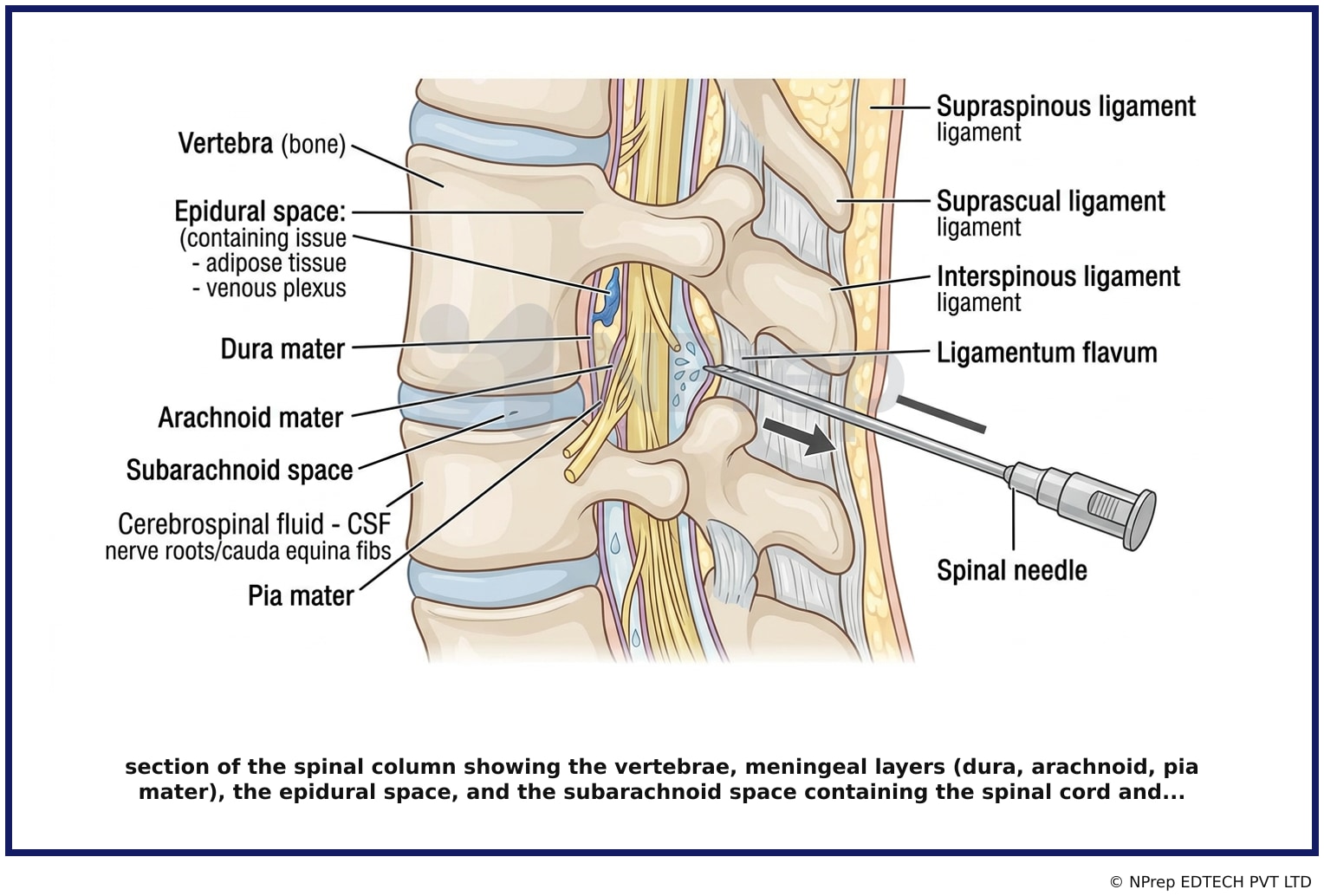
- Visual 1: Diagram - A cross-section of the spinal column showing the vertebrae, meningeal layers (dura, arachnoid, pia mater), the epidural space, and the subarachnoid space containing the spinal cord and CSF. An arrow should indicate the needle path for an intrathecal injection, piercing the dura and arachnoid mater to enter the subarachnoid space.
Clinical Relevance
- Nursing practice connection: This is primarily an exam-oriented knowledge point with limited direct bedside application, so retain Administration route of intrathecal injections as background academic context rather than a clinical decision trigger.
- Correct identification of anatomical landmarks is critical for nurses assisting with or monitoring patients after an intrathecal injection to ensure medication is delivered to the correct space and to prevent complications.
- Complications can include post-dural puncture headache (PDPH), infection, bleeding, or nerve damage. Nurses must monitor for signs of these complications.
- What if? - If the needle is inserted into the epidural space instead of the subarachnoid space, the intended spinal anesthesia will fail, and the patient will not have adequate pain relief. The procedure would need to be repeated, or an alternative anesthetic plan would be required.
How to Approach the Question
- First, identify the key term in the question: 'intrathecal injection'.
- Recall the definition of 'intrathecal'. The prefix 'intra-' means 'within' and 'theca' refers to the sheath (meninges) surrounding the spinal cord.
- This definition directly points to an injection within the meningeal layers.
- Evaluate the options based on this definition. 'Subarachnoid space' is the fluid-filled space within the meninges.
- Eliminate the other options by defining their routes: 'into the muscle' is intramuscular, 'into the epidural space' is epidural (outside the dura mater), and 'into a vein' is intravenous.
Concept Tested & Keywords
- Concept Tested: Administration route of intrathecal injections
- Stem keywords: intrathecal injection, administered
- Lead-in keywords: How
Question ID
Q_iOziq2x0gpQuJpvDtNuz
Practise the full KGMU 2023
Attempt every question from this paper in a timed mock, then review the full solution for each one.
More Nervous system Questions
- A patient presents to the OPD with the complaint of back pain and weakness in both lower limbs. Which of the following findings would suggest compres…
- What is the early sign of increased ICP (Intracranial pressure)?
- A 28 year old patient admitted in the hospital for suspected brain tumour. While assessing the patient the alzon nurse would keep in mind that the mo…
- In Myasthenia Gravis, why does repetitive nerve stimulation show a decremental response?
- Which of the following "device/instrument" is used in Cervical spinal cord injuries?
- Doctor has advised the nurse to prepare the room for a patient with a spinal cord injury (at C7 level). Which one of the following is most essential…
- Mr. Santos, 18 year old student, is admitted to the ward with a diagnosis of epilepsy. He tells the nurse that he is experiencing a generalized tingl…
- A client with C4 spinal cord injury is at greatest risk for?
- What is the minimum possible score of Glasgow Coma Scale?
- Patient with increased ICP is receiving Inj. Mannitol. The nurse's understanding about the reason for administration of this drug is?
More KGMU 2023 Questions
- The teacher scalded Aruna in front of her classmates during Project submission. Conclusion I: Aruna was not as popular as her other classmates. Concl…
- Aruna leaves and goes 8 meters in the North direction from a certain point. Then she turns right and travels for 12 meters. She again turns right and…
- Kiran is Sister of Raj. Raj is Son of Suresh and Vinita is Mother of Suresh then what is relation between Vinita and Kiran?
- A person who lives at the same time with another?
- Select the most appropriate meaning of the below idiom. A black sheep?
- The train has arrived...the station.
- A vendor sold 20 kg of potato at 18 Rs. per kg. He bought 2-liter milk at the rate of 46 Rs./liter, 2 kg sugar at the rate of 35 Rs./kg and 10 packet…
- Which one is the perfect square?
- A is the smallest. C is taller than B and D. E is neither the tallest nor the smallest. Find which one is the tallest?
- From an entrance, a person walks 28 meters left, then turns right and walks 13 meters. They turn right again and walk 12 meters, and then walk 16 met…