
KGMU 2023
Medical & Surgical Nursing
Easy
For treatment of Hypovolemic shock which IV fluid is given?
Appeared in: KGMU 2023
Explanation
- Hypovolemic shock requires rapid expansion of the intravascular volume to restore blood pressure and tissue perfusion.
- Normal Saline 0.9% is an isotonic crystalloid solution, meaning it has the same effective osmolality as body fluids.
- Because it is isotonic, it remains primarily within the intravascular space after infusion, making it highly effective for volume replacement.
- Other common isotonic solutions used for this purpose include Ringer's Lactate.
Why Other Options Were Wrong
- Option A: Normal Saline 0.45% is a hypotonic solution. It has a lower solute concentration than blood, causing fluid to shift from the intravascular space into the cells, which would worsen the shock state.
- Option B: Dextrose 5% in water (D5W) is isotonic in the bag but becomes hypotonic once infused because the body quickly metabolizes the dextrose. This leaves free water, which distributes across all body compartments and does not effectively expand the intravascular volume.
- Option D: Normal Saline 3% is a hypertonic solution. It has a much higher solute concentration than blood. While it does pull fluid into the vascular space, its use is reserved for specific, severe conditions like symptomatic hyponatremia or increased intracranial pressure, due to the high risk of causing cellular dehydration and fluid overload.
Related Visual
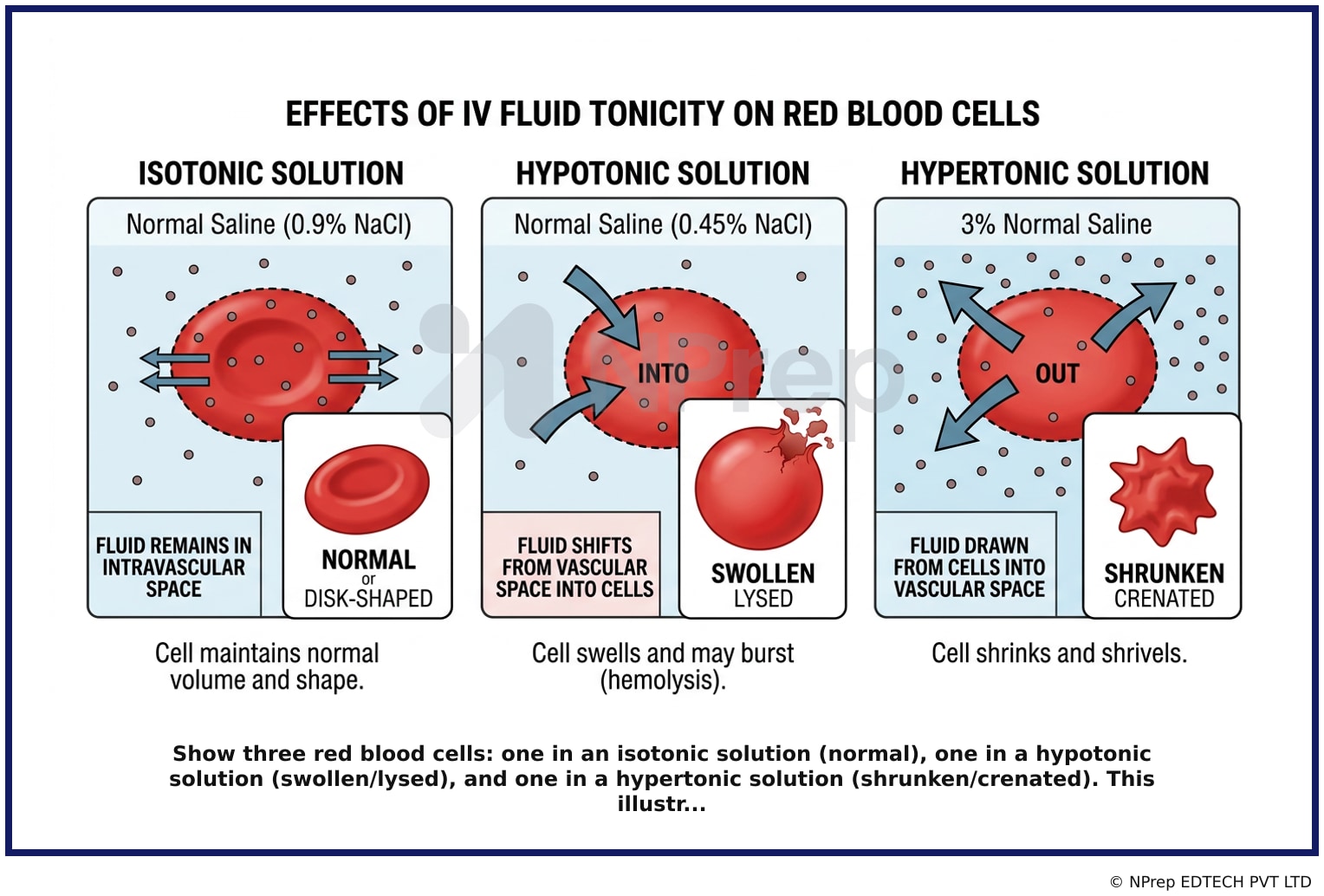
- Visual 1: Diagram - Show three red blood cells: one in an isotonic solution (normal), one in a hypotonic solution (swollen/lysed), and one in a hypertonic solution (shrunken/crenated). This illustrates the effect of different fluid tonicities.
- Visual 2: Flowchart - Depict the initial management of hypovolemic shock, starting with recognition of signs/symptoms, followed by securing IV access, and administering an isotonic crystalloid bolus.
Clinical Relevance
- Nursing practice connection: Prioritize focused assessment, early escalation, and real-time monitoring when managing IV fluid resuscitation for hypovolemic shock in acute care settings.
- Rapid identification and treatment of hypovolemic shock are critical nursing responsibilities to prevent irreversible organ damage and death.
- Nurses must use large-bore IV catheters (e.g., 16 or 18 gauge) to allow for the rapid infusion of fluids required in shock states.
- Constant monitoring for signs of fluid overload (e.g., crackles in the lungs, jugular venous distention, edema) is essential during rapid fluid resuscitation, especially in patients with underlying cardiac or renal conditions.
How to Approach the Question
- First, identify the core clinical problem in the question stem: 'Hypovolemic shock'.
- Recall the primary goal of treatment for this condition, which is to rapidly increase the volume of fluid within the blood vessels (intravascular volume).
- Next, analyze each IV fluid option based on its tonicity (isotonic, hypotonic, or hypertonic) and how that property affects fluid movement in the body.
- An isotonic fluid has the same concentration as blood and will stay in the vessels, making it the ideal choice.
- A hypotonic fluid will move out of the vessels into cells, making the problem worse.
- A hypertonic fluid is a specialized solution not used for initial, general volume replacement.
Concept Tested & Keywords
- Concept Tested: IV fluid resuscitation for hypovolemic shock
- Stem keywords: Hypovolemic shock, treatment, IV fluid
- Lead-in keywords: which
Question ID
QWHfGr63f3xAaVETKarUZm
Practise the full KGMU 2023
Attempt every question from this paper in a timed mock, then review the full solution for each one.
More Shock and Multisystem Failure Questions
- Identify the cannula which is used in patient with hemorrhagic shock shown in the picture:
- What is an early sign of hypovolemic shock?
- What is the risk factor for septic shock?
- A Patient with RTA comes into the emergency department that needs resuscitation. Which cannula is least preferred?
- A patient is suffering from bradycardia, warm dry skin and hypotension. Symptoms suggestive to neurogenic shock. What is another name of neurogenic s…
- A RTA patient brought into the emergency department with loss of massive blood with cervical spine injury, after assessment revealed that blood press…
- A patient has GI bleeding, with clot, BP 80/40 mm of hg. Priority nursing action is?
- Decrease blood pressure, rapid respiration, cold clammy & pale skin and decrease urine output all are clinical features seen in?
- Which of the following is a symptom of shock? (Choose the most appropriate option from below)
- A patient presents to the emergency with a history of multiple bee stings and a blood pressure of 80/50 mm Hg. He is having:
More KGMU 2023 Questions
- The teacher scalded Aruna in front of her classmates during Project submission. Conclusion I: Aruna was not as popular as her other classmates. Concl…
- Aruna leaves and goes 8 meters in the North direction from a certain point. Then she turns right and travels for 12 meters. She again turns right and…
- Kiran is Sister of Raj. Raj is Son of Suresh and Vinita is Mother of Suresh then what is relation between Vinita and Kiran?
- A person who lives at the same time with another?
- Select the most appropriate meaning of the below idiom. A black sheep?
- The train has arrived...the station.
- A vendor sold 20 kg of potato at 18 Rs. per kg. He bought 2-liter milk at the rate of 46 Rs./liter, 2 kg sugar at the rate of 35 Rs./kg and 10 packet…
- Which one is the perfect square?
- A is the smallest. C is taller than B and D. E is neither the tallest nor the smallest. Find which one is the tallest?
- From an entrance, a person walks 28 meters left, then turns right and walks 13 meters. They turn right again and walk 12 meters, and then walk 16 met…