
RUHS, Jaipur, PB B.Sc Nursing Entrance-2020
Applied Anatomy
Easy
Fertilization occurs in which part of the fallopian tube?
Appeared in: RUHS, Jaipur, PB B.Sc Nursing Entrance-2020
Explanation
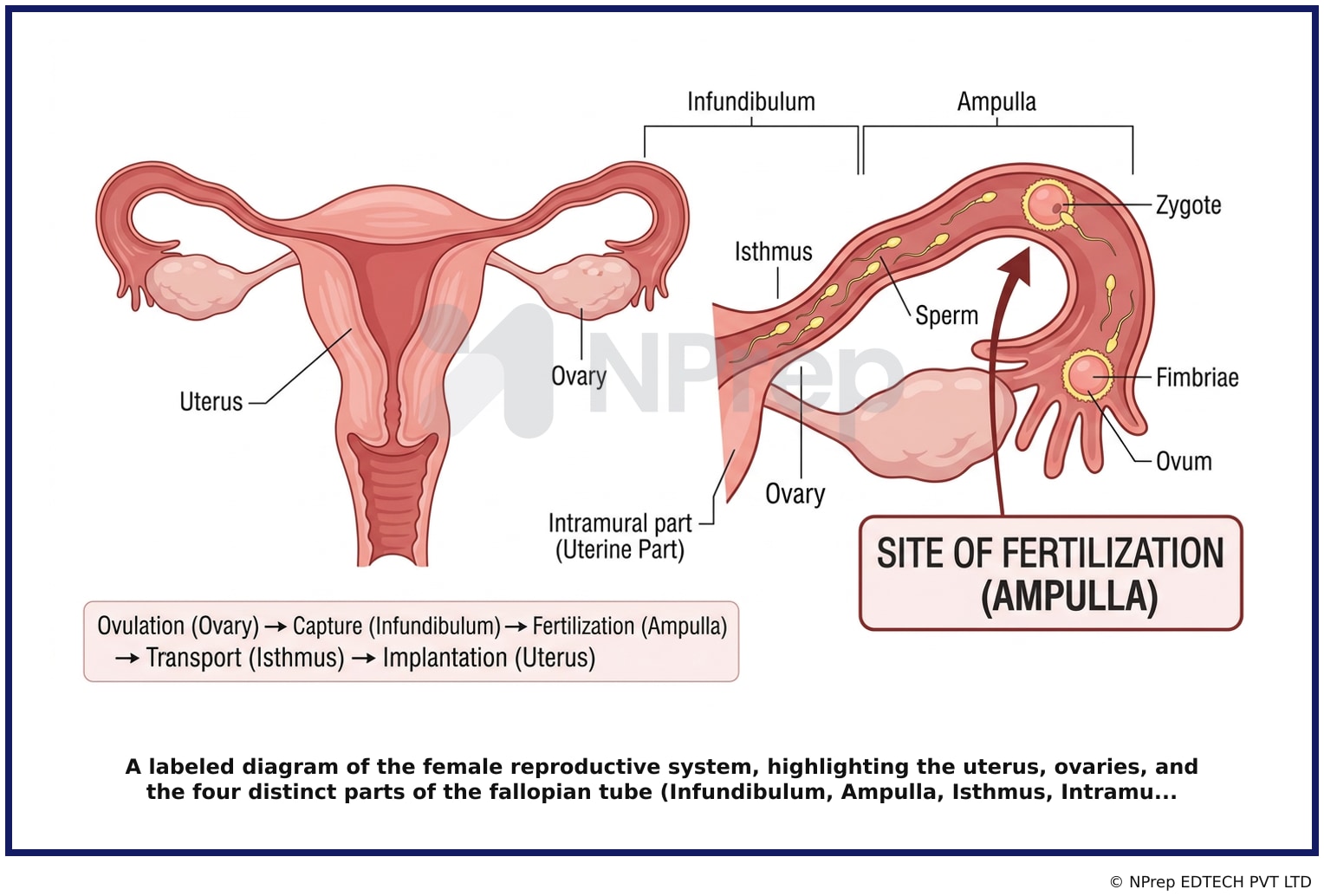
- The ampulla is the longest and widest section of the fallopian tube, providing ample space and time for the sperm and ovum to meet.
- It is the most common site for the fusion of the male and female gametes to form a zygote.
- The environment within the ampulla, including its fluid and ciliated cells, is optimized to facilitate fertilization.
- After being captured by the infundibulum, the ovum is transported to the ampulla where it awaits fertilization for up to 24 hours.
Why Other Options Were Wrong
- Option A: The isthmus is the narrower, muscular part of the tube closer to the uterus. Its primary role is to transport the fertilized egg (zygote) to the uterine cavity, not to host fertilization.
- Option C: The ovary is the female gonad responsible for producing and releasing the egg (ovulation). Fertilization does not occur in the ovary.
- Option D: The infundibulum is the funnel-shaped opening of the fallopian tube near the ovary. Its finger-like fimbriae are responsible for capturing the egg after ovulation, but fertilization typically occurs further down the tube in the ampulla.
Related Visual
Clinical Relevance
- Nursing practice connection: This is primarily an exam-oriented knowledge point with limited direct bedside application, so retain Anatomy of the female reproductive system and the site of fertilization as background academic context rather than a clinical decision trigger.
- Understanding the site of fertilization is crucial for diagnosing an ectopic pregnancy, where the fertilized egg implants outside the uterus. The most common site for an ectopic pregnancy is the ampulla of the fallopian tube.
- Blockages or damage to the fallopian tubes, particularly the ampulla, are a significant cause of female infertility as they can prevent the sperm and egg from meeting.
- Procedures like hysterosalpingography (HSG) are used to check the patency of the fallopian tubes in infertility investigations.
How to Approach the Question
- First, identify the core concept of the question, which is the specific anatomical location of fertilization.
- Recall the anatomy of the female reproductive tract, specifically the path the ovum takes after ovulation: Ovary → Infundibulum → Ampulla → Isthmus → Uterus.
- Consider the function of each part. The ovary produces the egg, the infundibulum catches it, the ampulla is where it typically meets the sperm, the isthmus transports it, and the uterus is for implantation.
- Eliminate the ovary, as it's the site of egg production, not fertilization.
- Compare the remaining parts of the fallopian tube. The infundibulum is for capture and the isthmus is for transport, leaving the ampulla as the primary site for the event of fertilization.
- Select 'Ampulla' as it is the widest part, providing the ideal location for the sperm and egg to fuse.
Concept Tested & Keywords
- Concept Tested: Anatomy of the female reproductive system and the site of fertilization.
- Stem keywords: Fertilization, fallopian tube
- Lead-in keywords: which part
Question ID
QkZdMfWzaIRkTeXUPn4gEk
Reference Book
E6 Anatomy Applied Ashalatha 4e p. 389-391
Practise the full RUHS, Jaipur, PB B.Sc Nursing Entrance-2020
Attempt every question from this paper in a timed mock, then review the full solution for each one.
More Reproductive System Questions
- The forward bending of the uterus in relation to the vagina is called:
- Which part of the breast is the Montgomery glands situated?
- The length of the fallopian tube ranges from?
- Longest portion of fallopian tube is?
- Bartholin gland is present in?
- Thickest layer of uterus is?
- In which part of the uterine tube does the fertilisation process occur?
- Urethral opening located behind the penis on the ventral surface?& x20;
- Where does fertilization take place?
- Which is the thickest layer of the uterus?
More RUHS, Jaipur, PB B.Sc Nursing Entrance-2020 Questions
- The epithelial tissue which is found in the uterine tubes is known as?
- The innermost layer of epidermis is called as?
- Which tissue region do nails originate from?
- Each cerebral hemisphere is divided into how many lobes?
- Intrinsic factor is produced by which cells within the stomach?
- Which hormone acts on the intestines and causes increased calcium absorption?
- Blood from the heart flows through the blood vessels in which order?
- Mr. Mohan developed quadriplegia following a diving accident. The most likely cause is?
- The right sequence of formation of urine is?
- Which part of the eye focuses light?