
INI-CET EXAM -2025
Medical & Surgical Nursing
Hard
During triage, who should receive the highest priority?
Appeared in: INI-CET EXAM -2025
Explanation
- Triage prioritization follows the systematic ABCDE approach: Airway, Breathing, Circulation, Disability, and Exposure.
- The patient who is unconscious with noisy breathing has a critical airway problem, which is the most immediate life-threatening condition.
- Unconsciousness impairs the patient's ability to protect their own airway from obstruction (e.g., by the tongue).
- Noisy breathing, such as grunting, gurgling, or stridor, is a cardinal sign of a partially obstructed airway that requires immediate intervention to prevent respiratory arrest.
- According to the Advanced Trauma Life Support (ATLS) guidelines, establishing a patent airway is the first and most critical step in managing a trauma or emergency patient.
Why Other Options Were Wrong
- Option A: A crying child, by definition, has a patent airway and is breathing. While the child is in distress and needs assessment, they are physiologically more stable than patients with compromised airways, breathing, or circulation.
- Option C: This patient has a serious 'Breathing' problem and is a high priority. However, an immediate 'Airway' problem takes precedence. Because this patient is conscious, their airway is still patent, making them a slightly lower priority than the unconscious patient with an obstructed airway.
- Option D: This patient has a critical 'Circulation' problem due to hemorrhage. This is a life-threatening condition, but it is prioritized after immediate airway and breathing problems are addressed, as hypoxia from a blocked airway causes irreversible damage more quickly.
Related Visual
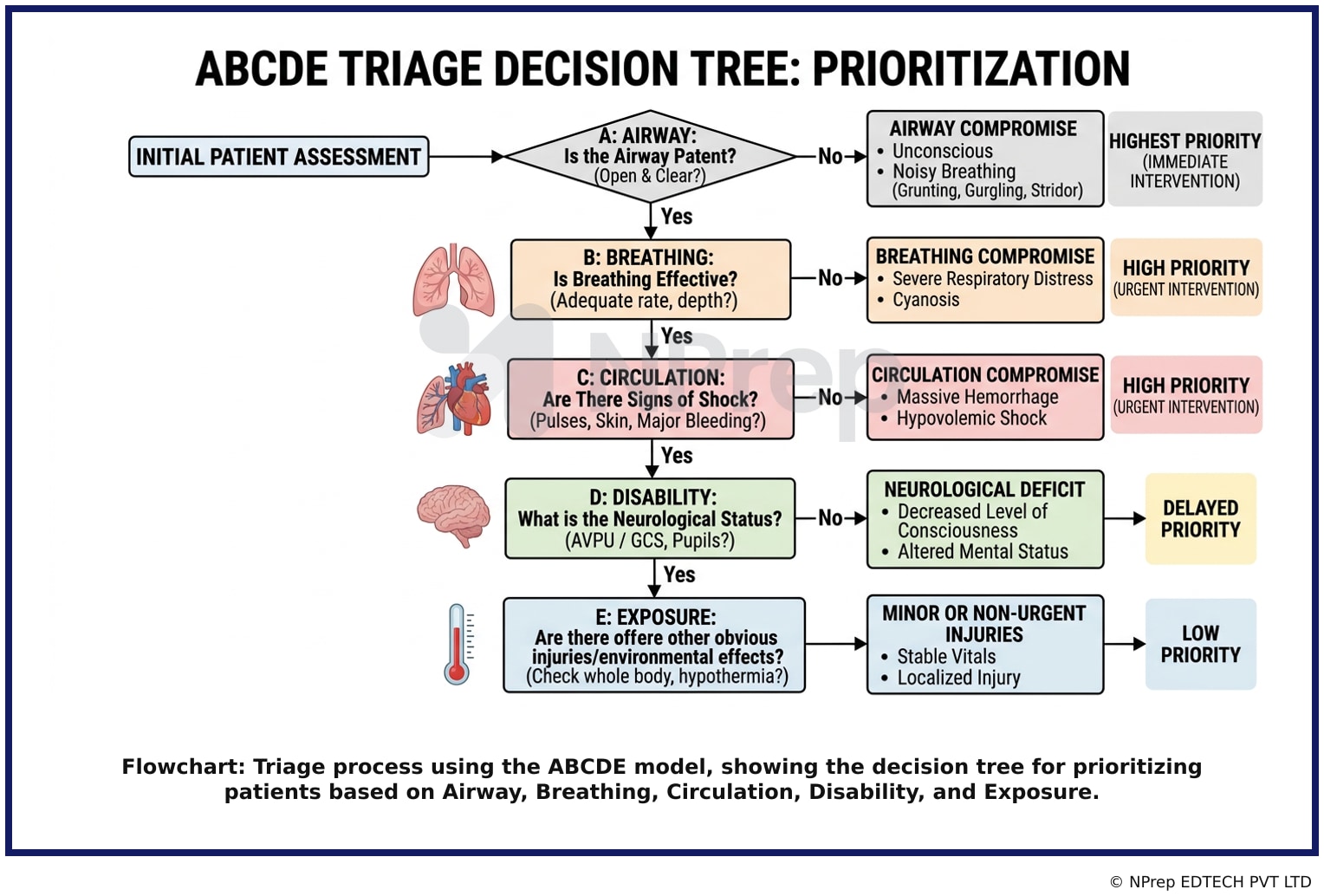
- Visual 1: Flowchart: Triage process using the ABCDE model, showing the decision tree for prioritizing patients based on Airway, Breathing, Circulation, Disability, and Exposure.
- Visual 2: Infographic: The 5-level Emergency Severity Index (ESI) with examples for each level, classifying the patient with airway compromise as ESI Level 1.
Clinical Relevance
- Nursing practice connection: This is primarily an exam-oriented knowledge point with limited direct bedside application, so retain Triage principles and prioritization of care in an emergency setting as background academic context rather than a clinical decision trigger.
- In any mass casualty incident or busy emergency department, rapid and accurate triage using the ABCDE framework is a core nursing competency essential for maximizing patient survival.
- Nurses must be able to quickly recognize the subtle and overt signs of airway compromise (e.g., snoring, gurgling, stridor, hoarseness) as this requires immediate intervention, such as a jaw-thrust maneuver, suctioning, or preparing for intubation.
- The principle of 'treat first what kills first' governs emergency care, and a blocked airway leads to death within minutes.
How to Approach the Question
- First, identify that this is a prioritization question, which requires you to rank patients based on the severity of their condition.
- Recall the standard protocol for emergency triage: the ABCDEs (Airway, Breathing, Circulation, Disability, Exposure). This provides a structured order of priorities.
- Evaluate each patient's condition and map it to one of the ABCDE categories.
- Option A (crying child): Stable, no immediate ABC issue.
- Option B (unconscious, noisy breathing): This is a critical 'A' (Airway) problem.
- Option C (conscious, breathing difficulty): This is a serious 'B' (Breathing) problem.
Concept Tested & Keywords
- Concept Tested: Triage principles and prioritization of care in an emergency setting.
- Stem keywords: triage, highest priority
- Lead-in keywords: highest priority
Question ID
QJndZ-hHuozCOr9ZDdhZJY
Practise the full INI-CET EXAM -2025
Attempt every question from this paper in a timed mock, then review the full solution for each one.
More Other Acute Problems Questions
- Identify the following image:
- A patient presents to the emergency department with the following vital signs: blood pressure 120/66 mmHg, pulse rate 88 beats per minute, respirator…
- A 30-year-old patient presents to the emergency department with a body temperature of 104°F (40°C). The patient’s additional vital signs are as follo…
- A patient was in an automobile accident, and sustained a head injury. Following admission to the hospital, a diagnosis of increasing ICP was made. Th…
- A patient was in an automobile accident and sustained a head injury following admission to the hospital a diagnosis of increased ICP was made. Which…
- What is the first step to take if someone has a convulsion? (Choose the most appropriate option from below)
- A patient admitted in the emergency is having tachypnoea with a respiratory rate of 28 breaths per minute. The likely diagnosis is:
- An example of an Open Drainage system used in surgical wounds is:
- You observe that a patient of head injury opens his eyes on painful stimuli but not on command; he localizes the site of the painful stimulus; and mu…
- An emergency room nurse is assessing a 22-year-old male who has been using opioids. What symptoms indicate that the client has overdose?
More INI-CET EXAM -2025 Questions
- The highlighted structure in the provided image articulates with which bone?& x20;
- Through which of the following foramina does the nerve supplying the muscles of mastication pass?& x20;
- In the given image, which region is correctly paired with its corresponding brain structure? • Middle cerebellar peduncle • Fasciculus cuneatus • Sup…
- Which of the following muscles is NOT typically associated with dysphagia or dysarthria?
- A muscle of mastication involved in opening the mouth exhibits the following characteristics. Identify the incorrect statement about it:
- In the illustrated image, which of the following structures is NOT associated with the area marked by the arrow?& x20;
- Match the following embryonic aortic arches with their respective adult derivatives: A. 1st Arch 1. Maxillary artery& x20; B. 2nd Arch 2. Common caro…
- Which of the following histology image is not an endocrine structure?& x20;
- Marked structure separates which of the following:
- Which of the following bones of the skull gives passage to a nerve arising from the brain & x20;