
MNS 2024
Pharmacology
Medium
Deferoxamine is used in the treatment of?
Appeared in: MNS 2024
Explanation
- Deferoxamine is an iron-chelating agent specifically designed to treat chronic iron overload (hemosiderosis).
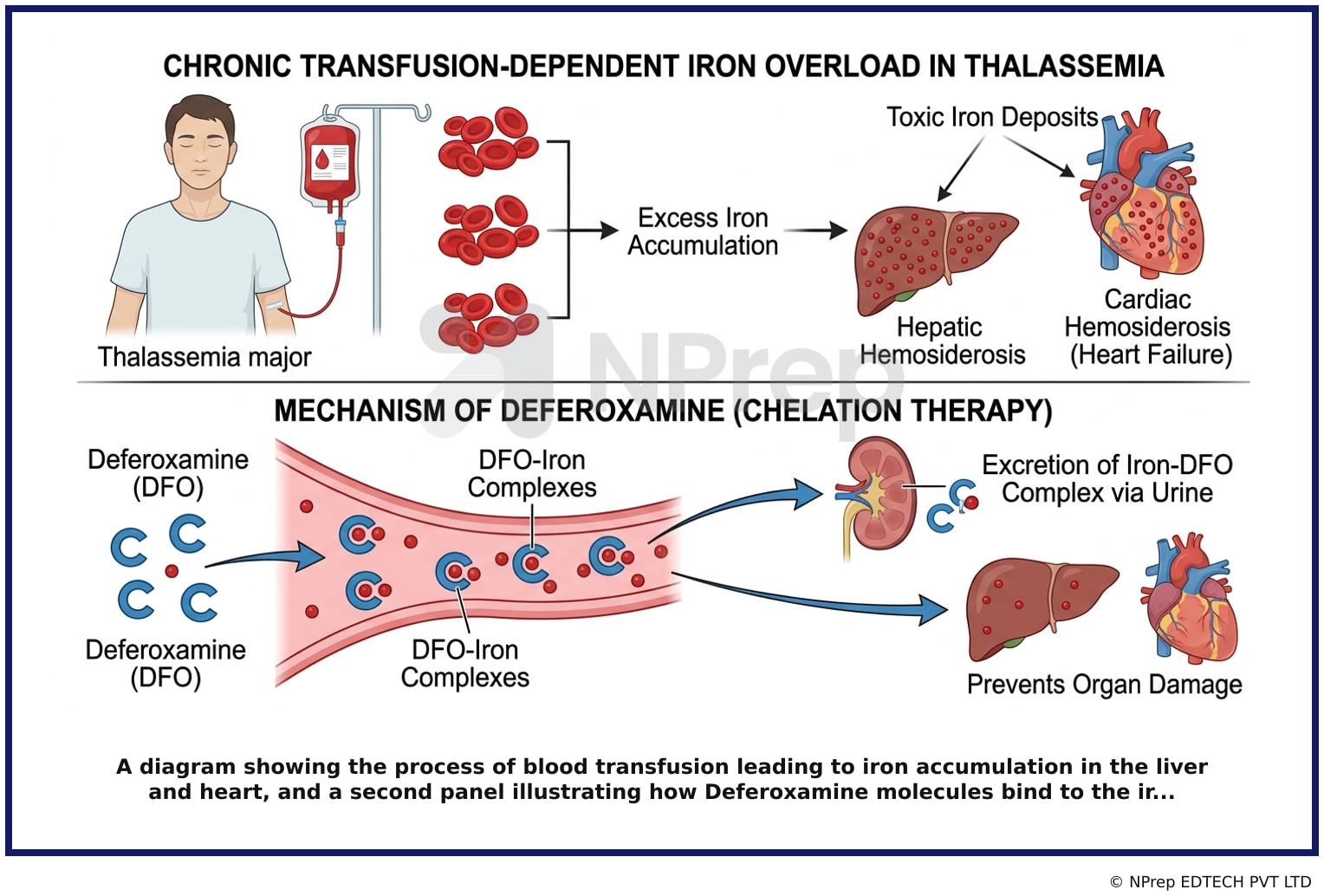
- Thalassemia major is a condition that requires lifelong, frequent blood transfusions to manage severe anemia.
- These repeated transfusions lead to a significant accumulation of iron in the body, which is toxic to organs like the heart and liver.
- Deferoxamine binds to this excess iron, forming a complex that is then excreted from the body, primarily through urine, thus preventing organ damage.
Why Other Options Were Wrong
- Option A: The primary treatment for aplastic anemia is immunosuppressive therapy or a bone marrow transplant to address the underlying bone marrow failure, not iron chelation.
- Option C: The primary treatment for sickle cell anemia focuses on managing pain crises and reducing sickling with drugs like hydroxyurea. Iron overload is not the central problem as it is in transfusion-dependent thalassemia.
- Option D: Megaloblastic anemia is caused by a deficiency in vitamin B12 or folic acid. The treatment is supplementation with the deficient vitamin, not iron removal.
Related Visual
Clinical Relevance
- Nursing practice connection: Knowing Pharmacology and clinical application of Deferoxamine helps nurses interpret findings accurately and avoid errors in routine assessment, medication administration, and patient teaching.
- Nurses play a crucial role in educating patients and families about the difficult, time-consuming nature of Deferoxamine administration (often a slow, overnight subcutaneous infusion) and the critical importance of adherence for survival.
- Monitoring for and managing the side effects of Deferoxamine, such as injection site reactions, hypotension, and long-term sensory deficits (vision, hearing), is a key nursing responsibility.
- What if? If a patient with thalassemia refuses their chelation therapy due to the discomfort of infusions, the nurse's priority is to explore the specific barriers, provide education on the life-threatening risks of untreated iron overload (like heart failure), and collaborate with the medical team to find alternatives, such as oral chelators (e.g., Deferasirox).
How to Approach the Question
- First, identify the drug in the question: Deferoxamine.
- Recall or deduce the drug's primary function. The 'fer' in the name is a clue related to iron. Deferoxamine is a classic iron-chelating agent.
- Next, analyze the options, which are all types of anemia. Ask yourself: Which of these conditions is most strongly associated with iron overload?
- Consider the pathophysiology of each anemia. Aplastic, sickle cell, and megaloblastic anemias have primary treatments that are not iron chelation.
- Recognize that Thalassemia major requires chronic, lifelong blood transfusions. This inevitably leads to severe iron overload, making it the primary indication for iron chelation therapy among the choices.
- Therefore, connect the drug's action (removing excess iron) with the disease that causes it (Thalassemia due to transfusions).
Concept Tested & Keywords
- Concept Tested: Pharmacology and clinical application of Deferoxamine
- Stem keywords: Deferoxamine, treatment
- Lead-in keywords: used in
Question ID
QNwbGbgP-KeR6P9aNzbQIx
Reference Book
E6 Pharmacology Katzung 16e p. 1604-1606
E6 Nelson Textbook of Pediatrics(2024) — Volume 2 pp. 776-778, 778-780
Practise the full MNS 2024
Attempt every question from this paper in a timed mock, then review the full solution for each one.
More Miscellaneous Drugs Questions
- Thiamine has been prescribed for an alcoholic patient. The rationale for administration of this medication is the prevention of:
- Identify the milky white solution which is widely used in OT for sedation and anesthesia based on the following the image:
- A patient who is prescribed oral cyclosporine should be advised to avoid:
- In which of the following type of poisoning bluish line on gums seen?
- An example of monoclonal antibiotic?
- In which of the following conditions are mentholated rubs contra-indicated?
- Which medicine used to increase the effect of local anesthesia?
- A nurse gave an injection of ondansetron to a patient. After 10 minutes, the patient's finger became blue in color. This is because of?
- The nurse is teaching a group of patients about the mood-stabilizing medication, lithium carbonate. Which of the following medications should instruc…
- Biological product, alpha-1 - antitrypsin is used for the treatment of which of the following diseases?
More MNS 2024 Questions
- Choose the best alternative that expresses the sentence in active/passive voice: The postman brought you a parcel? a. A parcel was brought to you by…
- Insert the suitable parts of speech: I have no — cash
- Choose an Antonym to replace the highlighted word: The religious leader was quite fanatical about his views on other religions?
- Fill the gap with the correctly spelt word in the sentence: We — round the pool and just always have a really good time? a. Longe b. Lounge c. Launge…
- Choose the correct set of synonyms for the word sanguine?
- Identify the active voices in the following? a. Ananya was making cartoon b. India lost world cup 2023 c. She sold the car d. Shanker was beaten up b…
- Choose the correct meaning of the idioms given in bold in the sentence: The principal proved to be a wet blanket at the students party?
- Match List I with List II | List - I | List - II | | --- | --- | | A. Extempore | I. A writer who steals ideas from others | | B. Soliloquy | II. A p…
- Anterior fontanel closes by?
- A patient is admitted with acute cholecystitis. He asks the nurse why the doctor does not take my gall bladder out. What would be her best response?