
RUHS, Jaipur, M.Sc Nursing Entrance Exam-2024
Medical & Surgical Nursing
Easy
Bonney's test is used to confirm
Appeared in: RUHS, Jaipur, M.Sc Nursing Entrance Exam-2024
Explanation
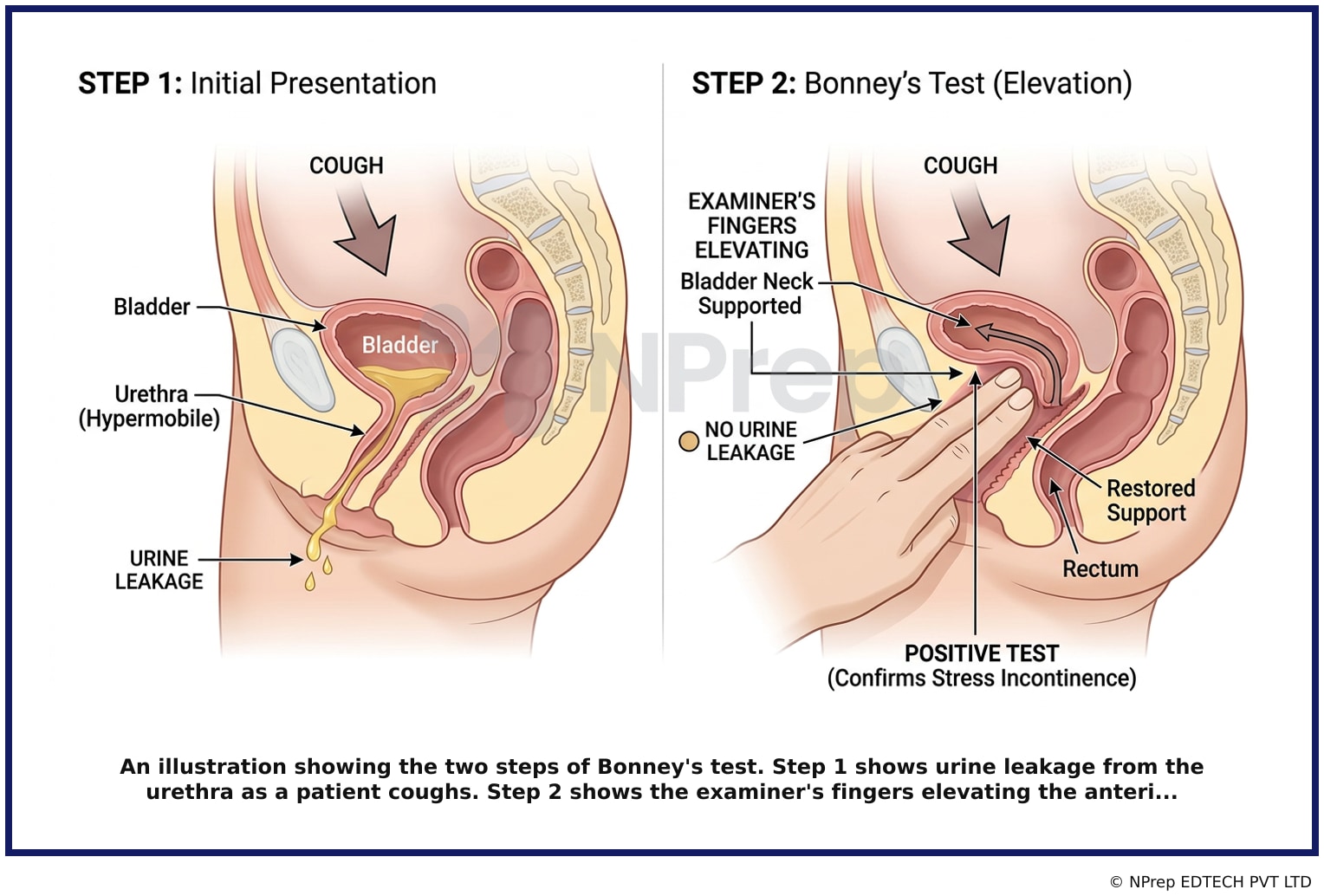
- Bonney's test is a specific clinical maneuver designed to diagnose stress urinary incontinence (SUI).
- SUI is primarily an anatomical problem caused by the hypermobility of the urethra and inadequate support of the bladder neck.
- The test works by manually elevating the bladder neck. If this support prevents urine leakage during a stress event like coughing, it confirms that the incontinence is due to this anatomical defect.
- A positive Bonney's test indicates that surgical procedures aimed at restoring support to the bladder neck are likely to be successful.
Why Other Options Were Wrong
- Option B: Urge incontinence is caused by involuntary contractions of the bladder's detrusor muscle. Bonney's test, which provides anatomical support, does not address this muscular overactivity.
- Option C: Overflow incontinence is due to an overdistended bladder that cannot empty properly, leading to dribbling. The test does not evaluate bladder emptying or obstruction.
- Option D: Neurogenic incontinence results from nerve damage affecting bladder control. Its diagnosis requires a comprehensive neurological evaluation and urodynamic studies to understand the specific type of nerve dysfunction.
Related Visual
Clinical Relevance
- Nursing practice connection: This is primarily an exam-oriented knowledge point with limited direct bedside application, so retain Diagnostic evaluation of urinary incontinence as background academic context rather than a clinical decision trigger.
- Accurately diagnosing the type of urinary incontinence is crucial for selecting the appropriate treatment, as management differs significantly (e.g., pelvic floor exercises for stress vs. anticholinergic medications for urge).
- A positive Bonney's test can help predict the success of surgical procedures like retropubic suspension or slings, which aim to restore bladder neck support.
- What if? If a patient leaks urine with coughing but the leakage is NOT stopped by Bonney's test, it may suggest intrinsic sphincter deficiency (ISD), a more severe form of stress incontinence where the urethral sphincter itself is weak. This would require different surgical considerations.
How to Approach the Question
- First, identify the key term in the question stem, which is 'Bonney's test'.
- Recall the purpose and procedure of this clinical test. It is a physical maneuver performed during a pelvic exam.
- Consider the mechanism of the test: it involves manually supporting the bladder neck to see if it stops urine leakage.
- Analyze the pathophysiology of each option. Stress incontinence is anatomical (lack of support), while urge, overflow, and neurogenic incontinence have different causes (muscular, obstructive, neurological).
- Match the test's mechanism (providing anatomical support) with the corresponding condition (stress incontinence).
Concept Tested & Keywords
- Concept Tested: Diagnostic evaluation of urinary incontinence
- Stem keywords: Bonney's test, confirm
- Lead-in keywords: BEST, MOST RELEVANT CLUE
- Negative lead-in flag: false
Question ID
Qo7NaboIMpyP0obFmpp6KR
Reference Book
E6 Nursing Brunner Adult Health 3SA Vol 2 Part 2 p. 112-114
E6 Gynecology Williams p. 108-133
Practise the full RUHS, Jaipur, M.Sc Nursing Entrance Exam-2024
Attempt every question from this paper in a timed mock, then review the full solution for each one.
More Urinary Tract Function Questions
- Assessing the laboratory findings which results would the nurse most likely to expect to find in a client with chronic renal failure?
- A nurse is taking care of Chronic renal dysfunction patient. What diet she will advise for this patient?
- A patient is admitted with acute renal kidney injury, and nurse is advised to monitor strict urine output. She notices urine output is less than 100…
- The following are the use of the central line catheter; EXCEPT:
- The involuntary loss of urine through an intact urethra as a result of sudden increase in the intra-abdominal pressure is called:
- Which of the following is the warning sign post renal transplantation?
- What is contraindicated in male patient reporting the symptoms of redness and ecchymosis in the scrotum region?
- A patient with low urine specific gravity will have all the following characteristics; EXCEPT:
- Food contraindicated with CRF and spironolactone:
- When initiating the use of a newly inserted Central Venous Access Device (CVAD), what is the recommended syringe size for the initial flushing proced…
More RUHS, Jaipur, M.Sc Nursing Entrance Exam-2024 Questions
- Which nerve is responsible for transmitting pain sensation from the appendix to the brain
- The coronary arteries arise from which part of aorta
- The role of Hepatic Portal System is to
- Which hormone is secreted by adrenal medulla & is involved in fight & flight response
- Which process is responsible for synthesis of ATP in mitochondria
- Which of the following enzymes is responsible for the breakdown of starch into glucose
- Which of the following is considered a key element of the chain of infection
- Which characteristic is commonly used to classify bacteria
- Excess collection of fluid in peritoneal cavity is known as
- In acid base balance, a pH below 7.35 is indicative of