
NORCET 9 Prelims-2025
Applied Physiology
Medium
Anaphylactic shock, characterized by a severe, systemic allergic reaction leading to massive vasodilation and increased capillary permeability, is classified as which type of shock?
Appeared in: NORCET 9 Prelims-2025
Explanation
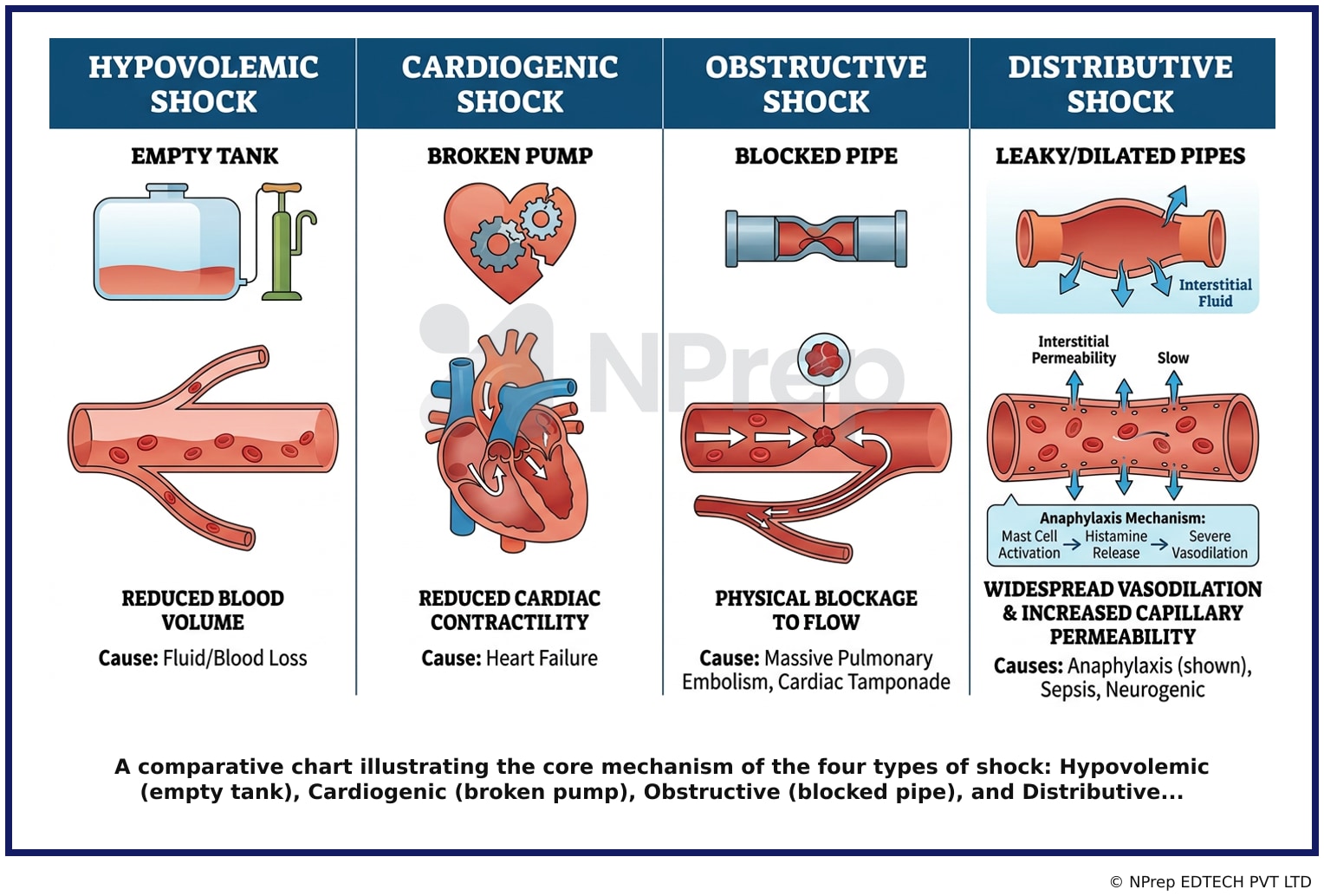
- Distributive shock is defined by a primary disturbance of reduced systemic vascular resistance (SVR) due to widespread vasodilation.
- Anaphylaxis is a severe, IgE-mediated allergic reaction that causes a massive release of histamine.
- Histamine leads to profound vasodilation and increased capillary permeability, causing fluid to shift from the intravascular to the interstitial space.
- This results in a 'relative' hypovolemia, where blood volume is poorly distributed, fitting the definition of distributive shock.
Why Other Options Were Wrong
- Option A: Cardiogenic shock is caused by primary heart pump failure, where the heart cannot pump enough blood to meet the body's needs. The primary problem is with cardiac contractility, not blood vessel dilation.
- Option B: Hypovolemic shock results from the actual loss of blood or fluid volume from the body. In anaphylaxis, the fluid volume is still within the body, just not within the blood vessels.
- Option D: Obstructive shock is caused by a physical blockage that impedes blood flow to or from the heart. The problem is a mechanical obstruction, not a change in vascular tone.
Related Visual
Clinical Relevance
- Nursing practice connection: This is primarily an exam-oriented knowledge point with limited direct bedside application, so retain Classification and Pathophysiology of Shock as background academic context rather than a clinical decision trigger.
- Recognizing anaphylactic shock as a form of distributive shock is crucial for initiating the correct treatment promptly. The primary goal is to reverse the vasodilation and support blood pressure.
- The first-line and most critical intervention for anaphylactic shock is the immediate administration of intramuscular (IM) epinephrine. It causes vasoconstriction, which counteracts the massive vasodilation, and bronchodilation, which helps with breathing difficulties.
- What if? If a patient in anaphylactic shock does not respond to initial epinephrine and fluid resuscitation, a continuous vasopressor infusion (like norepinephrine) may be required in an ICU setting to maintain adequate blood pressure by counteracting the persistent vasodilation.
How to Approach the Question
- First, identify the key pathophysiological processes described in the question stem: 'massive vasodilation' and 'increased capillary permeability' resulting from a 'severe, systemic allergic reaction'.
- Next, recall the four main classifications of shock: Cardiogenic, Hypovolemic, Distributive, and Obstructive.
- Analyze the primary mechanism for each shock type. Cardiogenic is pump failure, Hypovolemic is volume loss, and Obstructive is a physical blockage.
- Recognize that widespread vasodilation and maldistribution of blood flow are the defining characteristics of Distributive shock.
- Match the pathophysiology from the question (vasodilation and leaky vessels) to the correct classification, which is Distributive Shock.
- Eliminate the other options as their core mechanisms do not align with the description of anaphylaxis.
Concept Tested & Keywords
- Concept Tested: Classification and Pathophysiology of Shock
- Stem keywords: Anaphylactic shock, systemic allergic reaction, massive vasodilation, increased capillary permeability
- Lead-in keywords: classified as
- Negative lead-in flag: false
Question ID
Qo37oCv35y83w-ZmtcVPp7
Reference Book
E6 Medicine Harrison 22e Part 2 p. 215-217
E6 Nelson Textbook of Pediatrics(2024) — Volume 1 p. 645-647
Practise the full NORCET 9 Prelims-2025
Attempt every question from this paper in a timed mock, then review the full solution for each one.
More Circulatory & Lymphatic system Questions
- Symptoms of acute blood loss are:
- Which among the following statements is correct regarding first heart sound?
- What is the action of vagus nerve stimulation on heart rate?
- Excessively high heart rate ( 170) can ?
- Difference between systolic and diastolic blood pressure is called?
- Difference between systolic and diastolic blood pressure is called?
- In a healthy individual, weighing 70 kg at rest, the stroke volume is about?
- The site of pulse in the neck is called?
- Pulse rate more than 100 bpm is called as?
- ECG is used for the assessment/functioning of .... Organ?
More NORCET 9 Prelims-2025 Questions
- Which of the following best differentiates Surveillance from Epidemiological Research?
- What is the priority nursing assessment in the first 24 hours after admission of a client with a thrombotic CVA?
- A patient with severe acute pancreatitis is intubated and mechanically ventilated. The ventilator settings are: FiO₂ 100%, PEEP 12 cm H₂O, and the pa…
- A patient is prescribed dopamine at 15 mcg/min. The prepared infusion is dopamine 5 mg in 500 mL D5W. What IV pump rate (mL/hr) should be set to deli…
- A woman in labour with a twin pregnancy is being monitored. The first twin shows a low fetal heart rate. Suddenly the second twin's heart sounds beco…
- The telephone number 14416 (or 1800-891-4416) is associated with which national government service in India?
- Which of the following statements is NOT true regarding Anti-D immunoglobulin?
- An image shows a nurse applying pressure to the mother's lower abdomen during the third stage of labor. What is the nurse doing?
- When measuring blood pressure, if a cuff that is too small is used on a patient, how will the BP reading be affected?
- A patient is assessed using the Mini-Mental State Examination (MMSE) and scores 19/30. Which category does this score fall into?