
INI-CET EXAM -2025
Applied Microbiology & Infection control
Easy
An image shows a large operculated egg from a parasitic fluke, identified as belonging to the genus Fasciola. What is the most likely parasite? 
Appeared in: INI-CET EXAM -2025
Explanation
- The question explicitly states the parasite belongs to the genus Fasciola.
- Of the choices provided, Fasciola hepatica, also known as the sheep liver fluke, is the only species belonging to the genus Fasciola.
- The visual evidence in the image, a large and operculated egg, aligns perfectly with the known morphology of Fasciola hepatica eggs.
- These eggs are typically large, measuring around 130–150 μm in length and 63–90 μm in width.
Why Other Options Were Wrong
- Option B: The eggs of Clonorchis sinensis (Chinese liver fluke) are also operculated but are significantly smaller (around 30 µm) and have a distinctive urn-like shape with prominent 'shoulders' at the base of the operculum.
- Option C: The eggs of Schistosoma haematobium are fundamentally different as they are non-operculated. Their most distinguishing feature is a sharp, terminal spine.
- Option D: While the eggs of Paragonimus westermani (lung fluke) are operculated, they are smaller than Fasciola eggs (around 80-120 µm). They also have a thicker shell and a characteristically flattened operculum that sits on a slightly thickened rim.
Related Visual
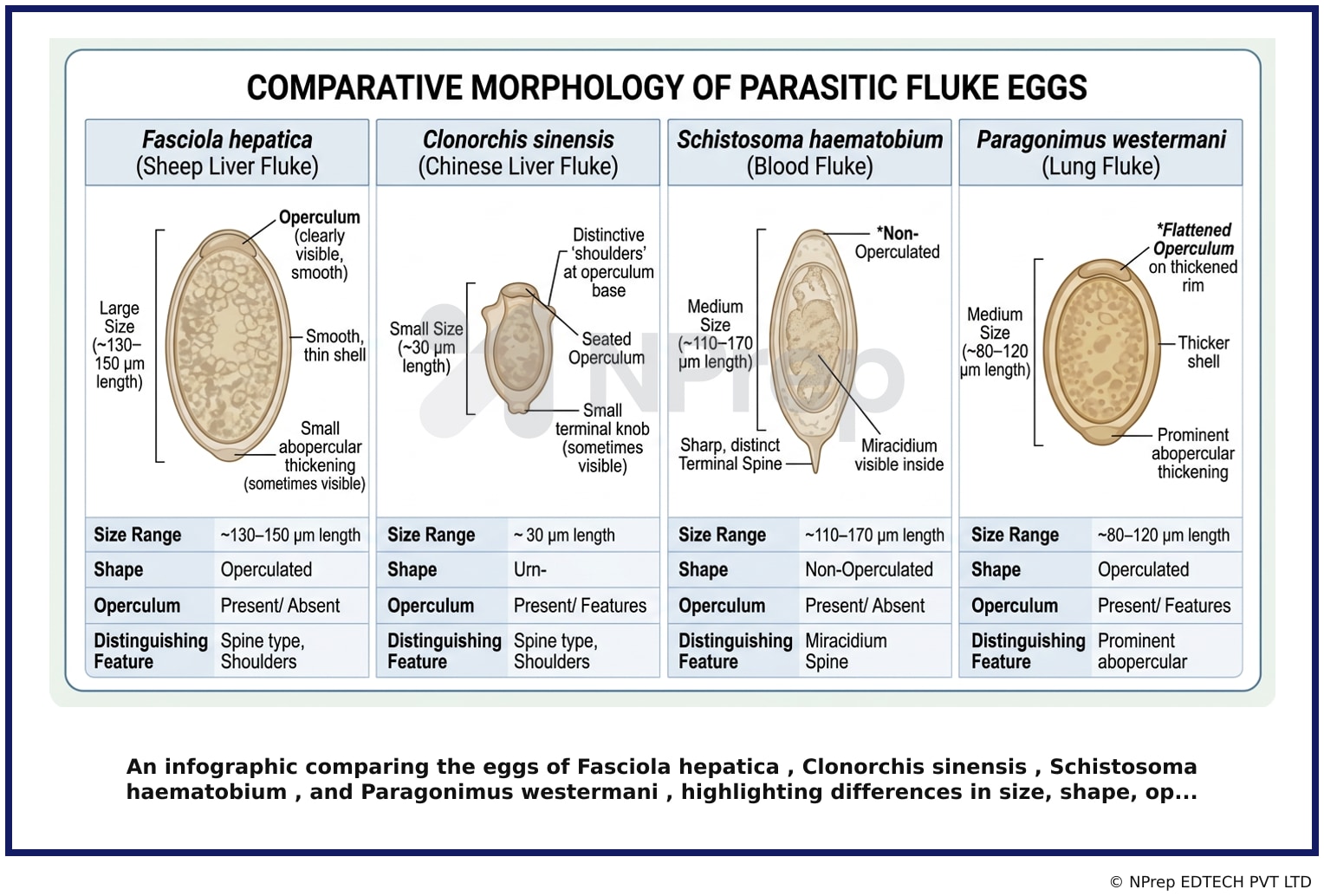
- Visual 1: Comparative Chart - An infographic comparing the eggs of Fasciola hepatica, Clonorchis sinensis, Schistosoma haematobium, and Paragonimus westermani, highlighting differences in size, shape, operculum, and spines.
- Visual 2: Life Cycle Diagram - A diagram illustrating the life cycle of Fasciola hepatica, showing the snail intermediate host and transmission via ingestion of aquatic plants like watercress.
Clinical Relevance
- Nursing practice connection: This is primarily an exam-oriented knowledge point with limited direct bedside application, so retain Identification of parasitic flukes (trematodes) based on their egg morphology as background academic context rather than a clinical decision trigger.
- The definitive diagnosis of fascioliasis (infection by Fasciola hepatica) in a clinical setting relies on the microscopic identification of these characteristic large, operculated eggs in a patient's stool sample or in fluid obtained from duodenal or biliary drainage.
- Nurses play a key role in patient education. For prevention, it is crucial to advise patients to avoid eating raw aquatic plants, especially watercress, from areas where sheep or cattle graze, as these can be contaminated with the infective metacercariae.
- What if? If the question described a similarly shaped egg but mentioned it was found in feces and was much larger (up to 175 µm), the parasite could be Fasciolopsis buski, the giant intestinal fluke. The key differentiator would be the clinical presentation focusing on intestinal symptoms rather than liver-related issues.
How to Approach the Question
- First, carefully read the question and identify the key descriptive terms. The prompt provides two critical clues: 'large operculated egg' and 'genus Fasciola'.
- Second, analyze the image to confirm the visual description. Observe the egg's large size, oval shape, and the presence of an operculum (a 'lid' or 'cap').
- Third, evaluate the options based on the information from the stem. The most direct approach is to identify which of the listed parasites belongs to the genus Fasciola.
- Fourth, use your knowledge of parasitology to eliminate the other options based on their distinct egg morphology. Recall that Schistosoma eggs are non-operculated and spined, while Clonorchis and Paragonimus eggs have different sizes and shapes.
- Finally, select the option that aligns with all the evidence. Fasciola hepatica is the only choice that fits both the genus name and the morphological description.
Concept Tested & Keywords
- Concept Tested: Identification of parasitic flukes (trematodes) based on their egg morphology.
- Stem keywords: large operculated egg, parasitic fluke, genus Fasciola, parasite
- Lead-in keywords: most likely
- Clinical cues: The genus identification to 'Fasciola' is the primary clue pointing directly to the answer.
Question ID
QnmPxfCwI1TuaC3DTljE4J
Practise the full INI-CET EXAM -2025
Attempt every question from this paper in a timed mock, then review the full solution for each one.
More Pathogenic Organisms Questions
- An acid-fast bacillus which is pathogenic:
- Causative organism of infectious mononucleosis is:
- Which among the following is a Gram-positive organism?
- What is the causative organism for Syphilis?
- Who discovered virus in biology?
- Which vector causes Zika virus disease?
- All of the following diseases caused by viruses, except?
- What does SARS stand for?
- What is the name of the organism responsible for tuberculosis?
- What causes the spread of chickenpox?
More INI-CET EXAM -2025 Questions
- The highlighted structure in the provided image articulates with which bone?& x20;
- Through which of the following foramina does the nerve supplying the muscles of mastication pass?& x20;
- In the given image, which region is correctly paired with its corresponding brain structure? • Middle cerebellar peduncle • Fasciculus cuneatus • Sup…
- Which of the following muscles is NOT typically associated with dysphagia or dysarthria?
- A muscle of mastication involved in opening the mouth exhibits the following characteristics. Identify the incorrect statement about it:
- In the illustrated image, which of the following structures is NOT associated with the area marked by the arrow?& x20;
- Match the following embryonic aortic arches with their respective adult derivatives: A. 1st Arch 1. Maxillary artery& x20; B. 2nd Arch 2. Common caro…
- Which of the following histology image is not an endocrine structure?& x20;
- Marked structure separates which of the following:
- Which of the following bones of the skull gives passage to a nerve arising from the brain & x20;