
Daman & Diu Staff Nurse - 2018
Obstetrics & Gynaecology
Easy
An amniotic fluid index of less than 5 cm indicates?
Appeared in: Daman & Diu Staff Nurse - 2018
Explanation
- The Amniotic Fluid Index (AFI) is a quantitative ultrasound measurement used to estimate the volume of amniotic fluid.
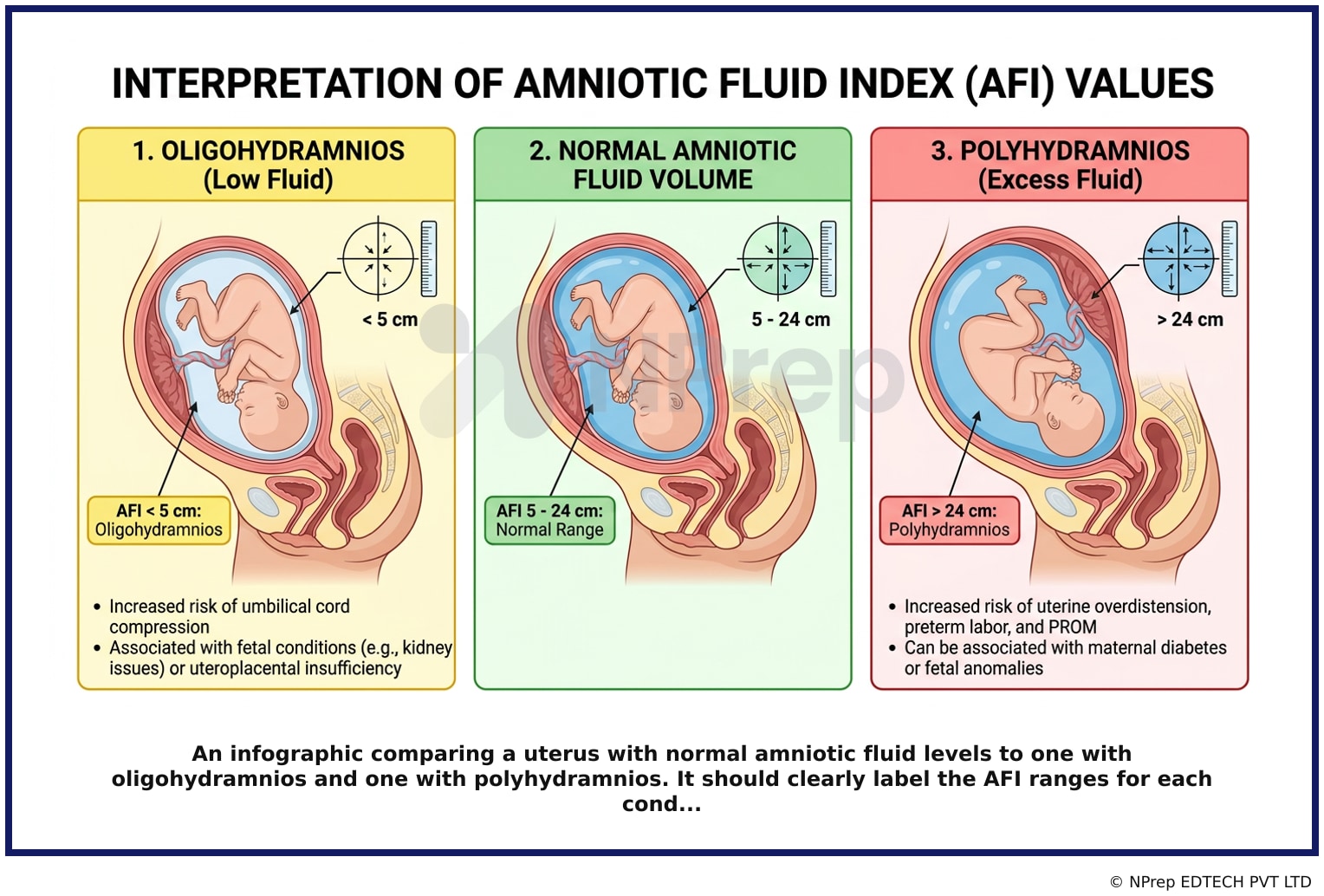
- A value of less than 5 cm is the standard diagnostic criterion for Oligohydramnios, which signifies an abnormally low level of amniotic fluid.
- Oligohydramnios is a significant finding as it can be associated with underlying maternal or fetal conditions and increases the risk of complications like umbilical cord compression.
- Fetal urine production is the primary source of amniotic fluid in the second half of pregnancy, so low fluid can indicate issues with the fetal kidneys or uteroplacental insufficiency.
Why Other Options Were Wrong
- Option A: Anhydramnios refers to the complete absence of amniotic fluid, which is a more severe condition than simply having a low volume. An AFI of less than 5 cm indicates low fluid, not a total lack of it.
- Option B: Hydramnios is the opposite of oligohydramnios. It signifies an excessive amount of amniotic fluid.
- Option C: Polyhydramnios is a synonym for hydramnios, meaning there is too much amniotic fluid, not too little. The question describes a low fluid index.
Related Visual
Clinical Relevance
- Nursing practice connection: This is primarily an exam-oriented knowledge point with limited direct bedside application, so retain Interpretation of Amniotic Fluid Index (AFI) values in pregnancy as background academic context rather than a clinical decision trigger.
- Nurses play a key role in recognizing the significance of AFI results and initiating appropriate fetal surveillance. Oligohydramnios requires close monitoring for signs of fetal distress, such as changes in the fetal heart rate, due to the increased risk of umbilical cord compression.
- Patient education is crucial. The nurse must explain the condition to the expectant mother, the need for increased monitoring (like non-stress tests or biophysical profiles), and signs to watch for, such as decreased fetal movement.
- What if? If the AFI was 26 cm instead of less than 5 cm, the diagnosis would be Polyhydramnios. The clinical focus would shift from cord compression risk to risks associated with uterine overdistension, such as preterm labor, premature rupture of membranes, and postpartum hemorrhage.
How to Approach the Question
- First, identify the key clinical value provided in the question: "Amniotic fluid index of less than 5 cm."
- Next, recall or look up the definitions for the terms related to amniotic fluid volume provided in the options.
- Match the given AFI value (< 5 cm) to its corresponding medical term.
- Anhydramnios means no fluid.
- Hydramnios and Polyhydramnios mean too much fluid (> 24 cm).
- Oligohydramnios means too little fluid (< 5 cm).
Concept Tested & Keywords
- Concept Tested: Interpretation of Amniotic Fluid Index (AFI) values in pregnancy.
- Stem keywords: amniotic fluid index, AFI, less than 5 cm
- Lead-in keywords: indicates
Question ID
QcMKYp0-q2K6fcUieeOUmA
Reference Book
E6 Obstetrics Williams p. 54-72
E6 Midwifery Obstetrics and Gynecology Nursing Sandeep Kaur p. 56-70
Practise the full Daman & Diu Staff Nurse - 2018
Attempt every question from this paper in a timed mock, then review the full solution for each one.
More Multiple Pregnancy, Amniotic Fluid Disorders, Abnormalities of Placenta and Cord Questions
- Oligohydramnios is related with which of the following condition?
- Normal PH of amniotic fluid?
- Find out the following image? & x20;
- A case of 35 weeks pregnancy with poly-hydramnios and marked respiratory distress is managed by?
- The functions of amniotic fluid are? a) Cushions the fetus b) Allows fetal movement c) Nutrient transport & x20; d) Prevents adhesions & x20;
- In which type of placental abnormality there is one or more lobes of placenta placed at varying distance from main placental margin?
- The water in the amniotic fluid is completely changed and replaced:
- What is normal amniotic fluid volume at term?
- What is the primary feature of oligohydramnios?
- A woman in labour with a twin pregnancy is being monitored. The first twin shows a low fetal heart rate. Suddenly the second twin's heart sounds beco…
More Daman & Diu Staff Nurse - 2018 Questions
- A patient with heart failure is on diuretics. Which is the accurate indicator of such patient's health status?
- A postoperative patient receives a stat dose of injection Pethidine intramuscularly. After one hour, the nurse checks on pain relief. Which step of t…
- The purpose of anti-embolism stocking is to?
- Which route of drug administration provides a rapid response in a patient?
- Which type of data does auscultation provide?
- Which of the following is the reason for intradermal injection to be used for testing allergic reaction?
- Which of these parameters indicates infection in a postoperative patient?
- The first line of intervention for prevention of infection is?
- The purpose of deep palpation is to access?
- Which of the following listed drug is a proton pump inhibitor?