
KGMU 2023
Pediatric Nursing
Easy
A newborn's mother asks the nurse why Vitamin K is given to her baby. The nurse correctly explains that Vitamin K helps in what process?
Appeared in: KGMU 2023
Explanation
- Vitamin K is essential for the synthesis of specific blood-clotting factors in the liver.
- These factors are Prothrombin (Factor II), Factor VII, Factor IX, and Factor X, which are all critical for the coagulation cascade.
- Newborns are born with a transient deficiency of Vitamin K because it does not cross the placenta well and their gut is sterile, lacking the bacteria needed for synthesis.
- Administering Vitamin K corrects this deficiency, enabling the infant's blood to clot effectively and preventing Vitamin K Deficiency Bleeding (VKDB).
Why Other Options Were Wrong
- Option A: Vitamin K does not cause gut maturation. The relationship is reversed: a mature gut with established bacterial flora is what allows the body to start producing its own Vitamin K.
- Option C: Vitamin K is a vitamin supplement, not a vaccine. It provides a necessary nutrient for a physiological process (clotting) but does not stimulate an immune response to produce antibodies.
- Option D: Vitamin K does not directly promote or stimulate brain tissue growth. Its protective effect on the brain is indirect.
Related Visual
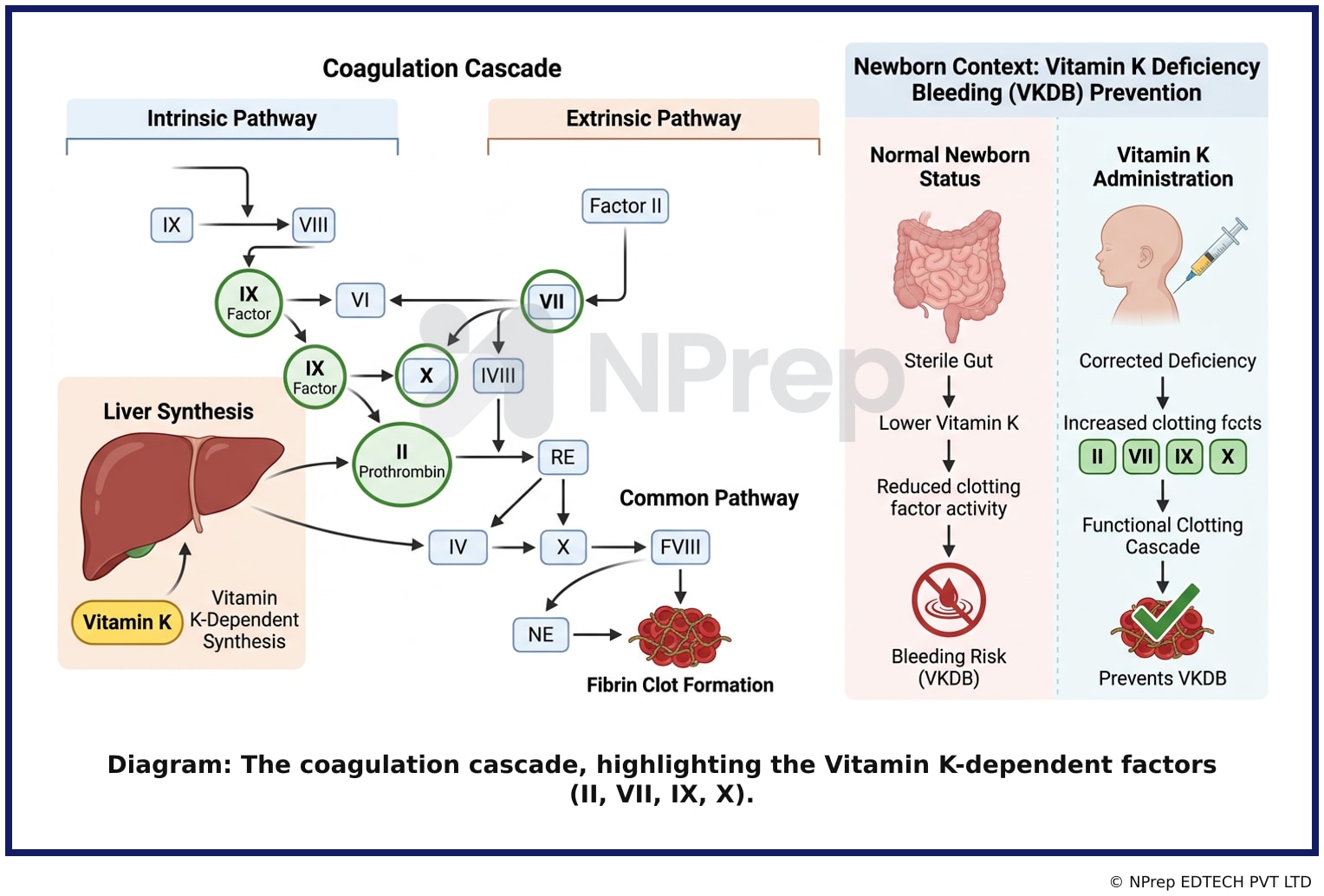
- Visual 1: Diagram: The coagulation cascade, highlighting the Vitamin K-dependent factors (II, VII, IX, X).
- Visual 2: Illustration: The correct intramuscular injection site for a newborn (vastus lateralis muscle on the anterolateral thigh).
Clinical Relevance
- Nursing practice connection: Knowing Role of Vitamin K in neonatal care and prevention of Vitamin K Deficiency Bleeding (VKDB) helps nurses interpret findings accurately and avoid errors in routine assessment, medication administration, and patient teaching.
- The nurse's primary role is to administer the Vitamin K injection safely and educate parents about its critical importance in preventing the rare but potentially fatal Vitamin K Deficiency Bleeding (VKDB).
- Parental refusal of the Vitamin K shot is a significant patient safety issue. The nurse must provide clear, evidence-based information to address concerns and meticulously document the refusal if it occurs, along with the counseling provided.
- What if the baby was born prematurely? The need for Vitamin K is even more critical, as premature infants are at a higher risk for bleeding complications, including intraventricular hemorrhage, and have even lower stores of the vitamin.
How to Approach the Question
- Identify the core of the question: This is a patient education scenario asking for the function of a common neonatal medication.
- Analyze the keywords: 'Newborn' and 'Vitamin K' are the key concepts. The question asks for the correct explanation from a nurse.
- Recall the primary reason for giving Vitamin K at birth. It is a standard prophylactic measure to prevent a specific bleeding disorder.
- Evaluate the options based on this primary function. The correct answer will directly relate to why bleeding is a concern in newborns.
- Eliminate distractors: 'Immunization' is a different category of medication. 'Gut maturation' and 'brain growth' are not direct functions of Vitamin K, although preventing brain bleeds is a key positive outcome.
Concept Tested & Keywords
- Concept Tested: Role of Vitamin K in neonatal care and prevention of Vitamin K Deficiency Bleeding (VKDB).
- Stem keywords: newborn, mother, nurse, Vitamin K
- Lead-in keywords: correctly explains, helps in what process
Question ID
QMuJsBw8QMYdr3_9Jg-Ixi
Practise the full KGMU 2023
Attempt every question from this paper in a timed mock, then review the full solution for each one.
More Neonatology Questions
- Which of the following intervention demonstrates the nurse understand about the newborn's thermoregulatory ability?
- A nurse in a delivery room is assisting delivery of a newborn. After delivery, which of the following intervention would be appropriate to prevent he…
- Oxygen toxicity in pre-term babies causes?
- Which of the following injections is routinely administered to a newborn to prevent bleeding?
- The preterm infant's elbow may easily be brought across the chest with no resistance. This is the?
- Newborn maturity rating is done using:
- The nurse evaluates the adequacy of the neonate's oxygen by monitoring?
- Identify the image below, which is used in the NICU during phototherapy?& x20;
- Babies who are born before the end of 37 weeks of gestation and have a normal rate of intrauterine growth are called \ \ \ \ \ \ .
- Preventive method of thick meconium stained liquor is?
More KGMU 2023 Questions
- The teacher scalded Aruna in front of her classmates during Project submission. Conclusion I: Aruna was not as popular as her other classmates. Concl…
- Aruna leaves and goes 8 meters in the North direction from a certain point. Then she turns right and travels for 12 meters. She again turns right and…
- Kiran is Sister of Raj. Raj is Son of Suresh and Vinita is Mother of Suresh then what is relation between Vinita and Kiran?
- A person who lives at the same time with another?
- Select the most appropriate meaning of the below idiom. A black sheep?
- The train has arrived...the station.
- A vendor sold 20 kg of potato at 18 Rs. per kg. He bought 2-liter milk at the rate of 46 Rs./liter, 2 kg sugar at the rate of 35 Rs./kg and 10 packet…
- Which one is the perfect square?
- A is the smallest. C is taller than B and D. E is neither the tallest nor the smallest. Find which one is the tallest?
- From an entrance, a person walks 28 meters left, then turns right and walks 13 meters. They turn right again and walk 12 meters, and then walk 16 met…