
KGMU 2023
Obstetrics & Gynaecology
Easy
A female patient complains of vaginal itching, redness, and a curdy white discharge. These symptoms are characteristic of an infection with which organism?
Appeared in: KGMU 2023
Explanation
- The patient's triad of symptoms—vaginal itching, redness, and a curdy white discharge—are the classic signs of vulvovaginal candidiasis.
- This infection is caused by an overgrowth of the fungus Candida albicans, which is a common commensal organism in the vagina.
- The discharge is characteristically described as thick, white, and clumpy, resembling cottage cheese.
- Unlike other common vaginal infections, candidiasis does not typically produce a foul odor and the vaginal pH remains normal (less than 4.5).
Why Other Options Were Wrong
- Option A: Chlamydia infections are often asymptomatic. When symptoms are present, they typically involve a mucopurulent discharge from the cervix (cervicitis), not a curdy white vaginal discharge. Itching is not a primary symptom.
- Option C: Trichomoniasis, caused by the protozoan Trichomonas vaginalis, typically produces a profuse, thin, frothy, and malodorous discharge that is yellow-green in color. The classic 'strawberry cervix' may also be seen.
- Option D: Gardnerella is the primary bacterium associated with bacterial vaginosis (BV). BV is characterized by a thin, homogeneous, grayish-white discharge with a distinct 'fishy' odor, especially after adding KOH (a positive 'whiff test'). Itching is not a prominent feature.
Related Visual
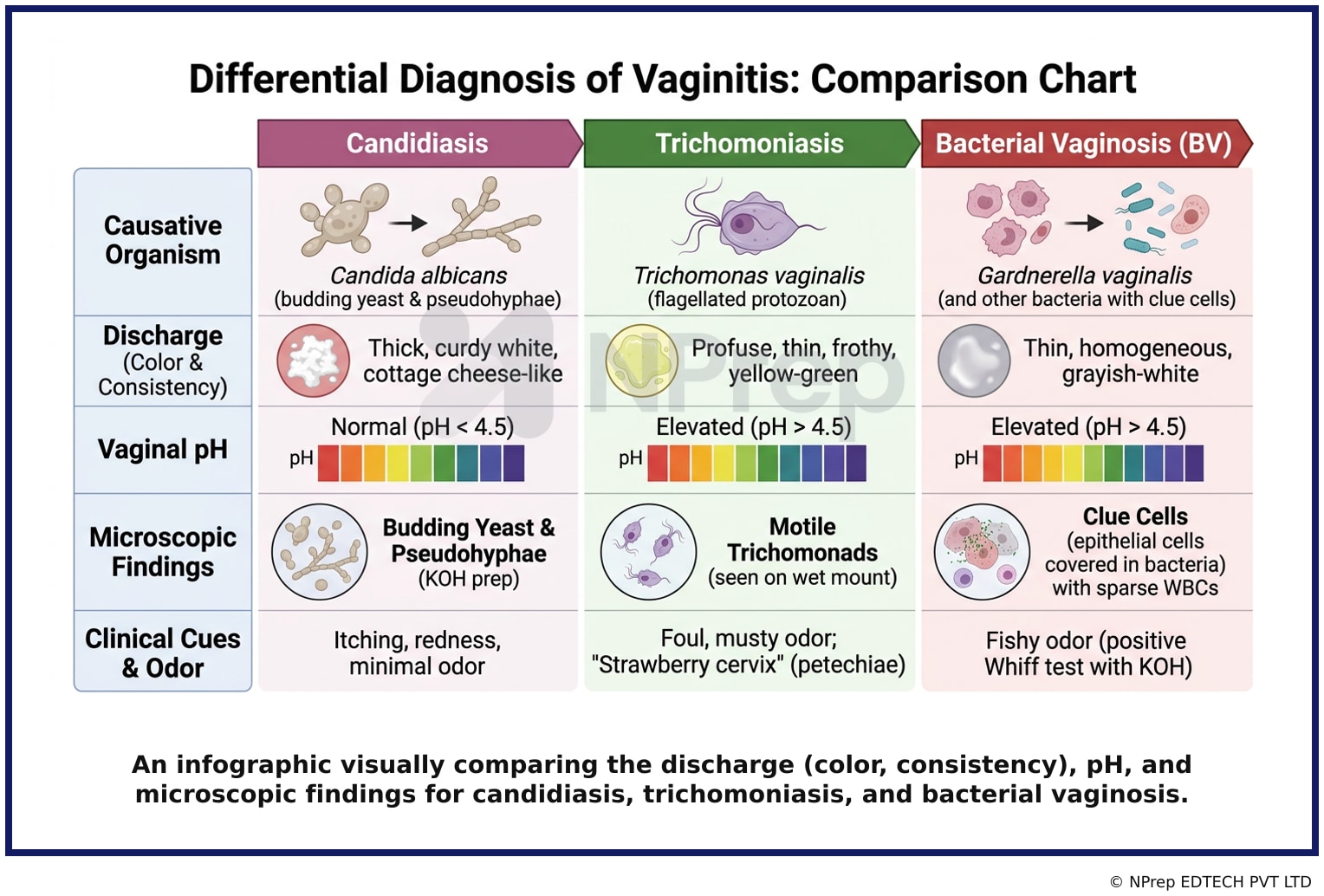
- Visual 1: Comparison Chart - An infographic visually comparing the discharge (color, consistency), pH, and microscopic findings for candidiasis, trichomoniasis, and bacterial vaginosis.
- Visual 2: Microscopic View - A slide showing the pseudohyphae and budding yeast of Candida albicans as seen in a KOH prep, contrasted with clue cells (BV) and motile trichomonads.
Clinical Relevance
- Nursing practice connection: Use the key finding related to Differential diagnosis of vaginitis based on clinical presentation to guide bedside assessment, documentation, and the next nursing action.
- Accurate diagnosis of vaginitis is essential because the treatments are different. Using an antifungal for a bacterial infection will be ineffective and can delay proper care.
- Patient education is a key nursing role. Nurses should instruct patients on completing the full course of medication, proper hygiene (e.g., avoiding douching), and recognizing symptoms of different infections.
- What if? - If the patient was pregnant, treatment choice would be critical. While topical azoles are generally considered safe, oral fluconazole is often avoided, especially in the first trimester, due to potential risks to the fetus. The nurse must ensure the prescribed treatment is safe for pregnancy.
How to Approach the Question
- First, analyze the clinical scenario and identify the key symptoms presented in the question stem. Here, the key findings are 'vaginal itching,' 'redness,' and 'curdy white discharge.'
- Next, recall the classic presentations of the common causes of vaginitis listed in the options.
- Systematically compare the patient's symptoms to the known characteristics of each organism.
- Chlamydia: Primarily causes cervicitis, often asymptomatic.
- Candida: Causes itching, redness, and a thick, white, curdy discharge.
- Trichomonas: Causes a frothy, yellow-green, malodorous discharge.
Concept Tested & Keywords
- Concept Tested: Differential diagnosis of vaginitis based on clinical presentation.
- Stem keywords: vaginal itching, redness, curdy white discharge
- Lead-in keywords: characteristic of
- Clinical cues: The combination of itching, redness, and a 'curdy white' discharge is a hallmark sign pointing directly to a specific type of infection.
Question ID
QejSkzySa76Q2c3jGoTfox
Practise the full KGMU 2023
Attempt every question from this paper in a timed mock, then review the full solution for each one.
More Infections of the Individual Pelvic Organs Questions
- Acidic medium of vagina is maintained by:
- Most common cause of vaginitis?
- A patient having pruritus and white discharge, which would be seen?
- Which of the following is NOT a common cause for vaginitis?
- A nurse is assessing a 27-year-old female client who visits her Gynecologist. The client is telling the nurse that she has been having a vaginal disc…
- What is the site of referred pain when pain is arising from the cervix?
- Inflammation of the fallopian tube is known as?
- pH of vagina becomes acidic due to?
- Which of the following would be informed to the pregnant client with genital herpes to protect the fetus?
- A female patient complains of a painful, tender, and swollen lump on one side of her vaginal opening, making it uncomfortable to walk or sit. Based o…
More KGMU 2023 Questions
- The teacher scalded Aruna in front of her classmates during Project submission. Conclusion I: Aruna was not as popular as her other classmates. Concl…
- Aruna leaves and goes 8 meters in the North direction from a certain point. Then she turns right and travels for 12 meters. She again turns right and…
- Kiran is Sister of Raj. Raj is Son of Suresh and Vinita is Mother of Suresh then what is relation between Vinita and Kiran?
- A person who lives at the same time with another?
- Select the most appropriate meaning of the below idiom. A black sheep?
- The train has arrived...the station.
- A vendor sold 20 kg of potato at 18 Rs. per kg. He bought 2-liter milk at the rate of 46 Rs./liter, 2 kg sugar at the rate of 35 Rs./kg and 10 packet…
- Which one is the perfect square?
- A is the smallest. C is taller than B and D. E is neither the tallest nor the smallest. Find which one is the tallest?
- From an entrance, a person walks 28 meters left, then turns right and walks 13 meters. They turn right again and walk 12 meters, and then walk 16 met…