
RRB Nsg. Superintendent-2026 (Shift -3rd)
Child Health Nursing (Pediatrics)
Hard
A 5-year-old child is prescribed nebulization for acute bronchospasm. Which nursing action best ensures the medication is effectively delivered during the procedure?
Appeared in: RRB Nsg. Superintendent-2026 (Shift -3rd)
Explanation
- Slow, deep breathing promotes laminar (smooth) airflow, which is essential for carrying aerosolized medication deep into the smaller airways (bronchioles) to treat bronchospasm.
- This technique maximizes the amount of drug deposited in the lungs, increasing the therapeutic effect.
- Compared to other methods, it is the most practical and achievable breathing pattern for a young child during a continuous nebulizer treatment.
- Rapid, shallow breathing (as with crying) creates turbulent flow, causing most of the medication to impact the upper airways, making it less effective.
Why Other Options Were Wrong
- Option A: A supine (lying flat) position restricts full lung expansion and diaphragmatic excursion, which significantly reduces the amount of air and medication that can be inhaled.
- Option C: Eating during nebulization poses a significant risk of aspiration (food or liquid entering the lungs), which can lead to pneumonia or airway obstruction. It also interferes with the child's ability to focus on breathing correctly.
- Option D: While a brief breath-hold after inhalation can increase drug deposition, it is very difficult for a 5-year-old to perform this maneuver correctly and repeatedly throughout a 10-15 minute nebulizer session. It is a technique more suited for older patients using metered-dose inhalers (MDIs).
Related Visual
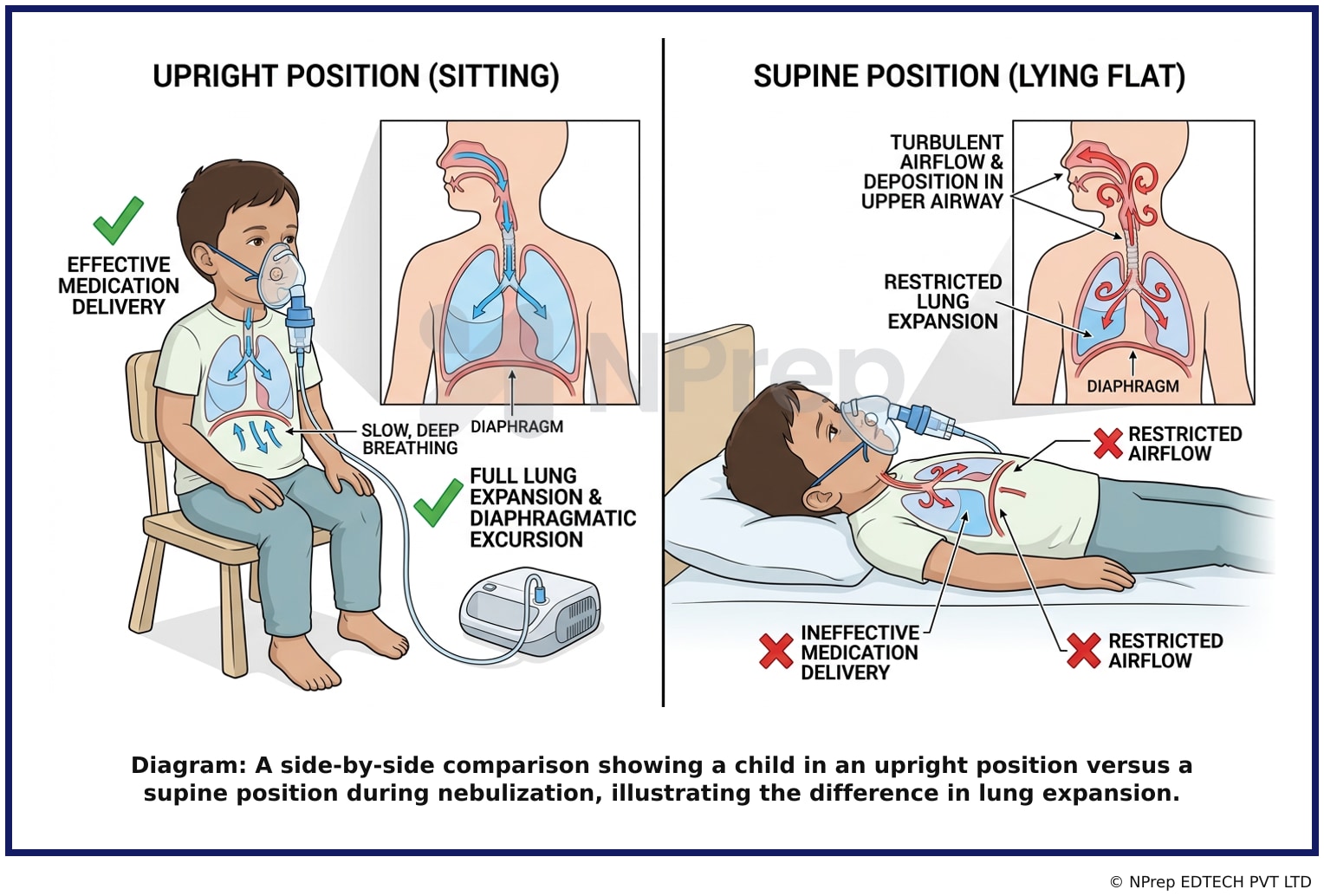
- Visual 1: Diagram: A side-by-side comparison showing a child in an upright position versus a supine position during nebulization, illustrating the difference in lung expansion.
- Visual 2: Infographic: An illustration of airflow in the lungs, comparing laminar flow (slow, deep breaths) reaching the lower airways with turbulent flow (fast, shallow breaths) depositing particles in the upper airway.
Clinical Relevance
- Nursing practice connection: Use the key finding related to Effective administration of nebulizer therapy in a pediatric patient to guide bedside assessment, documentation, and the next nursing action.
- A nurse's primary role during nebulization is to ensure both safety and efficacy. This includes proper patient education for the child and parents, correct positioning, and encouraging a calm environment to promote the right breathing technique.
- Making the treatment a positive or neutral experience is key for pediatric compliance. Using distractions like blowing bubbles, reading a story, or decorating the mask can prevent crying, which drastically reduces the effectiveness of the treatment.
- What if the child is an infant? The principles are the same, but the approach is adapted. The infant would be held upright in a caregiver's arms. The focus is on maintaining a good mask seal and keeping the infant calm, as they cannot follow instructions to breathe deeply. The treatment is often timed with sleep or quiet periods.
How to Approach the Question
- First, identify the goal of the question: to find the action that best ensures effective medication delivery.
- Analyze each option based on the principles of respiratory physiology and aerosol deposition.
- Eliminate option C (eating) immediately on the grounds of safety (aspiration risk).
- Eliminate option A (supine) because an upright position is known to maximize lung expansion.
- Compare the remaining two breathing techniques (B and D). Consider the patient's age (5 years) and the nature of the treatment (continuous nebulization).
- Conclude that asking a 5-year-old to hold their breath repeatedly is impractical. Therefore, encouraging slow, deep breathing is the most effective and realistic nursing action.
Concept Tested & Keywords
- Concept Tested: Effective administration of nebulizer therapy in a pediatric patient.
- Stem keywords: 5-year-old child, nebulization, acute bronchospasm, medication delivery
- Lead-in keywords: best ensures
- Clinical cues: Patient age (5 years) is a key factor in determining the most practical and effective technique.
- Negative lead-in flag: false
Question ID
Qu5MZ4C0OEvJLfLopSLOId
Practise the full RRB Nsg. Superintendent-2026 (Shift -3rd)
Attempt every question from this paper in a timed mock, then review the full solution for each one.
More Disorders of Respiratory System Questions
- Which of the following conditions is not involved in CROUP syndrome?
- A conscious child comes with aspirations and gasping. HCP tried ventilation resuscitation but he did not succeed then what is the next action on prio…
- How many times does the common cold consider normal at 2 years of age?
- A 4-year-old child is being discharged from the hospital after being treated for severe croup. Which one of the following instructions should the nur…
- A 7-year-old child is brought to the ER at midnight by his mother after symptoms appeared abruptly. The nurse's initial assessment reveals a temperat…
- If any foreign body stuck in a child's airway. Which of the following maneuver can be done to remove the object?
- A six-year-old child is admitted to the hospital with pneumonia. An immediate priority in this child's nursing care would include the following excep…
- Which lobe is most commonly affected in children with pulmonary atelectasis?
- An 18-month-old infant hospitalized with a severe asthma attack is given prednisone, 15 mg po bid. The nurse should?
- A 13-year-old boy suffering from asthma has been admitted to the hospital. Which of the following nursing interventions is performed to alleviate the…
More RRB Nsg. Superintendent-2026 (Shift -3rd) Questions
- In a division problem, the divisor is 17 times the quotient and 11 times the remainder. If the remainder is 34, what is the dividend?
- Seven boxes H, I, J, P, Q, R, and S are stacked one above the other, but not necessarily in this order. H is placed second from the bottom. Only thre…
- A box is pushed on a horizontal floor with a force of 20 N for a distance of 5 m in the direction of the force. What is the work done by the force?
- \ \ \ \ \ \ won the Ranji Trophy title in 2024-25 by drawing the final against Kerala and winning on the basis of a first-innings lead.
- P sells a Laptop to Q at a loss of 40% and Q sells the laptop to R at a profit of 25%. If R purchased the laptop for ₹8946, then what was the cost pr…
- A ball of mass 0.5km is accelerated at 4m/s2 if a second ball of mass 1 kg is to achieve the same acceleration, what force must be applied to it?
- If a real and inverted image is formed by a convex lens on a screen 20cm away from the lens, and the object is placed 30cm from the lens, what is the…
- In this question, two statements numbered (I) and (II) are given after a question. Decide whether the information given in the statements is sufficie…
- Which of the following fundamental rights explicitly prohibits human trafficking, forced labor, and the employment of children in hazardous occupatio…
- In the word MANAGER, each vowel is replaced by the letter immediately following it in the English alphabet, and each consonant is replaced by the let…