
ESIC Nursing Officer -2019 (Shift -1)
Non Nursing Subjects
Medium
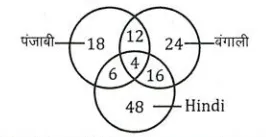
Study the given figures carefully and answer the question. The following Venn diagram shows information about the number of officers who speak three different languages in army camp XXX.What will be the ratio of the number of officers who speak Bengali and Hindi but not Punjabi to the number of officers who speak Bengali and Punjabi but not Hindi?
Appeared in: ESIC Nursing Officer -2019 (Shift -1)
Explanation
- The number of officers who speak Bengali and Hindi but not Punjabi is found in the intersection of the Bengali and Hindi circles, excluding the area that also intersects with the Punjabi circle. This value is 16.
- The number of officers who speak Bengali and Punjabi but not Hindi is found in the intersection of the Bengali and Punjabi circles, excluding the area that also intersects with the Hindi circle. This value is 12.
- The required ratio is the first value to the second value, which is 16:12.
- Simplifying the ratio 16:12 by dividing both numbers by their greatest common divisor (4) gives the final ratio of 4:3.
Why Other Options Were Wrong
- Option A: This is the inverse of the correct ratio. It incorrectly places the number of officers speaking Bengali and Punjabi (but not Hindi) first in the ratio (12:16).
- Option B: This ratio is incorrect. It does not correspond to the numbers derived from the Venn diagram for the specified conditions (16 and 12).
- Option D: This ratio is incorrect. It might be obtained by mistakenly comparing the number of officers speaking Bengali and Hindi (16) with the number speaking all three languages (4), which gives 16:4 or 4:1.
Related Visual

- Visual 1: Infographic - A guide on how to read a three-circle Venn diagram, highlighting the meaning of each section: 'only A', 'A and B only', and 'A, B, and C'.
Clinical Relevance
- Nursing practice connection: This is primarily an exam-oriented knowledge point with limited direct bedside application, so retain Interpreting Venn Diagrams and Calculating Ratios as background academic context rather than a clinical decision trigger.
- This question tests logical reasoning and data interpretation skills, which are essential for nurses.
- Nurses must accurately interpret data from various sources, such as patient charts, lab reports, and monitoring equipment, to make sound clinical decisions.
- What if the question asked for the ratio of officers who speak only one language to those who speak all three? The calculation would be (18+24+48) : 4, which is 90:4 or 45:2. This demonstrates the importance of carefully reading the specific criteria in any data analysis task.
How to Approach the Question
- First, carefully read the question to understand exactly which groups you need to compare. Pay close attention to words like 'and', 'but not', and 'only'.
- Identify the first group described in the question by locating the corresponding section in the Venn diagram. In this case, it's 'Bengali and Hindi but not Punjabi'.
- Find the number associated with this section. Here, the number is 16.
- Next, identify the second group: 'Bengali and Punjabi but not Hindi'.
- Find the number for this second section in the diagram. Here, the number is 12.
- Formulate the ratio using the numbers you found: 16:12.
Concept Tested & Keywords
- Concept Tested: Interpreting Venn Diagrams and Calculating Ratios
- Stem keywords: Venn diagram, ratio, Bengali, Hindi, Punjabi
- Lead-in keywords: What will be the ratio
Question ID
Qeb_OcHWuUUmwwUQg_E3PI
Practise the full ESIC Nursing Officer -2019 (Shift -1)
Attempt every question from this paper in a timed mock, then review the full solution for each one.
More Mathematics Questions
- The ratio of number of girls to boys in a school of 2520 students is 27:29. How many more girls should be admitted to make the ratio 1:1?
- Three candidates contested an election and received 4500, 7500 and 8000 votes respectively. What percentage of votes did the winning candidates get?
- Two bells ring at intervals of 59 seconds and 70 seconds. If they both ring at 10 O'clock in the morning together, after how many seconds will they r…
- The average of four numbers is 61. The largest number among them is 85 and the smallest number is 21. What will be the larger of the remaining two nu…
- In what ratio should water be mixed with milk so that on selling the mixture at cost price a profit of 20% is made?
- A quality control analyst rejects 0.08% of the fabric produced, finding it defective. How many meters of fabric must he examine to reject 4 meters?
- A man traveled from his village to the post office at a speed of 25km/hr and returned at a speed of 4km/hr. If the entire journey took 5 hours and 48…
- A train is running at 60 km/hr. How much time will it require to cross a 2 km bridge?
- The average monthly income of R1 and R2 is Rs. 99,500. The average monthly income of R2 and R3 is Rs. 1,15,600 and the average monthly income of R1 a…
- If Rohan bought 20 books at the rate of Rs. 120 each, 30 books at the rate of Rs. 150 each, and 15 books at the rate of Rs. 100 each, then find the a…
More ESIC Nursing Officer -2019 (Shift -1) Questions
- Schultze method and Matthew Duncan method describe:
- Bleeding in the first trimester with no uterine contraction or pain and no dilation of cervix indicates:
- Which of the below is an example of unintentional tort?
- The mode of inheritance of cystic fibrosis is:
- Repeated involuntary or intentional passage of feces by a child in inappropriate places, after the age when bowel control is normally expected, is ca…
- Intermittent claudication is a sign of:
- The type of assessment done to compare the client's current status to previously obtained baseline data is called:
- The full form of DALY in the context of community health is:
- The "Adam's Apple" is formed by:
- What is the document called that authorizes nurses to take specific actions under certain conditions when a doctor is not immediately available?