
INI-CET EXAM -2026
Forensic Nursing & Indian laws
Hard
A male traveller from Afghanistan is found dead in a hotel room. Autopsy shows the stomach packed with foreign substances. What is this phenomenon called?

Appeared in: INI-CET EXAM -2026
Explanation
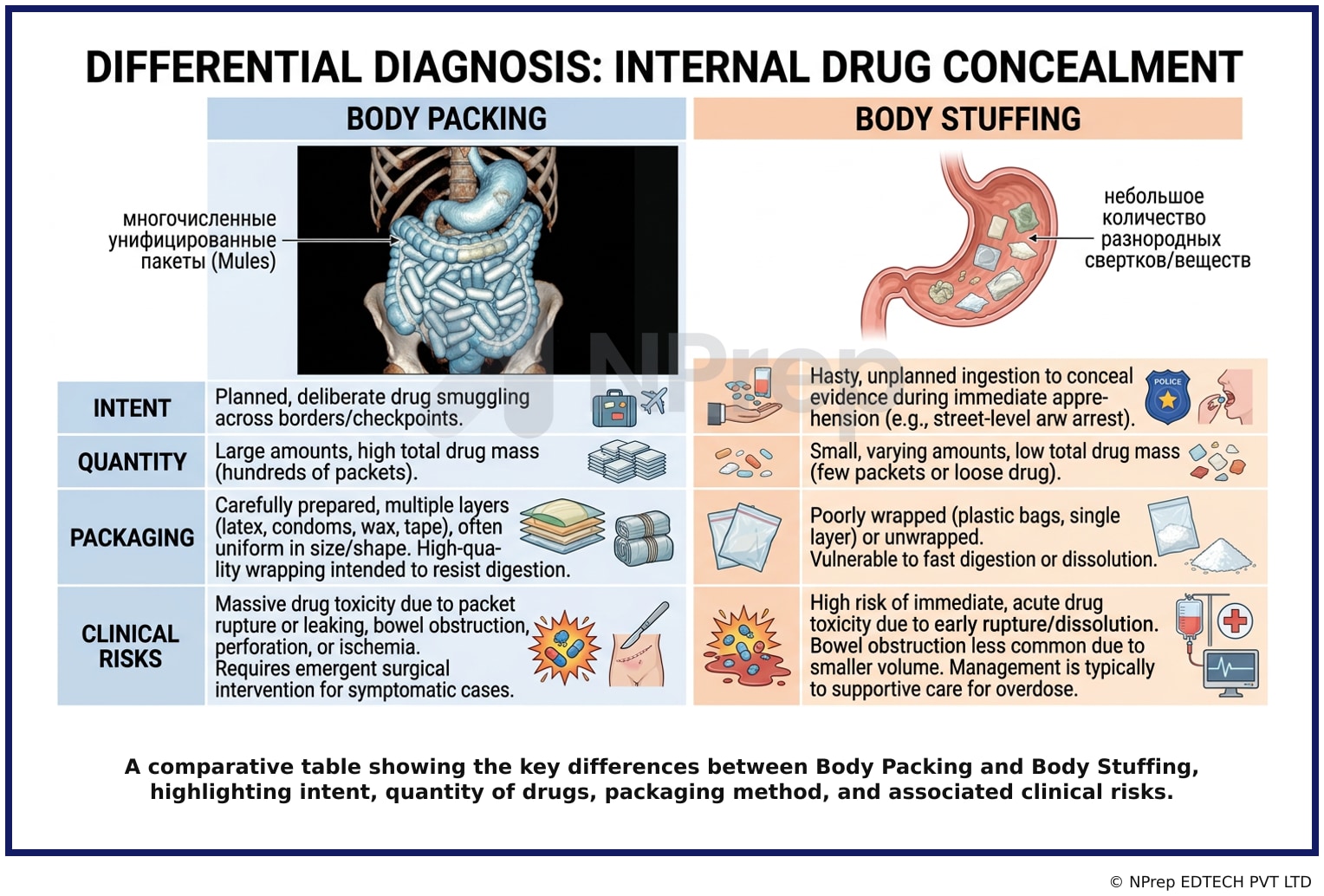
- Body packing is the correct medical and forensic term for the planned ingestion of multiple, well-wrapped packets of illicit drugs for smuggling.
- This method involves large quantities of drugs, as seen in the provided CT scan, where numerous packets fill the gastrointestinal tract.
- The goal is to transport drugs across borders internally. The individual is often referred to as a 'mule'.
- Death often occurs due to packet rupture, leading to acute and massive drug toxicity, which aligns with the case description.
Why Other Options Were Wrong
- Option B: Body stuffing refers to the hasty, unplanned swallowing of small amounts of poorly wrapped or unwrapped drugs, typically to evade immediate arrest by law enforcement. It does not involve the large quantity and careful preparation seen in body packing.
- Option C: 'Body storage' is not a recognized medical or forensic term for this practice. It is a descriptive but technically incorrect phrase.
- Option D: 'Body smuggle' is a colloquial description but not the correct technical term used in medicine or forensics. The correct term specifies the method of concealment.
Related Visual
Clinical Relevance
- Nursing practice connection: This is primarily an exam-oriented knowledge point with limited direct bedside application, so retain Forensic terminology for internal drug concealment as background academic context rather than a clinical decision trigger.
- Nurses in emergency departments must be able to recognize potential body packers, who may present with symptoms of drug toxicity (e.g., seizures, coma, cardiac arrest) or bowel obstruction.
- A high index of suspicion is crucial for travelers from known drug-exporting regions presenting with unexplained symptoms. Abdominal imaging (CT scan is preferred) is essential for diagnosis.
- Management of a symptomatic body packer is a medical emergency. Endoscopic removal is contraindicated due to the high risk of rupturing the packets. The primary treatment is often emergency surgery (laparotomy) to remove all packets.
How to Approach the Question
- First, analyze the keywords in the question: 'traveller from Afghanistan' (suggests international travel and a potential drug source region), 'dead', 'autopsy', and 'stomach packed with foreign substances'. These clues point towards a smuggling attempt gone wrong.
- Next, carefully examine the image. The 3D CT scan shows a very large number of uniform, capsule-shaped objects inside the abdomen. This uniformity and large quantity suggest a planned, organized effort rather than a spontaneous act.
- Correlate the clinical scenario with the visual evidence. The combination of smuggling context and a large, organized quantity of ingested items strongly points to the specific practice of 'body packing'.
- Evaluate the options based on established forensic and medical terminology. 'Body packing' is the precise term for planned, large-scale internal concealment for smuggling.
- Differentiate this from 'body stuffing', which is a hasty, small-scale act to avoid arrest. The scale of what's shown in the image rules out body stuffing.
- Eliminate 'body storage' and 'body smuggle' as they are not standard technical terms for this phenomenon.
Concept Tested & Keywords
- Concept Tested: Forensic terminology for internal drug concealment.
- Stem keywords: traveller, Afghanistan, dead, autopsy, stomach packed, foreign substances
- Lead-in keywords: What is this phenomenon called?
- Clinical cues: The image showing a large quantity of uniform packets is a key indicator of a planned, large-scale operation, which defines body packing.
- Clinical cues: The location 'Afghanistan' is a known source region for opiates, adding context to the smuggling scenario.
Question ID
QrsvcD4cXXdksF1-zmKflY
Reference Book
E6 Medicine Davidson Principles Practice 24e p. 164-166
Practise the full INI-CET EXAM -2026
Attempt every question from this paper in a timed mock, then review the full solution for each one.
More Forensic Toxicology Questions
- Maximum level of alcoholism legally allowed for driving in India?
- A patient comes in the emergency department with suspicious poisoning. In which of the following type of poisoning are hairs preserved?
- What is the legal limit of blood alcohol concentration among adults aged above 18 for driving in India?
More INI-CET EXAM -2026 Questions
- In the diagram of the abdominal wall musculature, the muscle labelled 'X' and the structure formed by its aponeurosis are best identified as:
- A 45-year-old chronic smoker is being counselled for smoking cessation therapy. Which of the following statements regarding nicotine replacement and…
- Lamotrigine is most effective in which of the following seizure types?& x20;
- In the labelled diagram of laryngeal intrinsic muscles, which labelled muscle is solely responsible for abduction of the vocal cords?
- & x20;Which muscle, as shown in the diagram, attaches to the cartilaginous portion of the Eustachian tube and also blends with the soft palate?
- Q4. Match each of the following organs with its correct embryological tissue of origin: Organ Embryological Origin& x20; A. Thyroid gland 1. Neural c…
- Q5. Match each of the following gastrointestinal organs with its distinctive histological feature: & x20;Organ Histological Feature & x20;1\. Ileum a…
- Q6. A developmental remnant of the embryological hindgut persisting in the retrorectal (presacral) space is most likely to give rise to which of the…
- & x20;The histological section shown in the image, characterized by predominantly serous acini, is best identified as which organ?
- A failure of fusion of the maxillary process with the medial nasal process during embryonic development results in which type of cleft anomaly?