
AIIMS CRE 2025
Medical & Surgical Nursing
Easy
Which type of HIV is associated with slower disease progression?
Appeared in: AIIMS CRE 2025
Explanation
- HIV-2 is characterized by a slower rate of disease progression compared to HIV-1.
- Patients with HIV-2 infection typically exhibit lower plasma viral loads (viremia).
- The decline in CD4+ T-cell counts is significantly slower in HIV-2 infection, leading to a much longer asymptomatic phase before the onset of AIDS.
- HIV-2 is also less infectious and is transmitted less efficiently than HIV-1.
Why Other Options Were Wrong
- Option A: HIV-1 is the most common and virulent strain of the virus, associated with rapid disease progression to AIDS if untreated.
- Option C: This is incorrect because HIV-1 and HIV-2 have distinctly different rates of disease progression. HIV-1 is significantly more aggressive.
- Option D: This is incorrect as there is a well-documented difference in the clinical course of HIV-1 and HIV-2 infections.
Related Visual
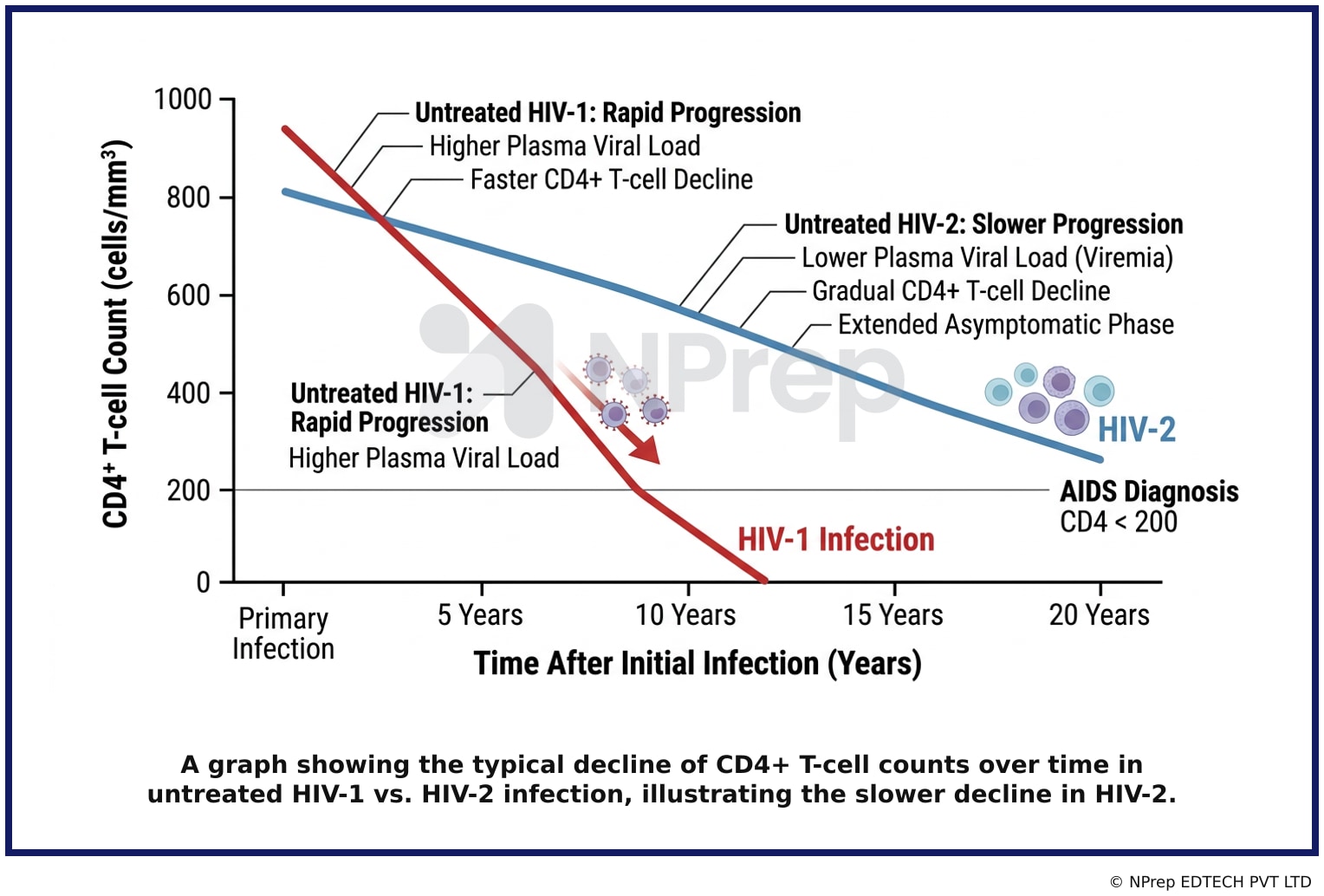
- Visual 1: Comparative Graph - A graph showing the typical decline of CD4+ T-cell counts over time in untreated HIV-1 vs. HIV-2 infection, illustrating the slower decline in HIV-2.
- Visual 2: World Map - A map highlighting the geographical prevalence of HIV-1 (global) versus HIV-2 (predominantly West Africa).
Clinical Relevance
- Nursing practice connection: Knowing Types and Pathophysiology of Human Immunodeficiency Virus (HIV) helps nurses interpret findings accurately and avoid errors in routine assessment, medication administration, and patient teaching.
- Differentiating between HIV-1 and HIV-2 is crucial for patient prognosis, counseling, and long-term management, as the expected disease course differs significantly.
- Although HIV-2 progresses more slowly, it can still lead to AIDS. Therefore, patients require regular monitoring of CD4 counts and viral load, and may eventually need antiretroviral therapy (ART).
- Nurses should be aware that some ART drugs, particularly non-nucleoside reverse transcriptase inhibitors (NNRTIs), are not effective against HIV-2.
How to Approach the Question
- First, identify the key concept in the question, which is the 'rate of disease progression' related to different 'types of HIV'.
- Recall the two main types of Human Immunodeficiency Virus: HIV-1 and HIV-2.
- Access your knowledge about the characteristics of each type. Remember that HIV-1 is the globally dominant and more aggressive strain, responsible for the pandemic.
- Contrast this with HIV-2, which is known to be less virulent and less common.
- Based on this contrast, deduce that HIV-2 is the type associated with slower disease progression.
- Evaluate the options to confirm your answer and eliminate the distractors.
Concept Tested & Keywords
- Concept Tested: Types and Pathophysiology of Human Immunodeficiency Virus (HIV)
- Stem keywords: HIV, slower disease progression
- Lead-in keywords: Which type
Question ID
Q-H58-VoO_cDjQ1qsR4Vsz
Practise the full AIIMS CRE 2025
Attempt every question from this paper in a timed mock, then review the full solution for each one.
More Immunologic Function Questions
- In an immunocompromised patient, the nurse should take infection prevention methods when WBC is:
- A nurse notices redness and itching around intravenous cannula insertion site. What she should suspect?
- A nurse has given the following glove to the surgeon. What could be the possible reason?
- A person agrees with the organ donation .Before transplantation which thing should be done as priority?
- Which among the following is NOT a major manifestation of rheumatic fever?
- Which of the following vaccines is contra-indicated in symptomatic HIV infection whose CD4 count is less than 400 cells/$mm^{3}$?
- Which of the following is due to Delayed Hypersensitivity (Type IV) type of reaction?
- Which route is used to administer a chemotherapeutic agent to minimize the associated physical discomforts and risks of infection and infiltration by…
- What laboratory test is used to monitor disease progression and immune status in HIV-positive patients?
- Which is a chronic inflammatory and autoimmune disease affecting peripheral synovial joints of bone?
More AIIMS CRE 2025 Questions
- What is the preferred first-line ART regimen for HIV-infected adults?
- Which action reduces the risk of mother-to-child transmission of HIV during childbirth?
- Which antiretroviral regimen is recommended for newborns exposed to HIV?
- What is the duration of ARV prophylaxis for newborns exposed to HIV?
- What is the recommendation for ARV treatment in HIV-positive pregnant women during labor?
- PEP (Post-exposure prophylaxis) after needle-stick injury should be initiated within:
- How long should post-exposure prophylaxis (PEP) be continued after potential HIV exposure?
- Which body fluid is most likely to transmit HIV through a needle-stick injury?
- Recommended HIV follow-up testing schedule for healthcare workers after needle-stick injury is:
- Which statement about post-exposure prophylaxis is true?