
Raj. CHO -2025
Obstetrics & Gynaecology
Easy
Which screening test is used to detect urinary tract infections during pregnancy?
Appeared in: Raj. CHO -2025
Explanation
- The urine dipstick test is a rapid, non-invasive, and cost-effective method used for initial screening of UTIs.
- It detects key indicators of infection, such as leukocyte esterase (from white blood cells) and nitrites (a byproduct of common urinary pathogens).
- A positive dipstick result prompts further investigation with a urine culture, but it serves as the primary screening step.
- Early detection through screening is vital in pregnancy to prevent complications from asymptomatic bacteriuria.
Why Other Options Were Wrong
- Option B: A complete blood count (CBC) indicates a systemic inflammatory response (like an elevated WBC count) but is not specific to the urinary tract. It cannot differentiate a UTI from an infection elsewhere in the body.
- Option C: An ultrasound is an imaging modality that assesses the structure of the kidneys and bladder. It does not detect the presence of bacteria or infection itself.
- Option D: Cervical cytology (Pap smear) is a screening test for cervical cancer and cellular changes caused by the human papillomavirus (HPV). It has no role in diagnosing urinary tract infections.
Related Visual
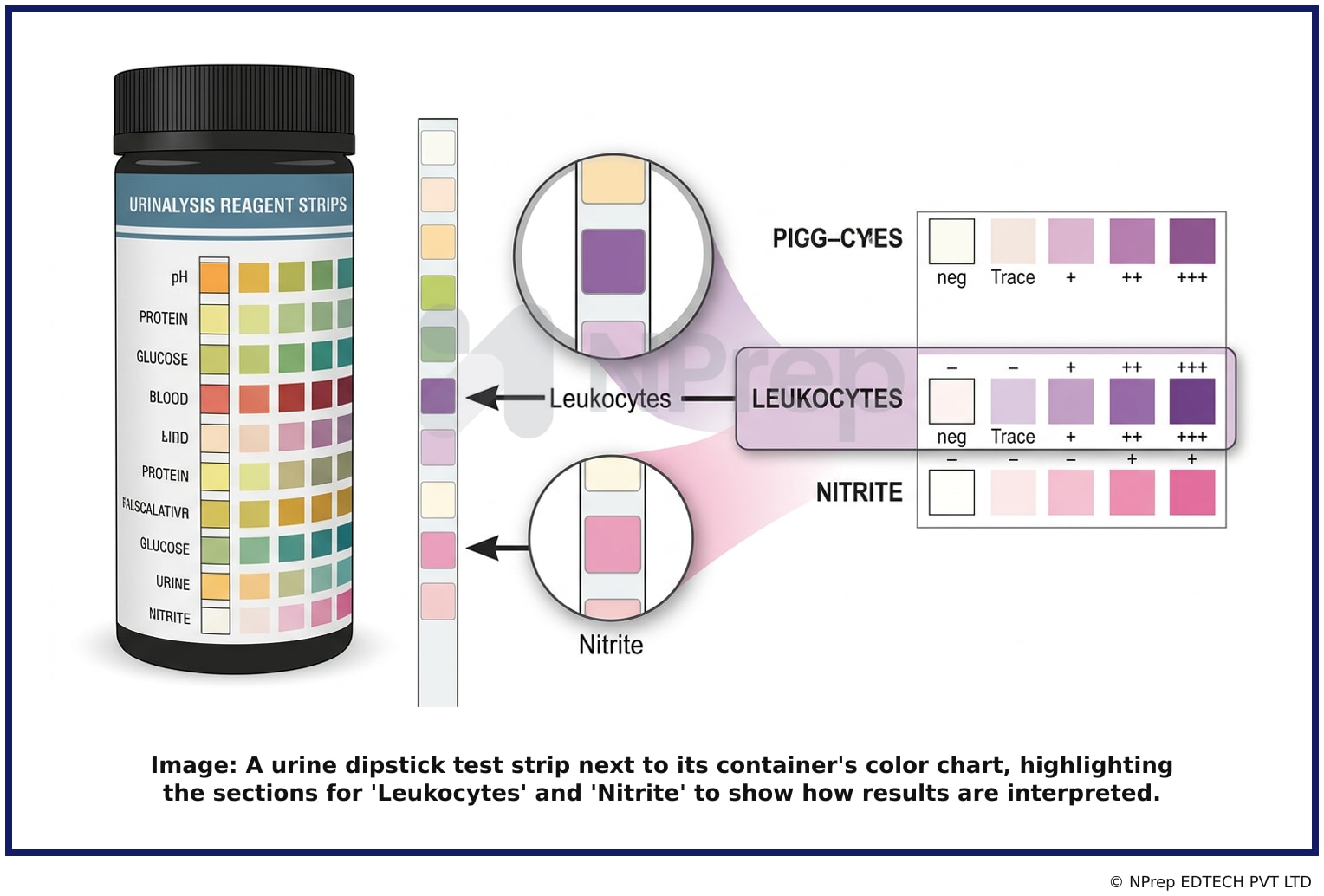
- Visual 1: Image: A urine dipstick test strip next to its container's color chart, highlighting the sections for 'Leukocytes' and 'Nitrite' to show how results are interpreted.
- Visual 2: Infographic: A flowchart showing the screening and diagnostic pathway for UTIs in pregnancy, starting with a routine dipstick test, leading to urine culture if positive, and then to targeted antibiotic therapy.
Clinical Relevance
- Nursing practice connection: This is primarily an exam-oriented knowledge point with limited direct bedside application, so retain Screening for Urinary Tract Infections (UTIs) in Pregnancy as background academic context rather than a clinical decision trigger.
- Nurses are often responsible for collecting urine samples and performing dipstick tests at antenatal visits. Accurate technique and interpretation are essential for reliable screening.
- Patient education is a key nursing role. The nurse must explain the importance of treating UTIs in pregnancy, even if the patient feels well (asymptomatic bacteriuria), to prevent harm to both mother and baby.
- What if the dipstick is negative for nitrites but positive for leukocyte esterase? The nurse should still consider it a positive screen and send the urine for culture. Some bacteria do not produce nitrites, and leukocyte esterase alone is a significant finding.
How to Approach the Question
- First, identify the key terms in the question: 'screening test', 'urinary tract infections', and 'pregnancy'. The word 'screening' implies a rapid, initial test, not a definitive diagnostic or imaging procedure.
- Evaluate each option based on its primary function. Ask yourself, 'What is this test typically used for?'
- Consider Option A (Urine dipstick): This is a well-known, quick test for urine abnormalities. It fits the description of a 'screening' tool.
- Consider Option B (CBC): This is a blood test for general infection/inflammation, not specific to the urinary tract.
- Consider Option C (Ultrasound): This is an imaging test for structure, not a test for infection.
- Consider Option D (Cervical cytology): This is for cervical cancer screening, not UTIs.
Concept Tested & Keywords
- Concept Tested: Screening for Urinary Tract Infections (UTIs) in Pregnancy
- Stem keywords: screening test, urinary tract infections, pregnancy
- Lead-in keywords: Which
Question ID
QKPAAZYCNa5lxL8bwRz2Ts
Reference Book
E6 Comprehensive Textbook of Community Health Nursing for BSc Nursing Students Part 2 — Subpart B (pp 276-535 of 550) p. 276-550
Practise the full Raj. CHO -2025
Attempt every question from this paper in a timed mock, then review the full solution for each one.
More Urinary Problems in Gynecology Questions
- You are teaching Kegel exercises to a female patient. Her understanding of these exercises is correct when she states that:
- Kegel exercise is done to?
- Which of the following tests is used to assess stress incontinence?
- Inability to control urination is known as:
- Which condition is most commonly associated with inability to void urine in the immediate postpartum period?
More Raj. CHO -2025 Questions
- Which one is the modifiable risk factor of the Coronary Heart disease?
- Which of the following is not one of the aim of first aid? (Choose the most appropriate option from below)
- What is the first step to take if someone has a convulsion? (Choose the most appropriate option from below)
- Which of the following is the primary action of Antipyretic drugs? (Choose the most appropriate option from below)
- What is the primary function of carbohydrates in the human diet? (Choose the most appropriate option from below)
- Which of the following is a congenital malformation of the heart?
- Match the greenhouse gases with their sources: Greenhouse gases Source a. Methane 1. Landfills b. Carbon dioxide 2. Fossil fuel burning c. Nitrous ox…
- Which of the following is a non-occupational disease?
- Which antibiotic is known as first wonder drug?
- The human skeleton is divided into two main parts?