
RRB Nsg. Superintendent-20 July 2019 (Shift-3rd)
Pharmacology
Easy
Which purgative causes hypokalemia?
Appeared in: RRB Nsg. Superintendent-20 July 2019 (Shift-3rd)
Explanation
- Dulcolax is the brand name for bisacodyl, which is classified as a stimulant laxative.
- Stimulant laxatives work by increasing intestinal motility and secretion of water and electrolytes into the bowel.
- Chronic or excessive use of stimulant laxatives leads to significant loss of fluids and electrolytes, with hypokalemia (low potassium) being a classic and clinically important adverse effect.
- This class of laxatives is the most likely to cause dependence and significant electrolyte disturbances with long-term use.
Why Other Options Were Wrong
- Option A: Osmotic purgatives (like lactulose or magnesium citrate) primarily work by drawing water into the bowel. While any significant diarrhea can cause electrolyte shifts, they are not the class most characteristically associated with causing hypokalemia from chronic use.
- Option B: Liquid paraffin is a lubricant laxative. Its main adverse effect with chronic use is the malabsorption of fat-soluble vitamins (A, D, E, K) and the risk of lipid pneumonia if aspirated, not hypokalemia.
- Option C: Castor oil is a potent stimulant laxative, but its use is limited due to severe cramping and unpalatability. While it can cause dehydration and electrolyte loss, Dulcolax (bisacodyl) is a more common and representative example of a stimulant laxative whose chronic use leads to hypokalemia.
Related Visual
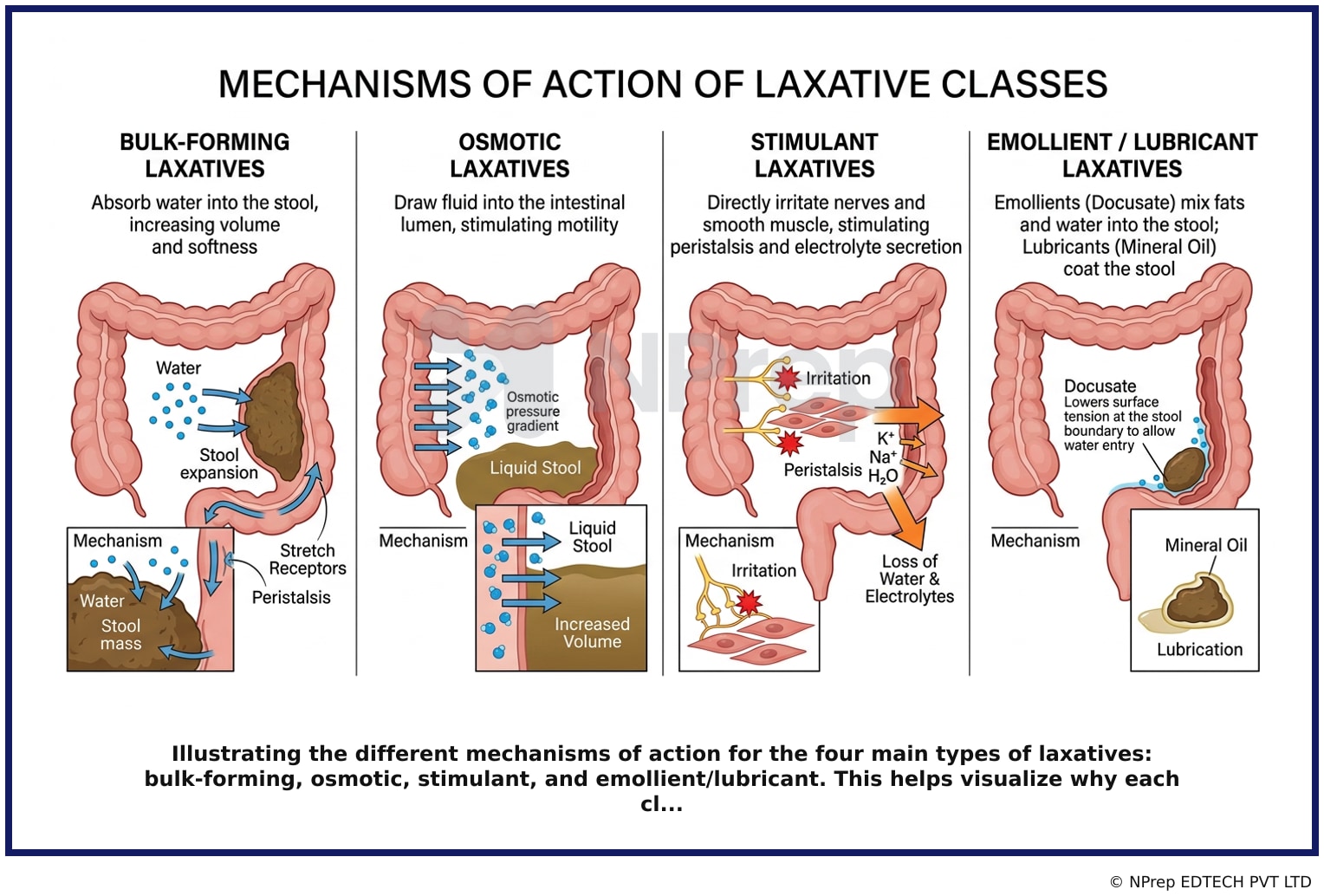
- Visual 1: Diagram - Illustrating the different mechanisms of action for the four main types of laxatives: bulk-forming, osmotic, stimulant, and emollient/lubricant. This helps visualize why each class has different side effects.
- Visual 2: Flowchart - Showing the progression from chronic stimulant laxative use to increased intestinal secretion, potassium loss, and finally, the clinical manifestations of hypokalemia (muscle weakness, arrhythmias).
Clinical Relevance
- Nursing practice connection: This is primarily an exam-oriented knowledge point with limited direct bedside application, so retain Adverse effects of laxatives and purgatives as background academic context rather than a clinical decision trigger.
- Nurses must educate patients that over-the-counter does not mean without risk. Chronic laxative use, especially of stimulants, can lead to dependence ('lazy bowel syndrome') and serious electrolyte imbalances.
- A key nursing assessment for patients with chronic constipation or suspected eating disorders includes asking specifically about laxative use, as this is often a hidden practice.
- What if? If a patient on chronic diuretic therapy (like furosemide, which also wastes potassium) reports using Dulcolax daily, the risk for severe, life-threatening hypokalemia is critically high. The nurse's priority is to assess the patient immediately for signs of hypokalemia and notify the provider.
How to Approach the Question
- First, identify the core of the question: it's asking for a specific adverse effect (hypokalemia) linked to a class of drugs (purgatives/laxatives).
- Next, classify each option into its pharmacological group. 'Osmotic purgative' is a class. 'Liquid paraffin' is a lubricant. 'Castor oil' and 'Dulcolax' are both stimulants.
- Recall the primary mechanism and the most common or classic side effects for each class. Stimulant laxatives are well-known for causing electrolyte loss with chronic use.
- Differentiate between the two stimulant options. Dulcolax (bisacodyl) is a widely used, prototypical example for laxative abuse and its consequences, making it a stronger answer than the less commonly used castor oil.
- Select the option that represents the strongest and most clinically recognized association between the drug type and the specified side effect.
Concept Tested & Keywords
- Concept Tested: Adverse effects of laxatives and purgatives
- Stem keywords: purgative, hypokalemia
- Lead-in keywords: Which
Question ID
Q6dr-v5TMH_Yb86Pe2AORc
Practise the full RRB Nsg. Superintendent-20 July 2019 (Shift-3rd)
Attempt every question from this paper in a timed mock, then review the full solution for each one.
More Gastrointestinal Drugs Questions
- A patient on long term antibiotics therapy with loss of GI flora may chance of?
- A patient with Parkinson's syndrome receives continuous levodopa to increase the level of?
- A patient is receiving histamine receptor antagonist for peptic ulcers and ask to the nurse about mode of action of histamine receptor antagonist. Th…
- A patient has a peptic ulcer and is taking antacids. What is the action of antacid?
- A patient is receiving histamine receptor antagonist for peptic ulcers and ask to the nurse about mode of action of histamine receptor antagonist. Th…
- Antacids are used in-
- Which of the following drugs is a proton pump inhibitor?
- When is injection ondansetron given before chemotherapy?
- A Physician has ordered Ranitidine (Zantac) 300 mg once a day (OD). At what time will a Nurse give this medicine from the following?
- Out of the following, which medicines are used for intestinal evacuation?
More RRB Nsg. Superintendent-20 July 2019 (Shift-3rd) Questions
- Where is oxytocin synthesized?
- What is the name of the muscle that extends from the sphenoid bone to the mandible?
- Complementary feeding should be initiated at the completion of \ \ \ \ \ \
- Where is kidney located?
- Psychosocial development stage for infants is \ \ \ \ \ \ \ \ \ \
- What immunization is given at birth?
- Functional nursing is a method of providing
- Which disease is the dementia associated with asymmetric atrophy of the frontal and temporal lobes?
- Thromboangiitis obliterans is also known as
- What is the other name of pyridoxine?