
DSSSB 12 August 2024
Easy
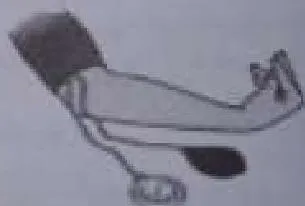
Which of the following signs is elicited in the image below?
Appeared in: DSSSB 12 August 2024
Explanation
- The image clearly depicts the procedure for eliciting Trousseau's sign.
- A blood pressure cuff is inflated on the upper arm, which induces ischemia.
- This ischemia triggers a characteristic carpopedal spasm (flexed wrist and adducted thumb) in individuals with low serum calcium levels.
- This specific response is the definition of a positive Trousseau's sign, a key indicator of latent tetany due to hypocalcemia.
Why Other Options Were Wrong
- Option A: Chvostek's sign involves tapping the facial nerve, not inflating a blood pressure cuff on the arm. A positive sign is twitching of the facial muscles.
- Option C: Kernig's sign is a test for meningeal irritation (meningitis). It involves flexing the patient's hip and then attempting to extend the knee, which causes pain and resistance in a positive test. It does not involve the arm or a BP cuff.
- Option D: Brudzinski's sign is also a test for meningeal irritation. It is positive when passive flexion of the patient's neck causes involuntary flexion of the hips and knees. It is unrelated to the arm or a BP cuff.
Related Visual

Clinical Relevance
- Nursing practice connection: This is primarily an exam-oriented knowledge point with limited direct bedside application, so retain Clinical assessment for hypocalcemia and meningeal irritation as background academic context rather than a clinical decision trigger.
- Recognizing Trousseau's sign is a critical nursing skill for the early detection of hypocalcemia.
- Prompt identification allows for timely intervention to prevent life-threatening complications such as laryngeal spasms, seizures, and cardiac arrhythmias.
- What if? If a patient who just had a thyroidectomy develops numbness and tingling around the mouth and then shows a positive Trousseau's sign, the nurse should anticipate an order for IV calcium gluconate, as this indicates acute hypocalcemia due to potential parathyroid gland injury or removal.
How to Approach the Question
- First, carefully analyze the image provided. Identify the key actions and objects: a blood pressure cuff is applied to the upper arm, and the hand is in a specific, unnatural posture (spasm).
- Connect the action to the result. The inflation of the cuff is causing the hand spasm.
- Review the definitions of the signs listed in the options.
- Chvostek's sign relates to the facial nerve.
- Kernig's and Brudzinski's signs relate to meningeal irritation and involve the legs and neck.
- Trousseau's sign specifically involves inducing carpopedal spasm by occluding blood flow to the arm with a cuff.
Concept Tested & Keywords
- Concept Tested: Clinical assessment for hypocalcemia and meningeal irritation.
- Stem keywords: sign, elicited, image
- Lead-in keywords: Which
- Clinical cues: The image shows a blood pressure cuff on the arm and a resultant carpopedal spasm, which is a specific diagnostic maneuver.
Question ID
Q-_8HGVp4zCsZVyN2IzWMi
Reference Book
E6 Nursing Brunner Adult Health 3SA Vol 1 Part 4 p. 30-32
E6 Pathology- ROBBINS & COTRAN PATHOLOGIC BASIS OF DISEASE 10TH Ed p. 1096-1098
E6 Nursing Brunner Adult Health 3SA Vol 1 Part 1 p. 154-156
Practise the full DSSSB 12 August 2024
Attempt every question from this paper in a timed mock, then review the full solution for each one.
More DSSSB 12 August 2024 Questions
- What is the meaning of conation?
- All of the following are selective serotonin inhibitors, EXCEPT:
- Which of the following is NOT a parameter of the Braden scale?
- Which of the following is a way of dealing with or remembering information by separating it into small groups?
- A common measure of the severity of a disease, based on current physiological parameters, age and previous health conditions, is the
- The formation of sequestrum and involucrum is seen in the pathogenesis of:
- An adult patient was diagnosed with paranoid schizophrenia, and the doctor prescribed him chlorpromazine. After three weeks, the patient developed a…
- World Anti-Tobacco Day is observed on:
- Which of the following pubertal changes is characterised by breast budding in females?
- What is the inability to recognize familiar inanimate objects called?