
DSSSB 6 September 2024
Obstetrics & Gynaecology
Medium
Which of the following manoeuvres requires the obstetrician to identify the posterior shoulder on vaginal examination, then to push the posterior shoulder in the direction of the foetal chest, thus rotating the anterior shoulder away from the symphysis pubis?
Appeared in: DSSSB 6 September 2024
Explanation
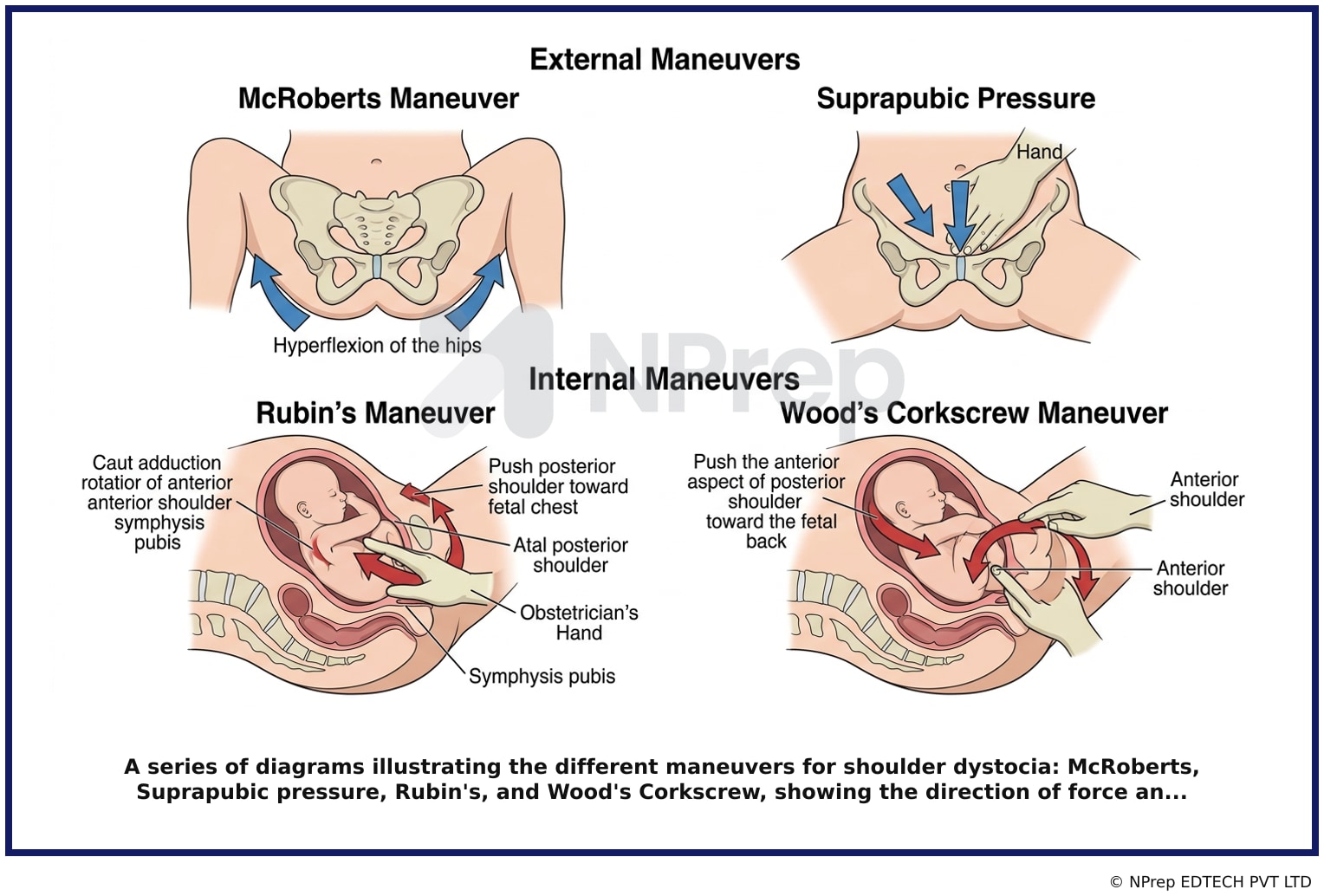
- Rubin's maneuver is an internal rotational technique used to resolve shoulder dystocia, an obstetric emergency.
- The procedure involves the provider inserting a hand vaginally to access the posterior aspect of the fetal shoulder.
- The provider then applies pressure to push the posterior shoulder toward the fetal chest, an action known as adduction.
- This adduction reduces the shoulder-to-shoulder (bisacromial) diameter of the fetus.
- This movement also helps to rotate the impacted anterior shoulder into a wider, oblique pelvic diameter, freeing it from behind the symphysis pubis and allowing for delivery.
Why Other Options Were Wrong
- Option A: The Zavanelli maneuver is a last-resort procedure for unresolved shoulder dystocia. It involves pushing the fetal head back into the uterus (cephalic replacement) followed by an emergency Cesarean section. It does not involve rotating the shoulders for a vaginal delivery.
- Option C: The McRoberts maneuver is an external, not internal, maneuver. It involves hyperflexing the mother's legs against her abdomen to change the angle of the pelvis. It does not involve the provider inserting a hand to manipulate the fetal shoulders.
- Option D: The Wood's corkscrew maneuver is also an internal rotational maneuver, but the direction of force is different. It involves pushing the anterior surface of the posterior shoulder toward the fetal back, causing the fetus to rotate like a corkscrew. The question describes pushing the shoulder toward the fetal chest.
Related Visual
Clinical Relevance
- Nursing practice connection: This is primarily an exam-oriented knowledge point with limited direct bedside application, so retain Management of shoulder dystocia using internal rotational maneuvers as background academic context rather than a clinical decision trigger.
- Shoulder dystocia is an unpredictable and acute obstetric emergency that requires immediate, skilled intervention to prevent fetal hypoxia, brachial plexus injury, or death.
- Nurses play a critical role in recognizing the 'turtle sign' (retraction of the fetal head), immediately calling for help (obstetrician, anesthesia, pediatrics), and assisting with the sequence of maneuvers, such as the HELPERR mnemonic.
- The nurse's responsibilities include assisting with maternal positioning (McRoberts), applying suprapubic pressure as directed, documenting the timing of events, and preparing for potential neonatal resuscitation.
How to Approach the Question
- First, identify the clinical scenario presented in the question stem: a specific technique to resolve shoulder dystocia.
- Break down the described actions: 1) identify the posterior shoulder, 2) push the posterior shoulder, 3) the direction of the push is toward the fetal chest, and 4) the result is rotation of the anterior shoulder.
- Mentally review the common maneuvers for shoulder dystocia. Eliminate the options that do not match the basic description.
- Eliminate Zavanelli maneuver, as it involves pushing the head back in for a C-section, not delivering the shoulders.
- Eliminate McRoberts maneuver, as it is an external procedure involving maternal leg positioning, not internal manipulation of the fetus.
- Differentiate between the two remaining internal rotational maneuvers: Rubin's and Wood's. The key is the direction of the push.
Concept Tested & Keywords
- Concept Tested: Management of shoulder dystocia using internal rotational maneuvers.
- Stem keywords: obstetrician, manoeuvre, posterior shoulder, vaginal examination, push, foetal chest, rotate, anterior shoulder
- Lead-in keywords: Which of the following
- Negative lead-in flag: false
Question ID
QdQyZDBvZDoLglBpJuvZDb
Reference Book
E6 Midwifery Obstetrics and Gynecology Nursing Sandeep Kaur p. 18-26
E6 Obstetrics Williams p. 7-18
Practise the full DSSSB 6 September 2024
Attempt every question from this paper in a timed mock, then review the full solution for each one.
More Prolonged Labor, Obstructed Labor, Dystocia Caused by Fetal Anomalies Questions
- Dystocia is:-
- The manoeuver commonly used to manage shoulder dystocia is?
- An image shows a nurse applying pressure to the mother's lower abdomen during the third stage of labor. What is the nurse doing?
- During a delivery, after the emergence of the fetal head, the nurse notes that it retracts back against the perineum (turtle sign), indicating should…
- Which of the following defines obstructed labour?
- An image shows a healthcare provider applying firm, downward pressure on the uterine fundus. What is the procedure here:
- The measure which is done to manage shoulder dystocia?
- When the first and second stages of Labour last longer than what duration, is it called prolonged labor?
- What is the cause of a Pathological Bandl's ring?
- Shoulder dystocia is managed by?
More DSSSB 6 September 2024 Questions
- Which of the following is NOT a primitive defence mechanism?
- After taking lithium drug for one month, a patient checked their serum lithium level and found it to be 1.0 mEq/L. The nurse checked the report and n…
- Select the option that correctly describes the condition being shown in the following image.
- Turbid, cloudy CSF is commonly associated with:
- According to the Mental Health Act, 1987, who from the following make(s) the application for admission under special circumstances?
- Which of the following types of schizophrenia is commonly characterised by excitement and stupor?
- What is the action of the Sitagliptin?
- Which gas is most commonly used for daily work in the wards and operation theatres?
- Sickle cell RBCs are also known as:
- Glimepiride is an example of a \ \ \ \ \ \ .