
AIIMS Bhopal NO - 2018 (Shift-1st)
Community Health Nursing
Medium
Which of the following infections is an airborne viral infection?
Appeared in: AIIMS Bhopal NO - 2018 (Shift-1st)
Explanation
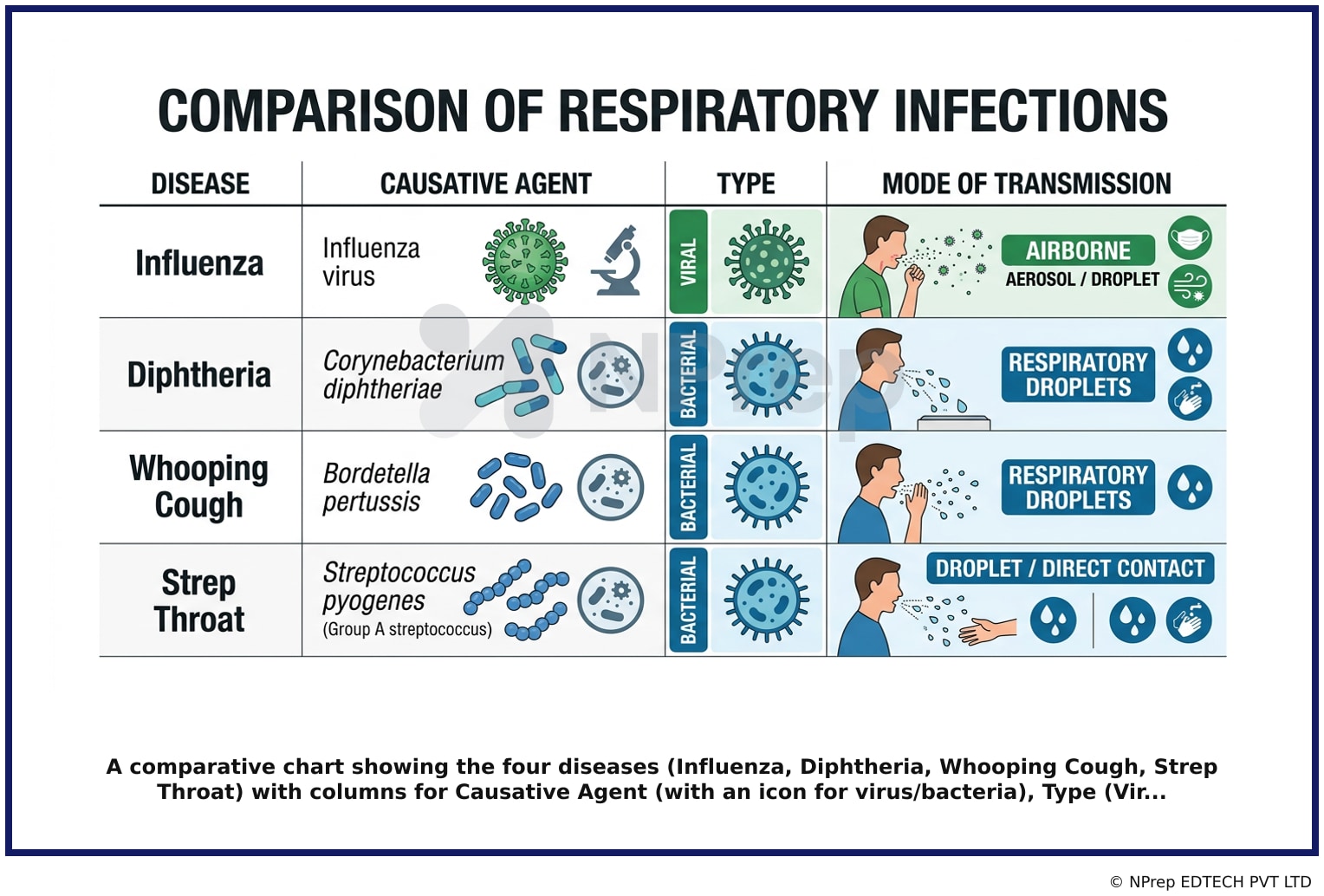
- Influenza is an acute respiratory illness caused by the influenza virus.
- It is transmitted from person to person primarily through respiratory droplets and smaller aerosols generated when an infected individual coughs, sneezes, or talks.
- Among the given options, influenza is the only infection caused by a virus, making it the correct answer for a 'viral infection'.
Why Other Options Were Wrong
- Option B: Diphtheria is a serious infection caused by the bacterium Corynebacterium diphtheriae, not a virus.
- Option C: Whooping cough, or pertussis, is a highly contagious respiratory tract infection caused by the bacterium Bordetella pertussis.
- Option D: Streptococcal sore throat, commonly known as strep throat, is a bacterial infection caused by Streptococcus pyogenes (Group A streptococcus).
Related Visual
Clinical Relevance
- Nursing practice connection: Knowing Differentiating between viral and bacterial respiratory infections and their modes of transmission helps nurses interpret findings accurately and avoid errors in routine assessment, medication administration, and patient teaching.
- Correctly identifying the pathogen type (viral vs. bacterial) is crucial for determining appropriate treatment, as antibiotics are ineffective against viruses like influenza.
- Nurses must implement appropriate transmission-based precautions. For droplet-transmitted infections like influenza, this includes wearing a surgical mask, practicing hand hygiene, and educating the patient on respiratory etiquette.
- What if? If a patient were diagnosed with tuberculosis (TB) instead, strict airborne precautions (N95 respirator, negative-pressure isolation room) would be mandatory, as TB is transmitted via smaller, more persistent airborne particles (aerosols).
How to Approach the Question
- First, analyze the question's core requirement: it asks for an infection that is both 'airborne' and 'viral'.
- Review each option and recall or determine its causative agent.
- Categorize each agent as either viral or bacterial.
- Influenza is caused by a virus. Diphtheria, whooping cough, and streptococcal sore throat are all caused by bacteria.
- Based on this initial filter, Influenza is the only possible correct answer as it's the only viral infection listed.
- Confirm that influenza is transmitted via the airborne/droplet route, which it is. This solidifies it as the correct choice.
Concept Tested & Keywords
- Concept Tested: Differentiating between viral and bacterial respiratory infections and their modes of transmission.
- Stem keywords: infections, airborne, viral
- Lead-in keywords: Which
- Negative lead-in flag: false
Question ID
QV6WFvrDBmzyiNLeTpQNTx
Reference Book
E6 Microbiology Essentials Sastry 4e Part 1 p. 131-133
E6 Microbiology Essentials Sastry 4e Part 2 p. 126-128
E6 Nursing Brunner Adult Health 3SA Vol 2 Part 1 p. 34-36
Practise the full AIIMS Bhopal NO - 2018 (Shift-1st)
Attempt every question from this paper in a timed mock, then review the full solution for each one.
More Respiratory Infections Questions
- What does I.M.N.C.I. mean in National Rural Health Mission?
- In caring for a patient with meningococcal meningitis, you will use
- Smallpox was officially declared eradicated by the WHO in the World?
- Koplik's spots are the clinical feature of?
- Among the following, identify the eradicated disease from the world?
- The induration of skin between 6 and 9 mm after tuberculin test indicates?
- What is the average incubation period of chickenpox?
- Which communicable disease is eradicated from India?
- Isolation of a child with mumps belongs to what level of prevention?
- What is the incubation period of measles (Rubeola)?
More AIIMS Bhopal NO - 2018 (Shift-1st) Questions
- What is the site of referred pain when pain is arising from the cervix?
- The division of bacterial cells and the exponential increase in their number are indicative of which phase?
- The nursing care that focuses on patient care along with the family needs, in the scope of a multidisciplinary health care team, is called?
- Which is not an indication of oxygen administration?
- Which of the following is considered under acute neuropsychiatric complications of AIDS?
- Which of the following is the unit of measurement in bacteriology?
- Melena suggests which of the following?
- Which of the following is the hypertensive Blood Pressure of a 6-year-old child?
- What should be the size of the endotracheal tube for a newborn weighing 2,000 to 3,000 gm?