
RRB Nsg. Superintendent-20 July 2019 (Shift-3rd)
General Knowledge
Easy
Which of the following are called nucleons?
Appeared in: RRB Nsg. Superintendent-20 July 2019 (Shift-3rd)
Explanation
- The particles that make up the atomic nucleus are collectively called nucleons.
- The nucleus of an atom is composed of two types of particles: protons, which have a positive electrical charge, and neutrons, which have no electrical charge.
- Therefore, protons and neutrons are the two types of nucleons. They account for almost the entire mass of an atom.
Why Other Options Were Wrong
- Option A: The nucleus is the structure that contains nucleons (protons and neutrons); it is not a nucleon itself. This option incorrectly pairs the whole structure with one of its parts.
- Option B: Valence electrons are electrons in the outermost shell of an atom. They are located outside the nucleus and are responsible for chemical bonding.
- Option D: Electrons are negatively charged particles that orbit the nucleus. They are a fundamental subatomic particle but are classified as leptons, not nucleons.
Related Visual
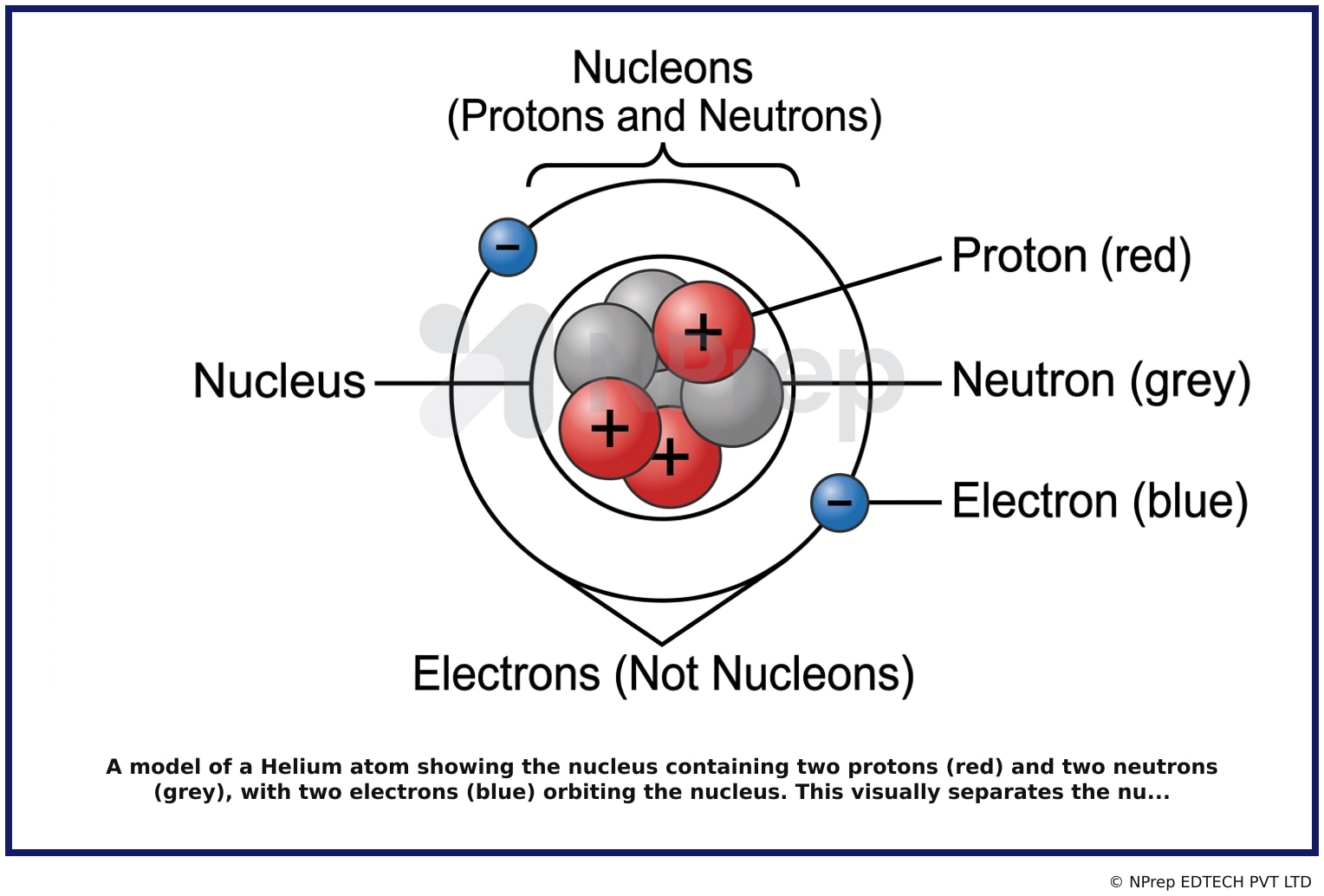
- Visual 1: Diagram - A model of a Helium atom showing the nucleus containing two protons (red) and two neutrons (grey), with two electrons (blue) orbiting the nucleus. This visually separates the nucleons from the electrons.
- Visual 2: Table - A comparative table of the three main subatomic particles (Proton, Neutron, Electron), listing their location, relative charge, and relative mass, clearly indicating that protons and neutrons are found in the nucleus.
Clinical Relevance
- Nursing practice connection: This is primarily an exam-oriented knowledge point with limited direct bedside application, so retain Definition of Nucleons in Atomic Structure as background academic context rather than a clinical decision trigger.
- Understanding atomic structure is fundamental to comprehending radioisotopes used in nuclear medicine for both diagnosis (e.g., PET scans using isotopes like Fluorine-18) and treatment (e.g., radiation therapy using Cobalt-60).
- The number of protons (atomic number) defines an element. This is critical for understanding the function of essential electrolytes in the body, such as sodium (Na+), potassium (K+), and calcium (Ca2+), and their role in nerve impulses and muscle contraction.
- What if? If an atom has a different number of neutrons but the same number of protons, it is called an isotope. For example, Iodine-131 is a radioactive isotope used to treat hyperthyroidism. It has the same chemical properties as stable iodine and is taken up by the thyroid gland, where its radiation destroys excess thyroid tissue.
How to Approach the Question
- First, identify the key term in the question: 'nucleons'.
- Break down the word: 'nucle-' refers to the nucleus of an atom. So, the question is asking which particles are in the nucleus.
- Recall the basic model of an atom: a central nucleus surrounded by orbiting electrons.
- Remember the components of the nucleus: positively charged protons and neutral neutrons.
- Evaluate the options: 'Protons and Neutrons' directly matches the components of the nucleus.
- Eliminate the other options: Electrons (including valence electrons) are outside the nucleus, and the 'nucleus' itself is the entire structure, not the individual particles it's made of.
Concept Tested & Keywords
- Concept Tested: Definition of Nucleons in Atomic Structure
- Stem keywords: nucleons
- Lead-in keywords: Which of the following
- Negative lead-in flag: false
Question ID
QlyO8IHebrgz6IOl7wf-Wj
Practise the full RRB Nsg. Superintendent-20 July 2019 (Shift-3rd)
Attempt every question from this paper in a timed mock, then review the full solution for each one.
More Basic Chemistry Questions
- The material used in the manufacture of lead pencil is -
- Lead is widely used in a variety of industries because of its properties EXCEPT?
- Which of the following statements is true for displacement reactions?
- Which of the following elements is a polyatomic molecule?
- Which of the following is an example of metalloids?
- Alkyl halides react with metallic sodium in ether. The reaction is known as?
- Hardness of water is caused by the presence of \ \ \ \ \ \ salts.
- What causes acid rain?
- Which gas is generally liberated when acid reacts with metal?
- Which of the following is the lightest element?
More RRB Nsg. Superintendent-20 July 2019 (Shift-3rd) Questions
- Where is oxytocin synthesized?
- What is the name of the muscle that extends from the sphenoid bone to the mandible?
- Complementary feeding should be initiated at the completion of \ \ \ \ \ \
- Where is kidney located?
- Psychosocial development stage for infants is \ \ \ \ \ \ \ \ \ \
- What immunization is given at birth?
- Functional nursing is a method of providing
- Which disease is the dementia associated with asymmetric atrophy of the frontal and temporal lobes?
- Thromboangiitis obliterans is also known as
- What is the other name of pyridoxine?