
KGMU 2023
Medical Surgical Nursing
Easy
Which lens is used in myopia?
Appeared in: KGMU 2023
Explanation
- Myopia, or nearsightedness, is a refractive error where the eye's shape causes light rays to focus at a point in front of the retina, rather than directly on its surface.
- This results in clear vision for near objects but blurry vision for distant objects.
- A concave lens is a diverging lens, which means it spreads out light rays before they reach the eye's lens.
- This divergence moves the focal point backward, ensuring the image of a distant object is focused precisely on the retina, thus correcting the blurry vision.
Why Other Options Were Wrong
- Option B: A convex lens is a converging lens that increases the refractive power. It would worsen myopia by bringing the focal point even further in front of the retina.
- Option C: A cylindrical lens corrects for refractive errors that are different in different meridians (planes) of the eye, which is not the primary issue in simple myopia.
- Option D: While a biconcave lens is a type of concave lens and does correct myopia, 'Concave' is the broader and more fundamental classification. In multiple-choice questions, the most general correct category is often the intended answer.
Related Visual
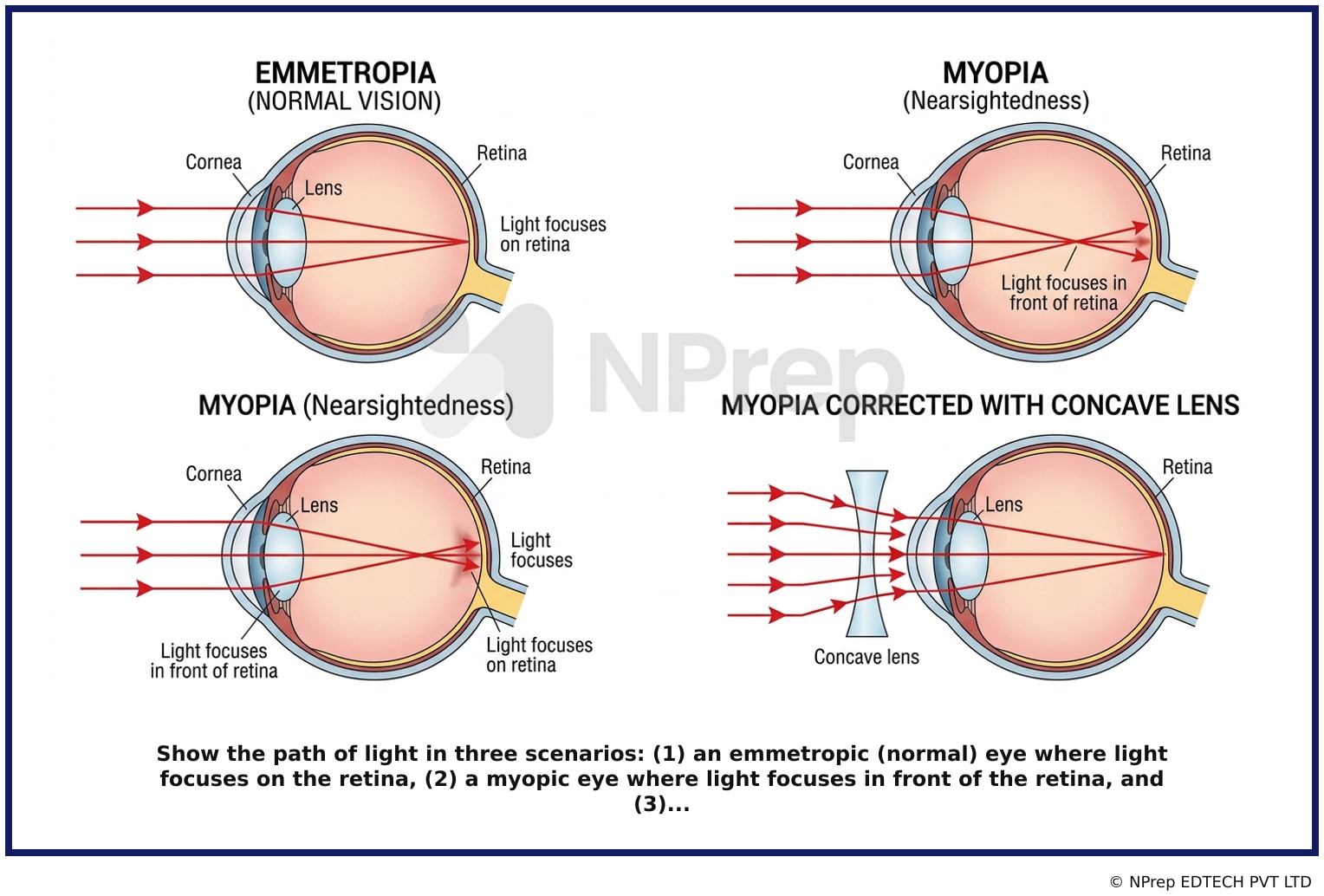
- Visual 1: Diagram - Show the path of light in three scenarios: (1) an emmetropic (normal) eye where light focuses on the retina, (2) a myopic eye where light focuses in front of the retina, and (3) a myopic eye corrected with a concave lens, showing the light being diverged to focus on the retina. This visual helps clarify the underlying physics of the condition and its correction.
Clinical Relevance
- Nursing practice connection: This is primarily an exam-oriented knowledge point with limited direct bedside application, so retain Correction of Myopia using Lenses as background academic context rather than a clinical decision trigger.
- Nurses play a key role in vision screening programs in schools and communities, helping to identify children and adults with potential refractive errors like myopia.
- Patient education is crucial. Nurses can explain to patients and families the importance of wearing prescribed corrective lenses consistently to prevent eyestrain, headaches, and potential worsening of vision.
- A nurse should be able to recognize symptoms of uncorrected myopia, such as squinting, sitting too close to the television, holding books close to the face, or difficulty seeing the blackboard in school.
How to Approach the Question
- First, identify the key term in the question: 'myopia'.
- Recall the definition of myopia. Myopia is also known as nearsightedness, a condition where distant objects are blurry.
- Remember the underlying optical problem in myopia: the focal point of the eye is in front of the retina.
- Consider the function of different lenses. A diverging lens is needed to spread the light and move the focal point backward.
- Identify which of the options is a diverging lens. A concave lens diverges light.
- Evaluate the other options. A convex lens converges light (for farsightedness), and a cylindrical lens corrects for astigmatism. A biconcave lens is a type of concave lens, making 'Concave' the best general answer.
Concept Tested & Keywords
- Concept Tested: Correction of Myopia using Lenses
- Stem keywords: lens, myopia
- Lead-in keywords: Which
Question ID
QHqe0iyU7YQzkNc33QWNEV
Practise the full KGMU 2023
Attempt every question from this paper in a timed mock, then review the full solution for each one.
More Ophthalmology Questions
- Ishihara chart is used for the assessment of.
- If glaucoma is not treated on time, it can lead to?
- Myopia can be corrected with the help of?
- Kayser-Fleisher (golden brown) ring at the limbus of corner seen with a hand lens is observed in?
- Match List I with List II and select the correct answer using the code given below the lists :| List I (Deficiency) | List II (Sign) | | :- A. Cornea…
- A nurse caring the patient after cataract surgery should include which of the following care immediately after the surgery? 1. Administer topical ant…
- All are the examination assessment of eyes EXCEPT
- \ \ \ \ \ is a suppurative infection in the lacrimal sac?
- A nurse is giving instructions to a patient and their family regarding home care after cataract removal in the right eye. Which statement from the pa…
- What is near-sightedness called?
More KGMU 2023 Questions
- The teacher scalded Aruna in front of her classmates during Project submission. Conclusion I: Aruna was not as popular as her other classmates. Concl…
- Aruna leaves and goes 8 meters in the North direction from a certain point. Then she turns right and travels for 12 meters. She again turns right and…
- Kiran is Sister of Raj. Raj is Son of Suresh and Vinita is Mother of Suresh then what is relation between Vinita and Kiran?
- A person who lives at the same time with another?
- Select the most appropriate meaning of the below idiom. A black sheep?
- The train has arrived...the station.
- A vendor sold 20 kg of potato at 18 Rs. per kg. He bought 2-liter milk at the rate of 46 Rs./liter, 2 kg sugar at the rate of 35 Rs./kg and 10 packet…
- Which one is the perfect square?
- A is the smallest. C is taller than B and D. E is neither the tallest nor the smallest. Find which one is the tallest?
- From an entrance, a person walks 28 meters left, then turns right and walks 13 meters. They turn right again and walk 12 meters, and then walk 16 met…