
RRB Nsg. Superintendent-20 July 2019 (Shift-3rd)
Nursing Research & Statistics
Easy
Which is the research method that combines both a longitudinal design and a cross-sectional design?
Appeared in: RRB Nsg. Superintendent-20 July 2019 (Shift-3rd)
Explanation
- The question asks for a design that merges longitudinal and cross-sectional approaches.
- This combined method is correctly known as a sequential or cross-sequential design.
- It involves studying multiple cohorts (a cross-sectional aspect) over a period of time (a longitudinal aspect).
- This allows researchers to analyze age-related changes more efficiently than a purely longitudinal study and to disentangle age effects from cohort effects.
- In the context of this question, 'Convergence design' is used as a synonym for this sequential approach, although it more commonly refers to a mixed-methods design.
Why Other Options Were Wrong
- Option B: Exploratory design is a mixed-methods sequential design, not a combination of longitudinal and cross-sectional time dimensions. It starts with qualitative data to explore a topic, followed by quantitative data collection.
- Option C: Explanatory design is a mixed-methods sequential design. It begins with quantitative data and uses subsequent qualitative data to explain the quantitative results.
- Option D: Divergence design is not a standard, recognized term in research methodology classifications.
Related Visual
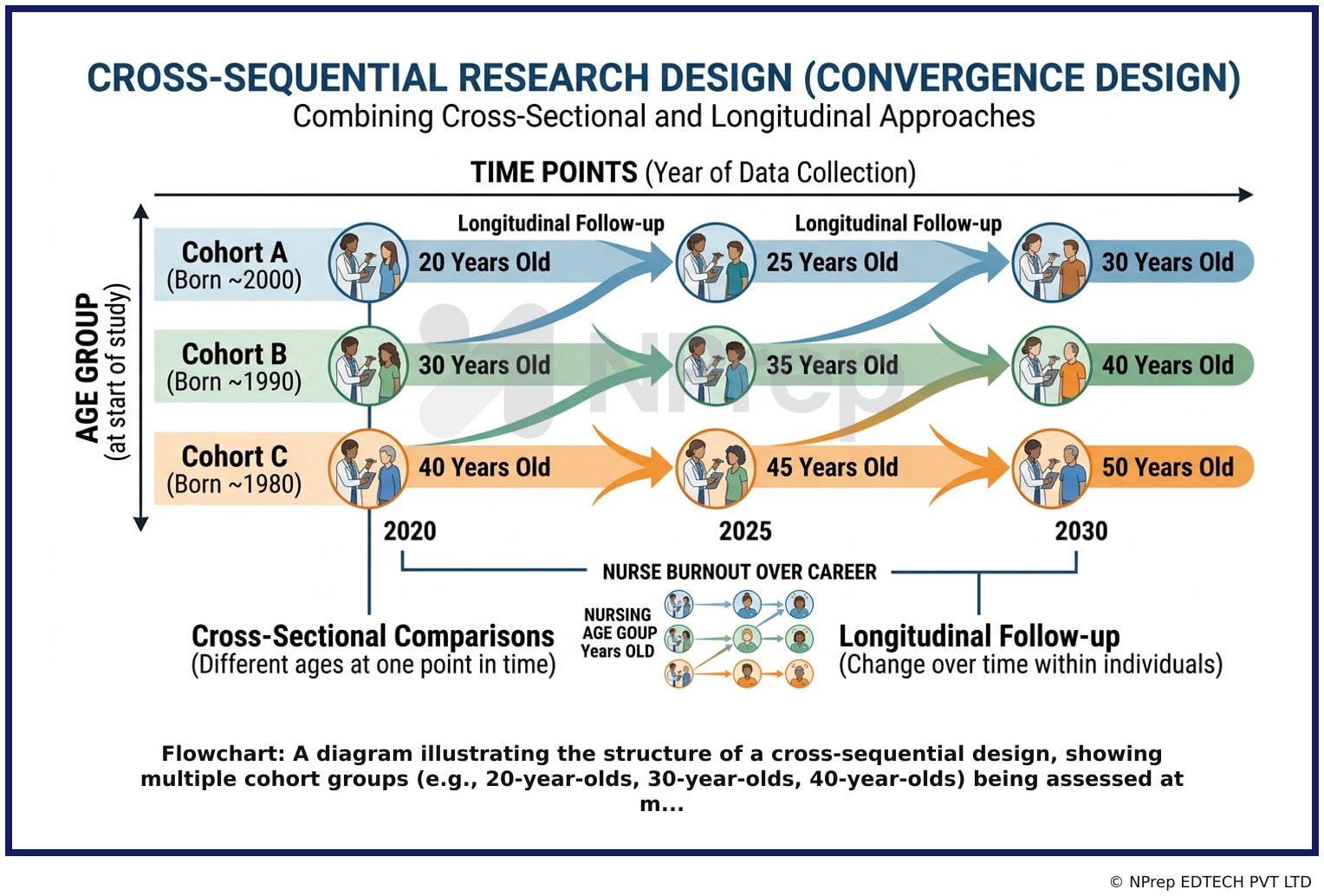
- Visual 1: Flowchart: A diagram illustrating the structure of a cross-sequential design, showing multiple cohort groups (e.g., 20-year-olds, 30-year-olds, 40-year-olds) being assessed at multiple time points (e.g., in 2020, 2025, and 2030). This visual would clarify how the cross-sectional and longitudinal elements are combined.
Clinical Relevance
- Nursing practice connection: This is primarily an exam-oriented knowledge point with limited direct bedside application, so retain Identification of research designs, specifically the design that combines longitudinal and cross-sectional approaches as background academic context rather than a clinical decision trigger.
- Understanding different research designs is crucial for nurses to critically appraise evidence for practice. Knowing the strengths and weaknesses of each design helps determine the validity and applicability of study findings.
- For example, a nurse reading a study on the long-term effects of a patient education program would recognize that a longitudinal or sequential design provides stronger evidence about change over time than a simple cross-sectional survey.
- What if? If a researcher wanted to understand both the prevalence of burnout among nurses of different age groups and how burnout develops as nurses advance in their careers, a sequential design would be ideal. A cross-sectional study would only show prevalence, while a longitudinal study would take many years.
How to Approach the Question
- First, dissect the question to identify the core requirement: a research design that 'combines both a longitudinal design and a cross-sectional design'.
- Recall the definitions of the key terms. A cross-sectional study looks at different groups at one point in time. A longitudinal study follows one group over time.
- Logically deduce what a combination would look like: following several different groups over time. This is known as a sequential or cross-sequential design.
- Evaluate the given options. Recognize that 'Exploratory' and 'Explanatory' designs refer to the sequence of qualitative and quantitative methods in mixed-methods research, not the time dimension.
- Identify 'Divergence design' as a non-standard term.
- This leaves 'Convergence design'. Even if you know this term usually applies to mixed-methods research, by elimination and context, it is the intended answer, likely used as a synonym for the correct 'sequential' design.
Concept Tested & Keywords
- Concept Tested: Identification of research designs, specifically the design that combines longitudinal and cross-sectional approaches.
- Stem keywords: research method, longitudinal design, cross-sectional design
- Lead-in keywords: Which is
Question ID
QsWlAHIqEHe8UbO0Fwrf_M
Practise the full RRB Nsg. Superintendent-20 July 2019 (Shift-3rd)
Attempt every question from this paper in a timed mock, then review the full solution for each one.
More Research Approaches and Designs Questions
- A true experimental design in research is characterized by the following properties; EXCEPT:
- Which variable is manipulated in experimental research?
- The research that is done to learn about cultural behaviour and cultural artifacts is called?
- Which of the following types of studies is an example of a qualitative research method?
- Data are collected at one point in time is known as?
- The relative risk of a disease can be obtained from:
- Cohort study is best described as:
- Which of the following is not true about case-control epidemiological studies?
- A researcher conducted a study to describe the lived experiences of care givers of patients with Dementia. Which type of qualitative study is conduct…
- The characteristic feature of experimental research design?
More RRB Nsg. Superintendent-20 July 2019 (Shift-3rd) Questions
- Where is oxytocin synthesized?
- What is the name of the muscle that extends from the sphenoid bone to the mandible?
- Complementary feeding should be initiated at the completion of \ \ \ \ \ \
- Where is kidney located?
- Psychosocial development stage for infants is \ \ \ \ \ \ \ \ \ \
- What immunization is given at birth?
- Functional nursing is a method of providing
- Which disease is the dementia associated with asymmetric atrophy of the frontal and temporal lobes?
- Thromboangiitis obliterans is also known as
- What is the other name of pyridoxine?