
RRB Nsg. Superintendent-20 July 2019 (Shift-3rd)
Applied Microbiology & Infection control
Easy
Which is the Nosocomial infection?
Appeared in: RRB Nsg. Superintendent-20 July 2019 (Shift-3rd)
Explanation
- A nosocomial infection, also known as a Hospital-Acquired Infection (HAI), is specifically defined as an infection that originates in a patient while they are in a hospital or another healthcare facility.
- These infections are not present or incubating at the time of the patient's admission.
- For an infection to be classified as nosocomial, it typically must appear 48 hours or more after hospital admission.
- Common examples include catheter-associated urinary tract infections (CAUTI), surgical site infections (SSI), and ventilator-associated pneumonia (VAP).
Why Other Options Were Wrong
- Option A: This describes a zoonotic infection, which is transmitted from an animal to a human.
- Option B: This describes a vector-borne disease, where an insect (the vector) transmits the pathogen.
- Option C: This describes a community-acquired infection, which is contracted outside of any healthcare setting.
Related Visual
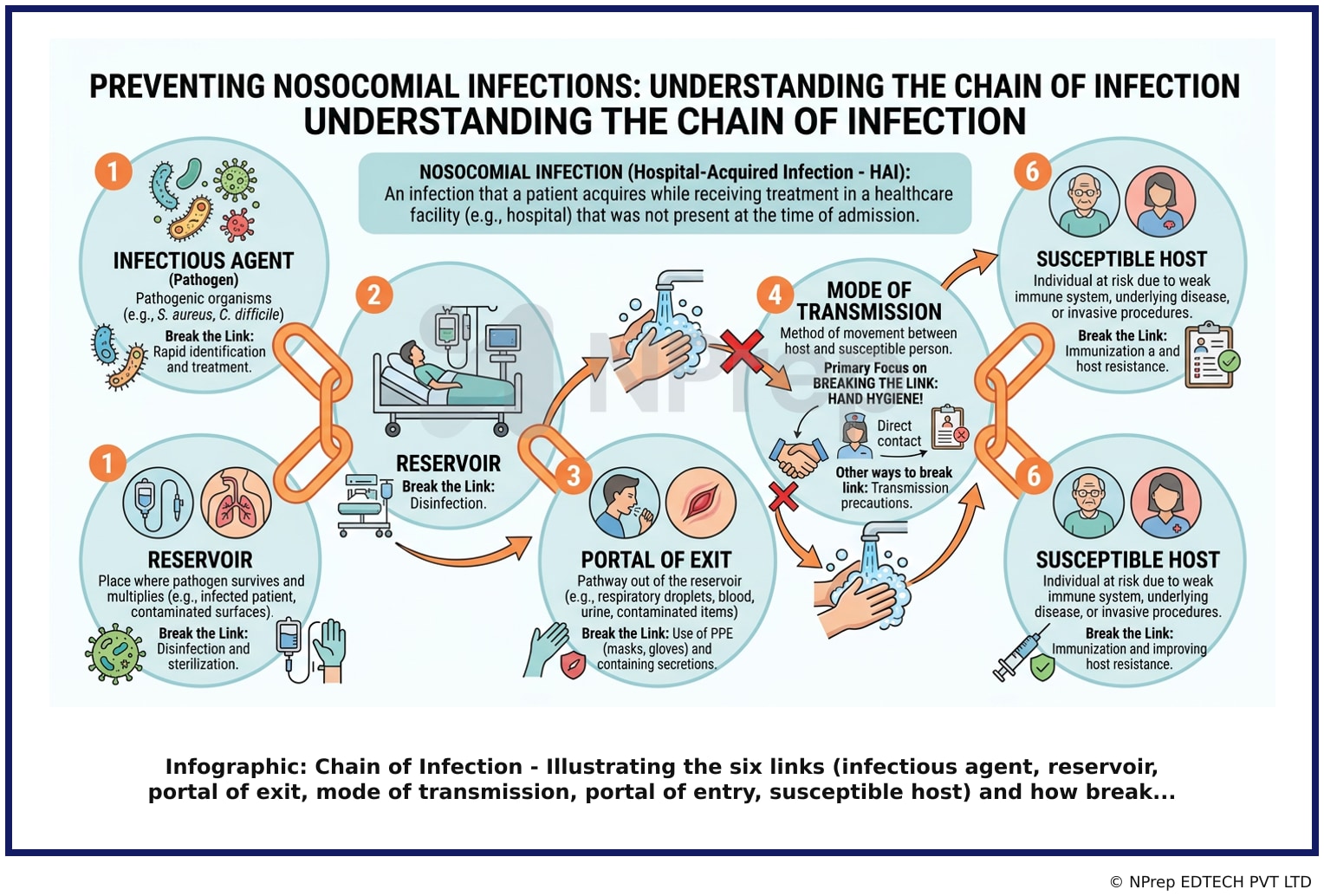
- Visual 1: Infographic: Chain of Infection - Illustrating the six links (infectious agent, reservoir, portal of exit, mode of transmission, portal of entry, susceptible host) and how breaking any link, such as with hand hygiene, can prevent nosocomial infections.
- Visual 2: Flowchart: Differentiating between Community-Acquired vs. Hospital-Acquired Infections - A simple decision tree based on the timing of symptom onset relative to hospital admission (less than 48 hours vs. greater than 48 hours).
Clinical Relevance
- Nursing practice connection: Knowing Definition and classification of nosocomial infections helps nurses interpret findings accurately and avoid errors in routine assessment, medication administration, and patient teaching.
- Preventing nosocomial infections is a primary patient safety goal and a key indicator of healthcare quality, directly impacting patient morbidity, mortality, and length of stay.
- Nurses are at the forefront of HAI prevention through meticulous adherence to infection control protocols like hand hygiene, aseptic techniques for procedures, and proper use of personal protective equipment (PPE).
- What if? If a patient develops symptoms of pneumonia within 24 hours of admission, it is classified as community-acquired pneumonia, not nosocomial, as the incubation period indicates the infection was present before arrival at the hospital.
How to Approach the Question
- Identify the core term in the question: 'Nosocomial infection'.
- Recognize this as a factual recall question that tests your knowledge of medical terminology.
- Analyze each option to see which one matches the definition of 'nosocomial'.
- Recall that the term originates from the Greek word for hospital ('nosokomeion'), directly linking it to a hospital setting.
- Systematically eliminate options that define other types of infections: animal source (zoonotic), mosquito bites (vector-borne), and home (community-acquired).
Concept Tested & Keywords
- Concept Tested: Definition and classification of nosocomial infections.
- Stem keywords: Nosocomial infection
- Lead-in keywords: Which is
Question ID
QlPpH6jOS3EzI4Lhbo5ysr
Practise the full RRB Nsg. Superintendent-20 July 2019 (Shift-3rd)
Attempt every question from this paper in a timed mock, then review the full solution for each one.
More Hospital-Acquired Infections Questions
- Nosocomial infections are also termed:
- What is the best method to prevent the spread of infection in the hospital?
- Most common late complication of central venous line or PICC?
- According to WHO, Surgical site infection is considered after how many days of surgery?
- Hospital-acquired infection is called?
- Infection that occurs as a result of a therapeutic or diagnostic procedure is called a/an?
- A Nosocomial infection is also known as:
- When a central venous catheter is not in use, how often should the catheter line be flushed to maintain its patency and prevent complications?
- A nurse is caring for a patient with a central line and notices the flush port has not been used in the last 24 hours. What is the most appropriate n…
- Nosocomial infections occur due to microbes known as:
More RRB Nsg. Superintendent-20 July 2019 (Shift-3rd) Questions
- Where is oxytocin synthesized?
- What is the name of the muscle that extends from the sphenoid bone to the mandible?
- Complementary feeding should be initiated at the completion of \ \ \ \ \ \
- Where is kidney located?
- Psychosocial development stage for infants is \ \ \ \ \ \ \ \ \ \
- What immunization is given at birth?
- Functional nursing is a method of providing
- Which disease is the dementia associated with asymmetric atrophy of the frontal and temporal lobes?
- Thromboangiitis obliterans is also known as
- What is the other name of pyridoxine?