
RRB Nsg. Superintendent-20 July 2019 (Shift-3rd)
Pharmacology
Easy
Which is the neurotransmitter responsible for sympathetic vasoconstriction?
Appeared in: RRB Nsg. Superintendent-20 July 2019 (Shift-3rd)
Explanation
- Norepinephrine is the principal neurotransmitter released by postganglionic neurons of the sympathetic nervous system.
- It acts on alpha-1 adrenergic receptors located on the smooth muscle of blood vessels.
- This binding causes smooth muscle contraction, leading to vasoconstriction and an increase in blood pressure.
- This mechanism is a core part of the body's 'fight-or-flight' response, helping to maintain perfusion to vital organs.
Why Other Options Were Wrong
- Option A: Angiotensin II is a potent vasoconstrictor, but it is a peptide hormone that is part of the renin-angiotensin-aldosterone system (RAAS), not a neurotransmitter released directly by sympathetic nerves.
- Option B: Epinephrine is primarily a hormone secreted by the adrenal medulla. While it can cause vasoconstriction by acting on alpha-1 receptors, it also strongly activates beta-2 receptors, which causes vasodilation in the blood vessels of skeletal muscles.
- Option D: Serotonin is a neurotransmitter mainly found in the central nervous system, platelets, and the gastrointestinal tract. While it can cause local vasoconstriction, especially to aid in blood clotting (hemostasis), it is not the primary neurotransmitter for systemic sympathetic vasoconstriction.
Related Visual
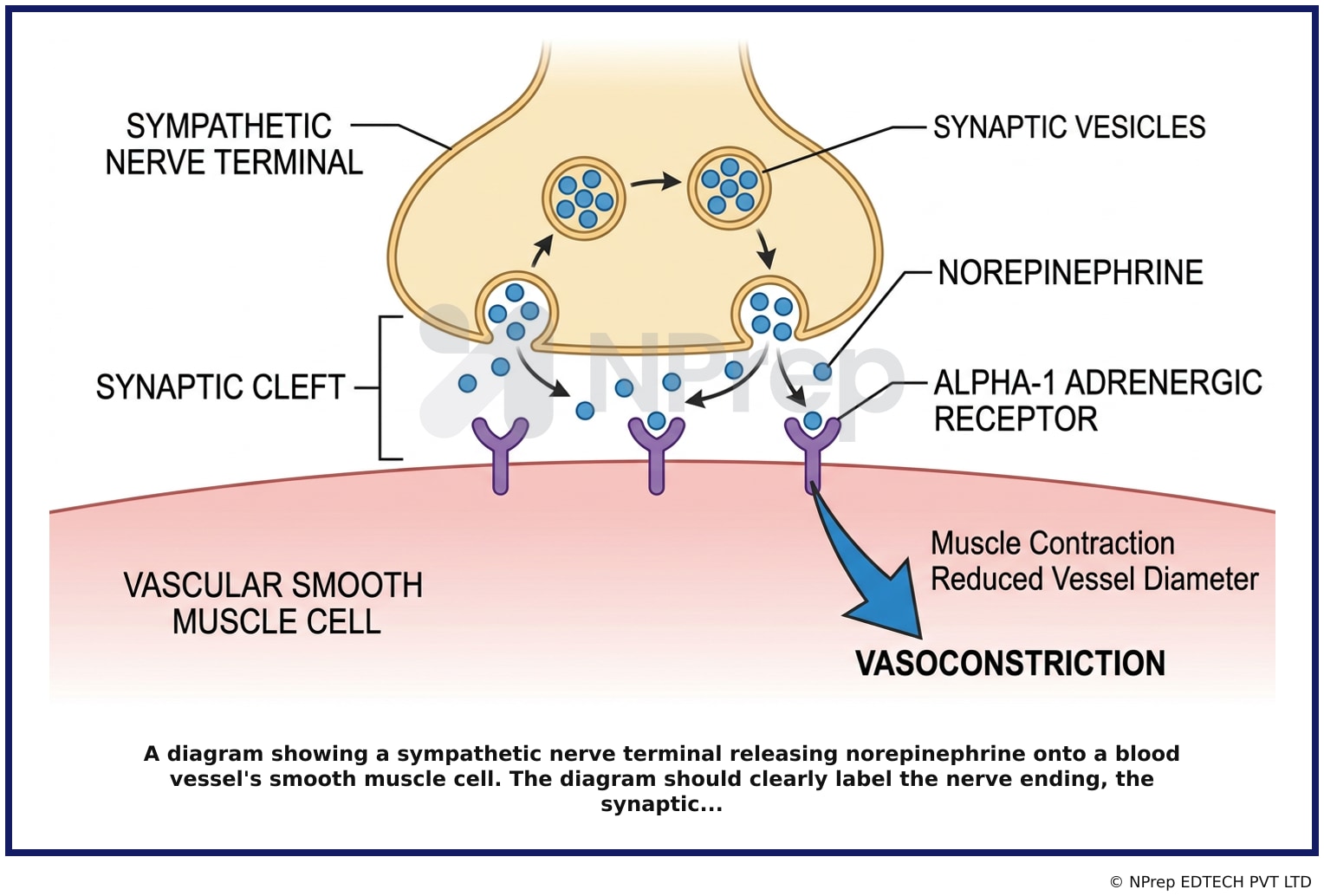
- Visual 1: Diagram - A diagram showing a sympathetic nerve terminal releasing norepinephrine onto a blood vessel's smooth muscle cell. The diagram should clearly label the nerve ending, the synaptic cleft, the norepinephrine molecules, and the alpha-1 adrenergic receptor on the muscle cell, with an arrow indicating the resulting vasoconstriction.
- Visual 2: Flowchart - A flowchart illustrating the sympathetic nervous system's effect on blood pressure. It would start with 'Sympathetic Activation', leading to 'Norepinephrine Release', then 'Binds to Alpha-1 Receptors', resulting in 'Vasoconstriction', and finally 'Increased Blood Pressure'.
Clinical Relevance
- Nursing practice connection: This is primarily an exam-oriented knowledge point with limited direct bedside application, so retain Autonomic Nervous System Pharmacology as background academic context rather than a clinical decision trigger.
- Understanding this mechanism is crucial for nurses, as many cardiovascular drugs target this pathway. For example, alpha-blockers like Prazosin are used to treat hypertension by blocking these alpha-1 receptors, preventing norepinephrine from causing vasoconstriction, thus lowering blood pressure.
- Nurses administering vasopressor medications, such as norepinephrine (Levophed), must continuously monitor the patient's blood pressure and assess for signs of peripheral ischemia, as excessive vasoconstriction can compromise circulation to the extremities.
- What if? If a patient is taking a non-selective beta-blocker (which blocks both beta-1 and beta-2 receptors) and experiences a situation causing a massive release of epinephrine (like an anaphylactic reaction or a pheochromocytoma crisis), the epinephrine can cause unopposed alpha-1 receptor stimulation. This leads to severe, widespread vasoconstriction and a dangerous hypertensive crisis, as the vasodilatory effect of beta-2 receptors is blocked.
How to Approach the Question
- First, identify the key terms in the question: 'neurotransmitter' and 'sympathetic vasoconstriction'. This directs you to the autonomic nervous system.
- Differentiate between a 'neurotransmitter' (released from nerve endings) and a 'hormone' (released into the bloodstream to act on distant targets). This helps to evaluate options like Angiotensin and Epinephrine.
- Recall the primary neurotransmitters of the autonomic nervous system. Acetylcholine is key for the parasympathetic system, while norepinephrine is key for the sympathetic system.
- Consider the specific action: 'vasoconstriction'. Evaluate each option's role in constricting blood vessels.
- Synthesize the information: Norepinephrine is the primary neurotransmitter of the sympathetic nervous system that causes vasoconstriction.
Concept Tested & Keywords
- Concept Tested: Autonomic Nervous System Pharmacology
- Stem keywords: neurotransmitter, sympathetic vasoconstriction
- Lead-in keywords: Which is
Question ID
QggtNm4MAm1inuY5qe1XkV
Practise the full RRB Nsg. Superintendent-20 July 2019 (Shift-3rd)
Attempt every question from this paper in a timed mock, then review the full solution for each one.
More Drugs acting on Autonomic Nervoys system Questions
- Recommended dose of adrenaline (epinephrine) used in pediatrics?
- Which of the following medication requires monitoring of blood glucose level which may cause glycogenolysis and insulin resistance?
- The drugs used to constrict the pupils are?
- Which of the following drugs is used for the dilation of pupil?
- The drug used to prevent aspiration and decrease the secretions is?
- Maximum dose of atropine can be given is?
- To decrease bradyarrhythmias in children during endotracheal intubation, Succinylcholine is given along with?
- Which drug has alpha-agonist effects and is used as a choice for treating anaphylaxis?
- What is the mechanism of action of pilocarpine in acute closed-angle glaucoma?
- This drug is used to?& x20;
More RRB Nsg. Superintendent-20 July 2019 (Shift-3rd) Questions
- Where is oxytocin synthesized?
- What is the name of the muscle that extends from the sphenoid bone to the mandible?
- Complementary feeding should be initiated at the completion of \ \ \ \ \ \
- Where is kidney located?
- Psychosocial development stage for infants is \ \ \ \ \ \ \ \ \ \
- What immunization is given at birth?
- Functional nursing is a method of providing
- Which disease is the dementia associated with asymmetric atrophy of the frontal and temporal lobes?
- Thromboangiitis obliterans is also known as
- What is the other name of pyridoxine?