
RRB Nsg. Superintendent-20 July 2019 (Shift-3rd)
Nursing Research & Statistics
Easy
Which is not a true experimental design?
Appeared in: RRB Nsg. Superintendent-20 July 2019 (Shift-3rd)
Explanation
- Exploratory designs are used for the preliminary investigation of a topic that is not well-defined or understood.
- They lack the three core components of a true experiment: manipulation of an independent variable, a control group, and random assignment of subjects.
- The primary goal of exploratory research is to generate hypotheses or gain initial insights, not to establish a definitive cause-and-effect relationship.
- Due to its unstructured and flexible nature, it is considered a non-experimental or pre-experimental design.
Why Other Options Were Wrong
- Option A: Factorial design is a type of true experimental design.
- Option B: Randomized block design is a type of true experimental design.
- Option D: Crossover design is a type of true experimental design.
Related Visual
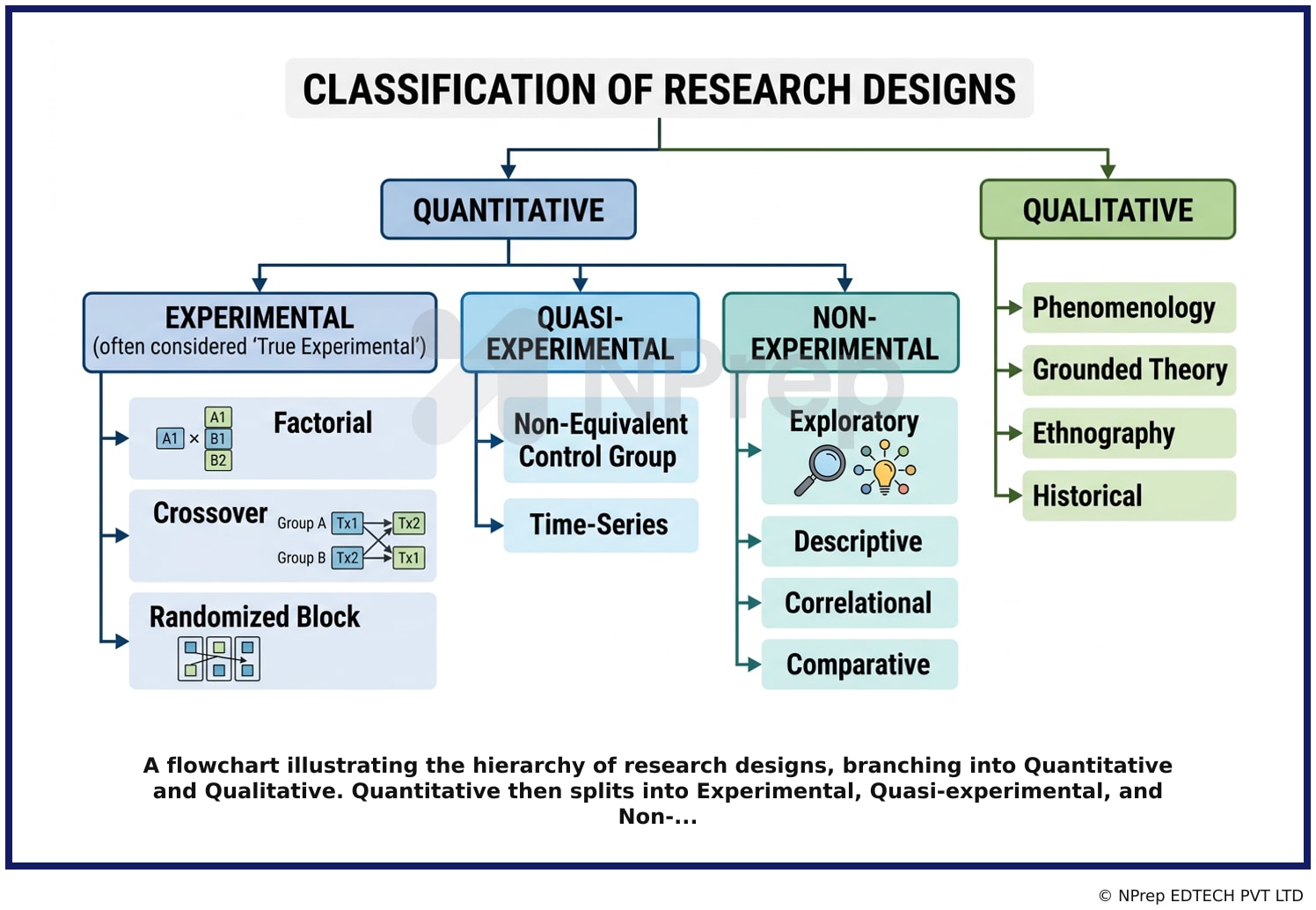
- Visual 1: Flowchart - A flowchart illustrating the hierarchy of research designs, branching into Quantitative and Qualitative. Quantitative then splits into Experimental, Quasi-experimental, and Non-experimental, with examples like 'Factorial' and 'Crossover' under Experimental, and 'Exploratory' under Non-experimental.
- Visual 2: Table - A comparison table highlighting the key differences between True-Experimental, Quasi-Experimental, and Exploratory designs based on criteria like Manipulation, Control, Randomization, and Research Goal.
Clinical Relevance
- Nursing practice connection: This is primarily an exam-oriented knowledge point with limited direct bedside application, so retain Classification of Research Designs as background academic context rather than a clinical decision trigger.
- Understanding the hierarchy of research designs is fundamental for nurses to practice evidence-based care. It allows them to critically appraise research articles and determine the strength and reliability of the evidence.
- A nurse reading a study based on an exploratory design would recognize that its findings are preliminary and should not be used to make significant changes in clinical practice without further, more rigorous research (like a Randomized Controlled Trial).
- What if? If a nurse is evaluating a new pressure ulcer prevention protocol, a study with a true experimental design (e.g., randomized block design controlling for patient mobility levels) provides much stronger evidence of effectiveness than an exploratory study that simply surveys nurses' opinions on the new protocol.
How to Approach the Question
- First, identify the negative keyword 'NOT' in the question. This signals that you must find the option that does not fit the specified category.
- Next, recall the defining characteristics of a 'true experimental design'. The three core principles are Manipulation, Control, and Randomization.
- Evaluate each option against these three principles.
- Factorial Design involves manipulating multiple variables and random assignment.
- Randomized Block Design explicitly uses randomization within controlled blocks.
- Crossover Design uses randomization to assign the order of treatments.
Concept Tested & Keywords
- Concept Tested: Classification of Research Designs
- Stem keywords: true experimental design
- Lead-in keywords: not
- Negative lead-in flag: The question asks to identify the option that is NOT a true experimental design.
Question ID
Q2NNn39JE-PjDWK4wdWURG
Practise the full RRB Nsg. Superintendent-20 July 2019 (Shift-3rd)
Attempt every question from this paper in a timed mock, then review the full solution for each one.
More Research Approaches and Designs Questions
- A true experimental design in research is characterized by the following properties; EXCEPT:
- Which variable is manipulated in experimental research?
- The research that is done to learn about cultural behaviour and cultural artifacts is called?
- Which of the following types of studies is an example of a qualitative research method?
- Data are collected at one point in time is known as?
- The relative risk of a disease can be obtained from:
- Cohort study is best described as:
- Which of the following is not true about case-control epidemiological studies?
- A researcher conducted a study to describe the lived experiences of care givers of patients with Dementia. Which type of qualitative study is conduct…
- The characteristic feature of experimental research design?
More RRB Nsg. Superintendent-20 July 2019 (Shift-3rd) Questions
- Where is oxytocin synthesized?
- What is the name of the muscle that extends from the sphenoid bone to the mandible?
- Complementary feeding should be initiated at the completion of \ \ \ \ \ \
- Where is kidney located?
- Psychosocial development stage for infants is \ \ \ \ \ \ \ \ \ \
- What immunization is given at birth?
- Functional nursing is a method of providing
- Which disease is the dementia associated with asymmetric atrophy of the frontal and temporal lobes?
- Thromboangiitis obliterans is also known as
- What is the other name of pyridoxine?