
RRB Nsg. Superintendent-20 July 2019 (Shift-3rd)
Applied Microbiology & Infection control
Easy
Which condition is identified by Ziehl-Neelsen technique?
Appeared in: RRB Nsg. Superintendent-20 July 2019 (Shift-3rd)
Explanation
- The Ziehl-Neelsen (ZN) stain is a specific type of differential stain known as an acid-fast stain.
- This technique is designed to identify bacteria with high mycolic acid content in their cell walls, which makes them resistant to decolorization by acids.
- Mycobacterium tuberculosis, the causative agent of Tuberculosis, is the primary example of an acid-fast bacillus.
- Therefore, the ZN technique is a cornerstone for the microscopic diagnosis of Tuberculosis, where the bacilli appear as red rods against a blue background.
Why Other Options Were Wrong
- Option A: Malaria is a parasitic disease caused by Plasmodium species. It is diagnosed by examining peripheral blood smears stained with Giemsa or Leishman stain, not the Ziehl-Neelsen stain.
- Option B: Syphilis is caused by the spirochete Treponema pallidum. This bacterium is too thin to be visualized by standard light microscopy, including ZN staining. It is typically identified using dark-field microscopy or serological tests.
- Option D: Typhoid fever is caused by Salmonella typhi, which is a Gram-negative bacterium. It is identified using Gram stain (where it appears pink) and confirmed with culture or serological tests like the Widal test, not the ZN stain.
Related Visual
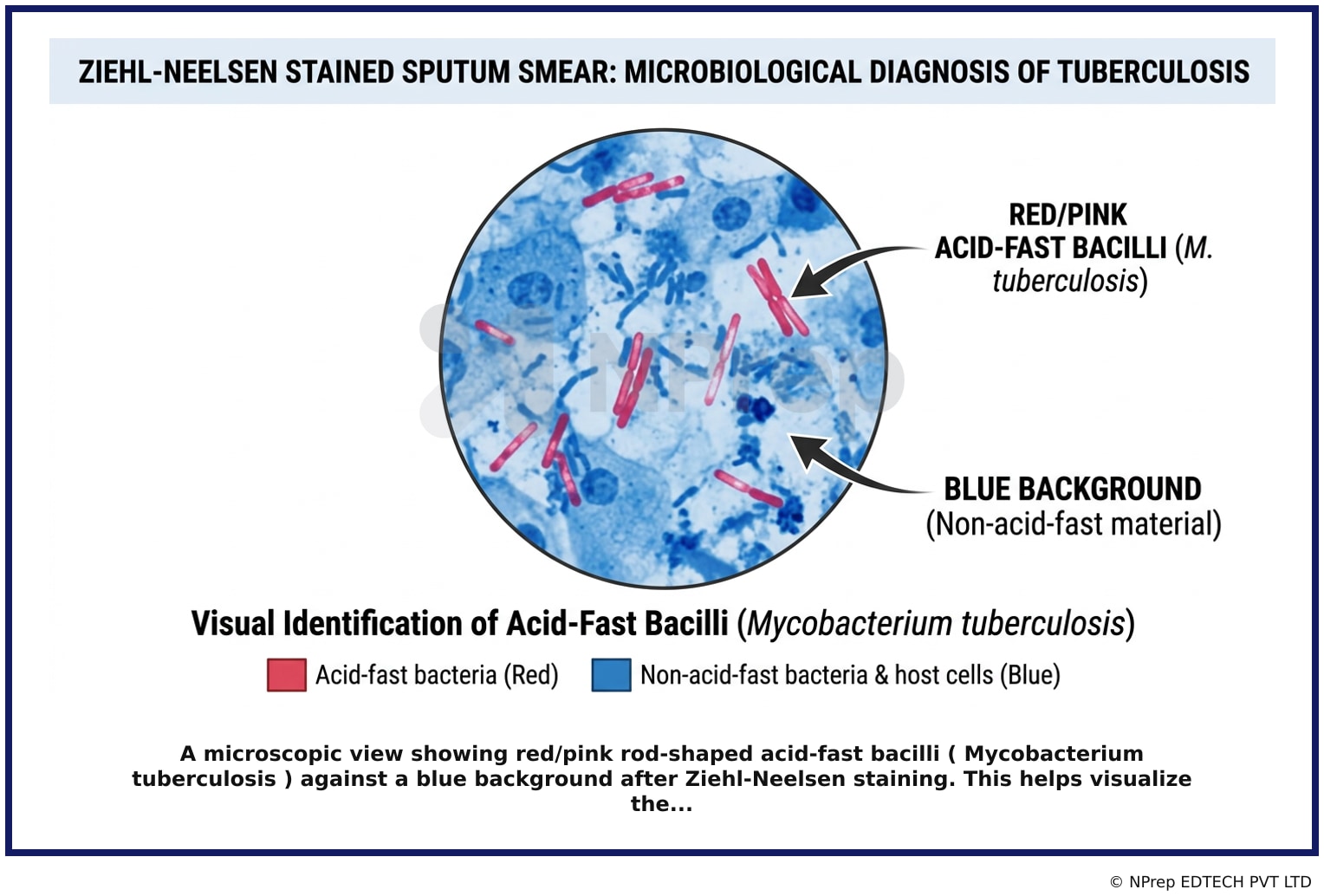
- Visual 1: Microscopic Image - A microscopic view showing red/pink rod-shaped acid-fast bacilli (Mycobacterium tuberculosis) against a blue background after Ziehl-Neelsen staining. This helps visualize the characteristic appearance.
- Visual 2: Flowchart - A step-by-step flowchart of the Ziehl-Neelsen staining procedure, from applying carbolfuchsin with heat, to decolorizing with acid-alcohol, and counterstaining with methylene blue.
Clinical Relevance
- Nursing practice connection: This is primarily an exam-oriented knowledge point with limited direct bedside application, so retain Diagnostic staining techniques in microbiology as background academic context rather than a clinical decision trigger.
- Prompt diagnosis of TB using ZN stain is crucial for initiating timely treatment and implementing infection control measures to prevent its spread, a major public health goal in India.
- A nurse may be responsible for collecting a quality sputum sample, ensuring it is from the lungs (not just saliva), and sending it to the lab promptly for ZN staining.
- What if? If a patient has symptoms of TB but the ZN stain is negative, the next step is not to rule out TB. Further investigations like a chest X-ray, CBNAAT/GeneXpert test, or culture are required, as the ZN stain can have low sensitivity in some cases (paucibacillary disease).
How to Approach the Question
- First, identify the core of the question, which is about a specific laboratory technique: 'Ziehl-Neelsen technique'.
- Recall or deduce the purpose of this technique. The name 'Ziehl-Neelsen' is strongly associated with 'acid-fast staining'.
- Connect the technique to the disease it diagnoses. Acid-fast staining is the primary method for identifying Mycobacterium, the causative agent of Tuberculosis.
- Evaluate the given options. Consider the causative agents and diagnostic methods for each.
- Eliminate the incorrect options. Malaria is a parasitic disease (diagnosed by blood smear), Syphilis is a spirochete (diagnosed by dark-field microscopy/serology), and Typhoid is a Gram-negative bacterium (diagnosed by Gram stain/culture). This leaves Tuberculosis as the only correct answer.
Concept Tested & Keywords
- Concept Tested: Diagnostic staining techniques in microbiology
- Stem keywords: Ziehl-Neelsen technique, condition, identified
- Lead-in keywords: Which
- Negative lead-in flag: false
Question ID
Q7ZItc9UQiNsgYVcsn8M7f
Practise the full RRB Nsg. Superintendent-20 July 2019 (Shift-3rd)
Attempt every question from this paper in a timed mock, then review the full solution for each one.
More General Characteristics of Microbes Questions
- Capacity of a microbe to cause disease is known as;-
- The organ of locomotion of bacteria:-
- What is the place within which microorganisms can thrive and reproduce?
- Which phase is maximum multiplication resulting in increased population of bacteria with reduced generation time?
- What is the correct sequence of the 'chain of infection'?
- The optimum temperature for the growth of the most pathogenic bacteria is?
- Rod-shaped bacteria are called?
- In laboratory cultures, most human pathogens grow best at?
- Causative agent of bacterial endocarditis?
- Which of the following kingdoms has a prokaryotic cell type?
More RRB Nsg. Superintendent-20 July 2019 (Shift-3rd) Questions
- Where is oxytocin synthesized?
- What is the name of the muscle that extends from the sphenoid bone to the mandible?
- Complementary feeding should be initiated at the completion of \ \ \ \ \ \
- Where is kidney located?
- Psychosocial development stage for infants is \ \ \ \ \ \ \ \ \ \
- What immunization is given at birth?
- Functional nursing is a method of providing
- Which disease is the dementia associated with asymmetric atrophy of the frontal and temporal lobes?
- Thromboangiitis obliterans is also known as
- What is the other name of pyridoxine?