
MP NHM CHO-2024 (Shift-2)
Child Health Nursing (Pediatrics)
Easy
What is the recommended period for exclusive breast feeding by WHO ?
Appeared in: MP NHM CHO-2024 (Shift-2)
Explanation
- The World Health Organization (WHO), supported by major pediatric and obstetric bodies, recommends exclusive breastfeeding for the first 6 months of life.
- For the first six months, breast milk provides all the energy and nutrients an infant needs for optimal growth and development.
- Breast milk contains crucial antibodies (like secretory IgA) that protect the infant from common illnesses such as diarrhea, respiratory infections, and necrotizing enterocolitis.
- This practice is associated with long-term health benefits for both the child (higher intelligence scores) and the mother (lower risk of breast and ovarian cancer).
Why Other Options Were Wrong
- Option A: Stopping exclusive breastfeeding at 3 months is too early. The infant's digestive and immune systems are not yet fully mature.
- Option C: This is incorrect for exclusive breastfeeding. An infant's nutritional needs, especially for iron and zinc, cannot be met by breast milk alone after 6 months.
- Option D: Delaying the introduction of complementary foods until 8 months can lead to nutritional deficiencies and may slow the infant's growth.
Related Visual
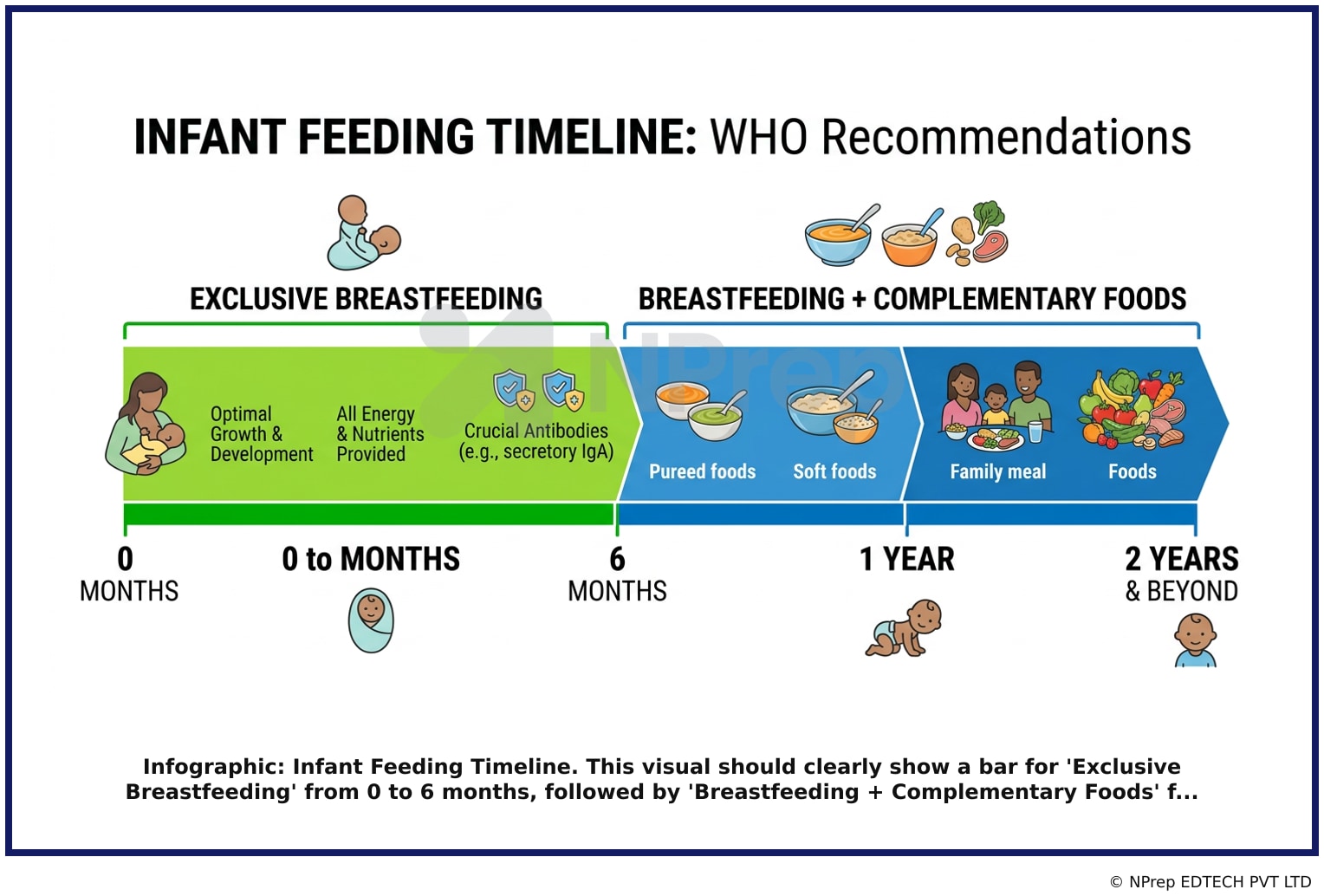
- Visual 1: Infographic: Infant Feeding Timeline. This visual should clearly show a bar for 'Exclusive Breastfeeding' from 0 to 6 months, followed by 'Breastfeeding + Complementary Foods' from 6 months to 2 years and beyond.
Clinical Relevance
- Nursing practice connection: This is primarily an exam-oriented knowledge point with limited direct bedside application, so retain WHO recommendation for exclusive breastfeeding duration as background academic context rather than a clinical decision trigger.
- Nurses are central to lactation support. They educate mothers on the benefits of exclusive breastfeeding, teach proper latching techniques to prevent nipple fissures, and help manage common challenges to promote successful breastfeeding.
- Nurses must be able to identify contraindications to breastfeeding, such as maternal HIV infection (in high-income countries), active untreated tuberculosis, or use of certain cytotoxic medications.
- What if? If a mother is unable to breastfeed or her milk supply is insufficient, the nurse's role is to provide education on safe and appropriate alternatives, such as properly prepared formula, while ensuring the mother does not feel guilt or failure.
How to Approach the Question
- Identify the keywords in the question: 'recommended period', 'exclusive breast feeding', and 'WHO'. This points to a question asking for a specific public health guideline.
- Recognize this as a factual recall question based on international health standards.
- Recall the globally recognized recommendation for the duration of exclusive breastfeeding.
- Evaluate the options. '6 months' is the standard recommendation.
- Distinguish between 'exclusive breastfeeding' (only breast milk) and 'continued breastfeeding' (breast milk plus other foods) to correctly eliminate longer durations like '1 year'.
Concept Tested & Keywords
- Concept Tested: WHO recommendation for exclusive breastfeeding duration.
- Stem keywords: exclusive breast feeding, WHO, recommended period
- Lead-in keywords: What is
- Negative lead-in flag: false
Question ID
Q-rC7s0-dwqsTvisVlee0j
Practise the full MP NHM CHO-2024 (Shift-2)
Attempt every question from this paper in a timed mock, then review the full solution for each one.
More Nutrition Questions
- Select the related word from the given alternatives: Autotroph: Producer::?: Consumer
- Which of the following is NOT assimilated by eukaryotic cells?
- Which of the following journal helps in keeping a daily or weekly log (details) of food and beverage intake as well as time spent watching television…
- Which of the following is not a cause of cavities in teeth?
- Foods and fluids high in caffeine to discourage intake are?
- Constipation can be prevented by?
- When one or more nutrients are added to the food, it is known as?
- All the food items cause color to the urine EXCEPT?
- Breast milk can be stored at room temperature safely for hours.
- When aiming for yield improvement, why is it important to select crop varieties suited to the local climate?
More MP NHM CHO-2024 (Shift-2) Questions
- \ \ \ \ \ \ fluid represents the 2/3 of Total Body Weight.
- The \ \ \ \ cavity contains the urinary bladder, uterus/ prostate and rectum.
- Where are lymphocytes formed?
- During muscle relaxation, the \ \ \ \ covers the active site on actin.
- Which of the following occurs when small defects in the muscle of the wall of the large intestine or colon allow small pockets or pouches to form?
- Which of the following body system is primarily responsible for maintaining homeostasis?
- How much time does a heartbeat last?
- Which equation is correct for stroke volume (SV)?
- \ \ \ \ type of nephrons have short loops of Henle that do not dip far beyond the cortex.
- What does the ciliary body in the eye do?