
RRB Nsg. Superintendent-20 July 2019 (Shift-3rd)
Medical Surgical Nursing
Easy
What is the positive sign that can be seen in deep vein thrombosis?
Appeared in: RRB Nsg. Superintendent-20 July 2019 (Shift-3rd)
Explanation
- Homan's sign is a classic physical assessment finding associated with Deep Vein Thrombosis (DVT).
- The sign is elicited by passive, abrupt dorsiflexion of the patient's foot with the knee extended.
- Pain in the calf or popliteal region upon this maneuver constitutes a positive Homan's sign.
- It is caused by the stretching of the posterior tibial nerve, which is irritated by the inflamed, thrombosed vein.
- However, it is important to note that this sign is considered unreliable, with low sensitivity and specificity, and is not recommended for routine assessment in modern practice.
Why Other Options Were Wrong
- Option B: Jacquemier's sign is related to pregnancy, not DVT. It is the bluish discoloration of the vaginal mucosa due to increased blood flow.
- Option C: Kernig's sign is a test for meningeal irritation, a hallmark of meningitis, not DVT.
- Option D: Hegar's sign is a probable sign of pregnancy, not DVT. It refers to the softening of the lower uterine segment.
Related Visual
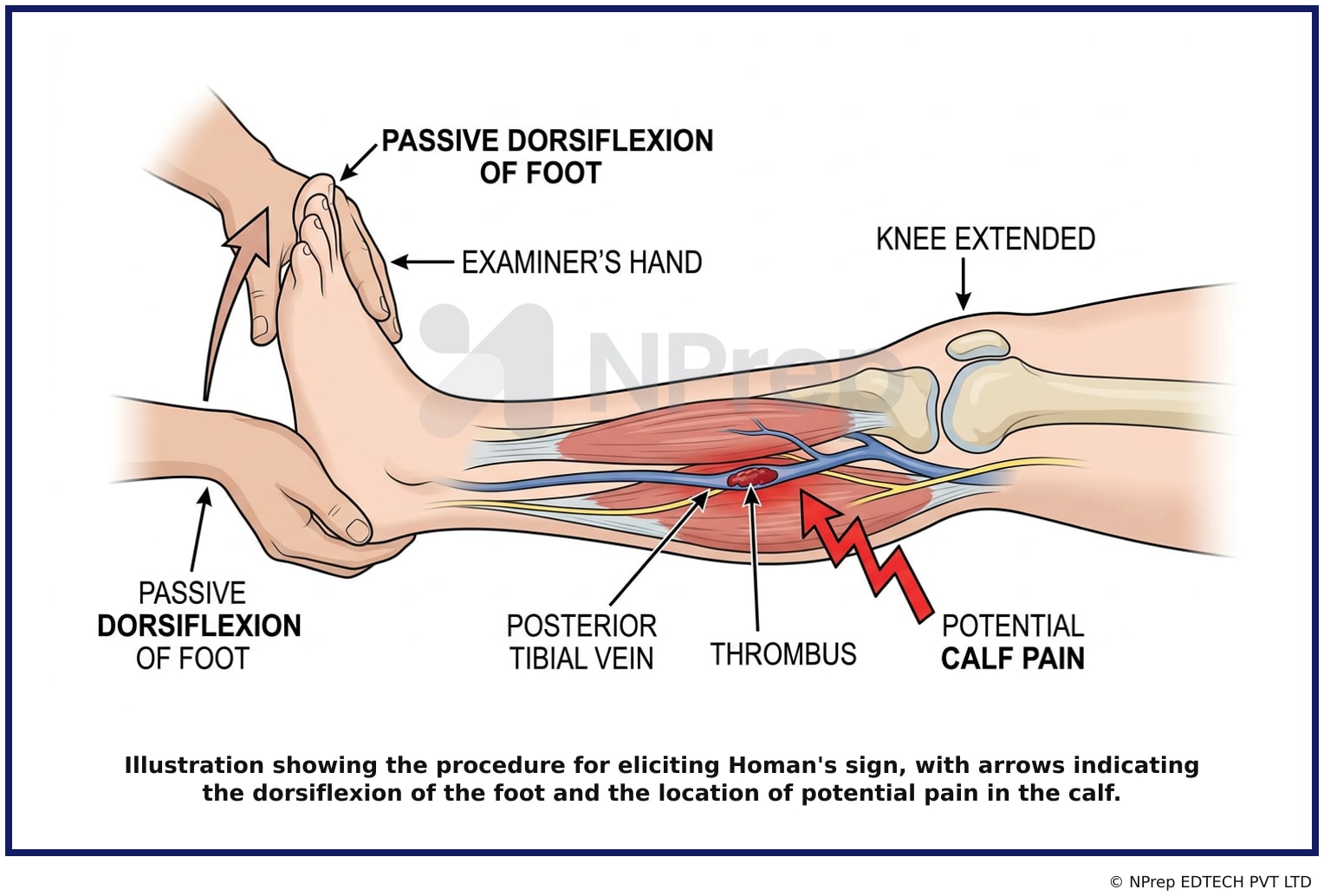
- Visual 1: Diagram - Illustration showing the procedure for eliciting Homan's sign, with arrows indicating the dorsiflexion of the foot and the location of potential pain in the calf.
- Visual 2: Diagram - Illustration of Kernig's sign, showing the patient supine with hip and knee flexed, and the painful resistance upon attempting to extend the knee.
- Visual 3: Table - A comparative table of presumptive, probable, and positive signs of pregnancy, listing Jacquemier's and Hegar's signs under the appropriate categories.
Clinical Relevance
- Nursing practice connection: This is primarily an exam-oriented knowledge point with limited direct bedside application, so retain Clinical assessment for Deep Vein Thrombosis (DVT) as background academic context rather than a clinical decision trigger.
- Recognizing the signs and symptoms of DVT is a critical nursing skill, as it is a potentially life-threatening condition that can lead to pulmonary embolism.
- Nurses must understand that Homan's sign is an unreliable indicator and should perform a comprehensive lower extremity assessment, looking for unilateral edema (especially a difference in calf circumference), erythema, warmth, and tenderness.
- Definitive diagnosis of DVT requires imaging studies, most commonly a venous Doppler ultrasound. A nurse's prompt reporting of suspicion is key to timely diagnosis and treatment.
How to Approach the Question
- First, identify the key concept in the question stem: 'deep vein thrombosis' (DVT).
- The question asks for a 'positive sign' associated with this condition.
- Review the options provided and recall the clinical signs associated with each term.
- Homan's sign is classically taught as a sign for DVT.
- Jacquemier's and Hegar's signs are related to pregnancy.
- Kernig's sign is related to meningitis.
Concept Tested & Keywords
- Concept Tested: Clinical assessment for Deep Vein Thrombosis (DVT)
- Stem keywords: deep vein thrombosis, positive sign
- Lead-in keywords: What is
Question ID
QykJeLPTTbxeRZyA2WoUgs
Practise the full RRB Nsg. Superintendent-20 July 2019 (Shift-3rd)
Attempt every question from this paper in a timed mock, then review the full solution for each one.
More Deep Vein Thrombosis Questions
- Pain felt in calf muscles when the foot is dorsiflexed with the leg extended at the knee is called as?
- While caring for a patient with DVT, which among the following is most suitable?
- The most important risk of deep vein thrombosis (DVT) is?
- Which one of the following interventions should be avoided by the nurse while caring for a client with deep vein thrombosis?
More RRB Nsg. Superintendent-20 July 2019 (Shift-3rd) Questions
- Where is oxytocin synthesized?
- What is the name of the muscle that extends from the sphenoid bone to the mandible?
- Complementary feeding should be initiated at the completion of \ \ \ \ \ \
- Where is kidney located?
- Psychosocial development stage for infants is \ \ \ \ \ \ \ \ \ \
- What immunization is given at birth?
- Functional nursing is a method of providing
- Which disease is the dementia associated with asymmetric atrophy of the frontal and temporal lobes?
- Thromboangiitis obliterans is also known as
- What is the other name of pyridoxine?