
KGMU 2023
Nursing Foundation
Easy
What is the best method for collecting a urine sample for a culture and sensitivity test?
Appeared in: KGMU 2023
Explanation
- The mid-stream clean-catch method is the gold standard for obtaining a urine sample for culture and sensitivity, as it is designed to be as free from contamination as possible.
- This technique involves discarding the initial part of the urine stream, which flushes away normal flora from the distal urethra and surrounding skin.
- Collecting the middle portion of the void provides a specimen that is most representative of the urine in the bladder, where the potential infection resides, leading to more accurate diagnostic results.
Why Other Options Were Wrong
- Option B: The first stream of urine is contaminated with bacteria and cells from the outer portion of the urethra and surrounding skin, which would lead to an inaccurate culture result.
- Option C: This is not a standard or recommended method for any specific diagnostic test. It does not offer the contamination-reducing benefits of the mid-stream technique and provides no unique diagnostic value.
- Option D: This method is used for quantitative analysis of substances excreted over a full day, such as hormones, proteins, or for creatinine clearance tests. The collection is not sterile, making it unsuitable for bacterial culture.
Related Visual
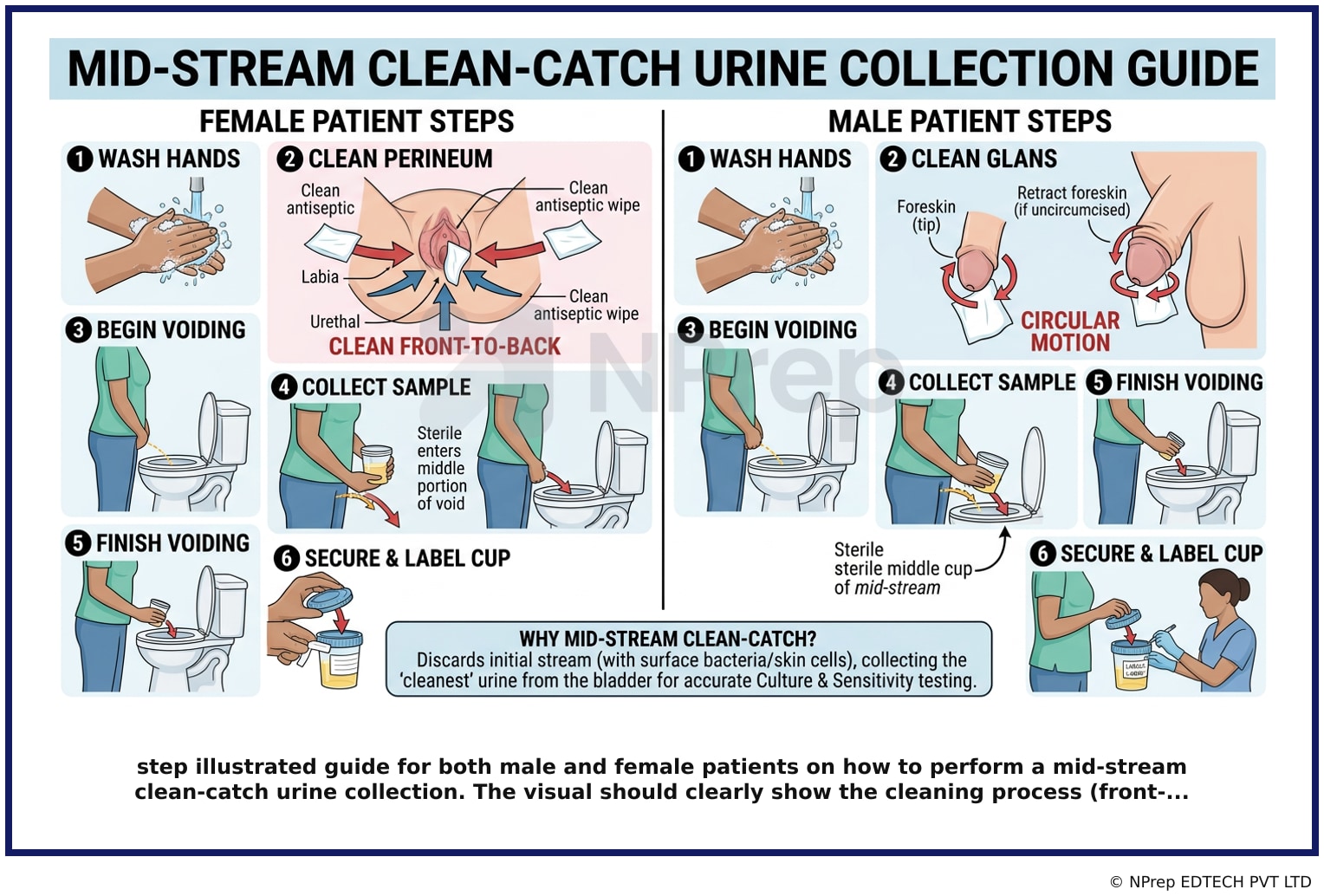
- Visual 1: Infographic - A step-by-step illustrated guide for both male and female patients on how to perform a mid-stream clean-catch urine collection. The visual should clearly show the cleaning process (front-to-back for females, circular for males) and the sequence of voiding, collecting, and finishing the void.
Clinical Relevance
- Nursing practice connection: This is primarily an exam-oriented knowledge point with limited direct bedside application, so retain Urine specimen collection for culture and sensitivity as background academic context rather than a clinical decision trigger.
- Obtaining a proper urine specimen is a critical nursing skill to ensure the accurate diagnosis of Urinary Tract Infections (UTIs) and guide appropriate antibiotic therapy, preventing treatment failure or the use of overly broad antibiotics.
- A contaminated sample can lead to a false-positive result, potentially causing unnecessary antibiotic administration, which contributes to patient side effects and the broader problem of antibiotic resistance.
- Patient education is paramount. A well-instructed patient is the key to obtaining a high-quality specimen and avoiding the need for a repeat collection or more invasive procedures.
How to Approach the Question
- First, identify the core of the question: it asks for the 'best method' for a specific laboratory test, 'culture and sensitivity'.
- Recall the purpose of a culture and sensitivity (C&S) test: to identify pathogenic bacteria causing an infection. This requires a sample that is as sterile and uncontaminated as possible.
- Evaluate each option based on the principle of minimizing contamination. 'First stream' would be contaminated by definition. '24-hour' collection is for measuring quantity over time and is not a sterile procedure. 'Last stream' is not a standard technique.
- Conclude that 'mid-stream clean-catch' is the only method specifically designed to reduce contamination by using the initial stream to flush the urethra before collecting the more representative sample from the middle of the void.
Concept Tested & Keywords
- Concept Tested: Urine specimen collection for culture and sensitivity
- Stem keywords: urine sample, culture and sensitivity test
- Lead-in keywords: best method
Question ID
QbuAM6wK8QMyj3g8eRoQ4u
Practise the full KGMU 2023
Attempt every question from this paper in a timed mock, then review the full solution for each one.
More Diagnostic testing Questions
- What is the minimum amount of urine that must be collected for a culture and sensitivity urine specimen for a 48 year old patient?
- The physician ordered a 24 hours urine specimen, on duty nurse collects the first specimen after explaining the procedure to the patient, This specim…
- Which of the following chart/instrument is used for Distance vision Assessment?
- A nurse teaches the client to collect urine specimen for bacterial infection includes?
- Otoscope is used to visualize?
- Which instrument is used to check RBS?
- External auditory canal can be straightened most appropriately in adults by pulling the pinna?
- Best time to collect sputum specimen is?
- Collection of urine sample for culture and sensitivity test should be done from?
- When a patient is getting shifted from the ward for a CT Scan, a nurse should do?
More KGMU 2023 Questions
- The teacher scalded Aruna in front of her classmates during Project submission. Conclusion I: Aruna was not as popular as her other classmates. Concl…
- Aruna leaves and goes 8 meters in the North direction from a certain point. Then she turns right and travels for 12 meters. She again turns right and…
- Kiran is Sister of Raj. Raj is Son of Suresh and Vinita is Mother of Suresh then what is relation between Vinita and Kiran?
- A person who lives at the same time with another?
- Select the most appropriate meaning of the below idiom. A black sheep?
- The train has arrived...the station.
- A vendor sold 20 kg of potato at 18 Rs. per kg. He bought 2-liter milk at the rate of 46 Rs./liter, 2 kg sugar at the rate of 35 Rs./kg and 10 packet…
- Which one is the perfect square?
- A is the smallest. C is taller than B and D. E is neither the tallest nor the smallest. Find which one is the tallest?
- From an entrance, a person walks 28 meters left, then turns right and walks 13 meters. They turn right again and walk 12 meters, and then walk 16 met…