
KGMU 2023
Applied Physiology
Easy
What is normal tidal volume?
Appeared in: KGMU 2023
Explanation
- Tidal Volume (TV) is the amount of air that moves in or out of the lungs with each respiratory cycle during quiet breathing.
- In a healthy 70-kg adult, the normal tidal volume is approximately 500 mL.
- This volume ensures adequate oxygenation and carbon dioxide removal at rest without excessive physiological effort.
Why Other Options Were Wrong
- Option B: 1500 mL does not correspond to a standard primary lung volume.
- Option C: 4500 mL is a lung capacity, not a volume. It is close to the Vital Capacity (VC).
- Option D: 1200 mL represents the Residual Volume (RV).
Related Visual
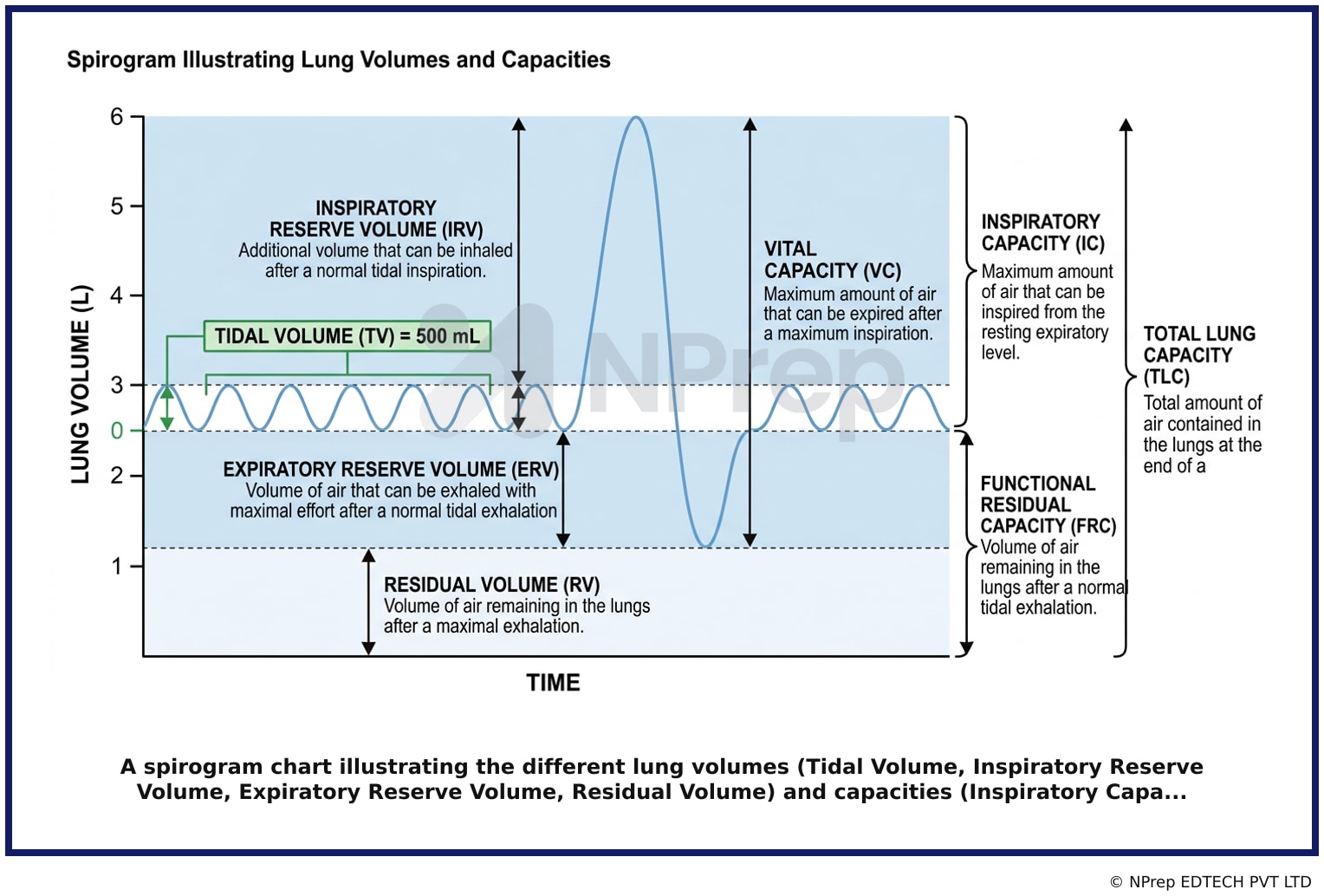
- Visual 1: Diagram - A spirogram chart illustrating the different lung volumes (Tidal Volume, Inspiratory Reserve Volume, Expiratory Reserve Volume, Residual Volume) and capacities (Inspiratory Capacity, Functional Residual Capacity, Vital Capacity, Total Lung Capacity). This visual helps to contextualize tidal volume in relation to other respiratory measurements.
Clinical Relevance
- Nursing practice connection: This is primarily an exam-oriented knowledge point with limited direct bedside application, so retain This question tests the knowledge of normal pulmonary lung volumes, specifically the tidal volume as background academic context rather than a clinical decision trigger.
- Understanding tidal volume is critical for nurses, especially in critical care, for setting parameters on mechanical ventilators. Incorrect settings can lead to lung injury (volutrauma or barotrauma).
- Tidal volume is a key parameter in assessing a patient's respiratory status, work of breathing, and response to respiratory therapies.
- What if? If a patient has a restrictive lung disease like pulmonary fibrosis, their tidal volume would likely be significantly decreased. To compensate and maintain adequate minute ventilation (Tidal Volume x Respiratory Rate), the patient would need to breathe at a faster rate (tachypnea).
How to Approach the Question
- This is a factual recall question testing knowledge of basic respiratory physiology.
- First, identify the term 'tidal volume' and recall its definition: the volume of air moved during normal, quiet breathing.
- Recall the standard value for an average adult, which is 500 mL.
- To confirm the answer, mentally review other lung volumes. Recognize that 1200 mL is the approximate residual volume and 4500 mL is close to vital capacity, which helps in eliminating these as incorrect options.
Concept Tested & Keywords
- Concept Tested: This question tests the knowledge of normal pulmonary lung volumes, specifically the tidal volume.
- Stem keywords: normal tidal volume
- Lead-in keywords: What is
Question ID
Q7iwon4dNMW5rB7PL8issn
Practise the full KGMU 2023
Attempt every question from this paper in a timed mock, then review the full solution for each one.
More Respiratory system Questions
- Temporary cessation of breathing is:
- Functions of bartholin's glands?
- An example of an aerobic exercise is:
- The volume of air normally inhaled and exhaled with each regular breath is called:
- The Lung Volume / Capacity that does not change with pulmonary disease is:
- What is the approximate maximum air volume in the lung for a normal healthy adult?
- Lack of oxygen in the blood stream is called?
- Breathing that is normal in rate and depth is called?
- Isotonic exercises such as walking are intended to?
- Muscle of inspiration is?
More KGMU 2023 Questions
- The teacher scalded Aruna in front of her classmates during Project submission. Conclusion I: Aruna was not as popular as her other classmates. Concl…
- Aruna leaves and goes 8 meters in the North direction from a certain point. Then she turns right and travels for 12 meters. She again turns right and…
- Kiran is Sister of Raj. Raj is Son of Suresh and Vinita is Mother of Suresh then what is relation between Vinita and Kiran?
- A person who lives at the same time with another?
- Select the most appropriate meaning of the below idiom. A black sheep?
- The train has arrived...the station.
- A vendor sold 20 kg of potato at 18 Rs. per kg. He bought 2-liter milk at the rate of 46 Rs./liter, 2 kg sugar at the rate of 35 Rs./kg and 10 packet…
- Which one is the perfect square?
- A is the smallest. C is taller than B and D. E is neither the tallest nor the smallest. Find which one is the tallest?
- From an entrance, a person walks 28 meters left, then turns right and walks 13 meters. They turn right again and walk 12 meters, and then walk 16 met…