
RRB Nsg. Superintendent-20 July 2019 (Shift-3rd)
Mental Health Nursing
Easy
What is an affective disorder?
Appeared in: RRB Nsg. Superintendent-20 July 2019 (Shift-3rd)
Explanation
- Affective disorders, also known as mood disorders, are primarily characterized by a pathological disturbance in the patient's mood.
- Bipolar disorder is a classic example of an affective disorder, defined by its characteristic extreme mood swings between two poles: mania (elevated mood) and depression (low mood).
- The core feature of Bipolar disorder is the pathological shift in mood, which directly fits the definition of an affective disorder.
Why Other Options Were Wrong
- Option A: This is an anxiety disorder, not a mood disorder. Its primary feature is an intense, irrational fear of a specific object or situation.
- Option C: This is a somatic symptom disorder. It is characterized by physical symptoms that cause significant distress but lack a clear medical explanation, which is different from a primary mood disturbance.
- Option D: This is a psychotic disorder. It is primarily characterized by disturbances in thought, perception, and behavior (e.g., hallucinations, delusions), not a primary disturbance of mood.
Related Visual
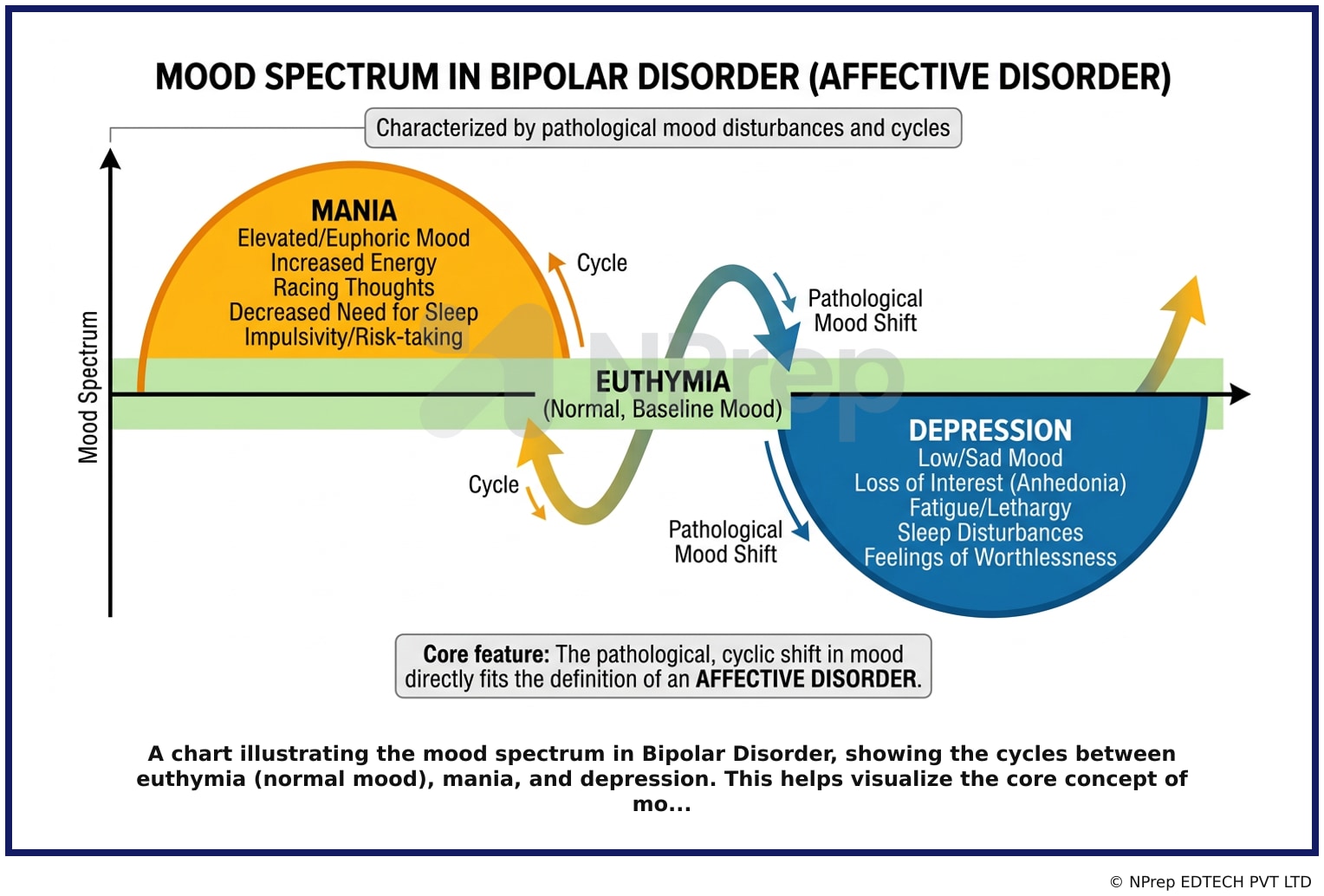
- Visual 1: Chart - A chart illustrating the mood spectrum in Bipolar Disorder, showing the cycles between euthymia (normal mood), mania, and depression. This helps visualize the core concept of mood swings.
Clinical Relevance
- Nursing practice connection: This is primarily an exam-oriented knowledge point with limited direct bedside application, so retain Classification of Affective (Mood) Disorders as background academic context rather than a clinical decision trigger.
- Correctly identifying a patient's condition as an affective disorder is crucial for initiating the right treatment; for instance, using mood stabilizers like lithium for bipolar disorder versus antipsychotics for schizophrenia.
- Nurses play a key role in monitoring for mood shifts, assessing suicide risk during depressive phases, and managing impulsive behaviors during manic phases to ensure patient safety.
- What if? If a patient presents with delusions and hallucinations that are consistent with their mood (e.g., grandiose delusions during mania), it is termed 'mood-congruent psychotic features' and is still part of the bipolar diagnosis, unlike schizophrenia where psychosis is the primary and defining feature.
How to Approach the Question
- First, understand the question's core concept: 'affective disorder'. Recall or deduce that this is another term for 'mood disorder'.
- Next, analyze each option based on its primary, defining characteristic.
- Evaluate Option A: Phobic anxiety disorder is defined by 'fear,' which is a hallmark of anxiety disorders.
- Evaluate Option B: Bipolar disorder is defined by extreme shifts in 'mood' (mania and depression).
- Evaluate Option C: Somatoform disorder is defined by 'physical symptoms' without a medical cause.
- Evaluate Option D: Schizophrenia is defined by 'thought and perception disturbances' (psychosis).
Concept Tested & Keywords
- Concept Tested: Classification of Affective (Mood) Disorders
- Stem keywords: affective disorder
- Lead-in keywords: What is
- Negative lead-in flag: false
Question ID
QLUvyWxqKtKK9cYWvv80Cm
Practise the full RRB Nsg. Superintendent-20 July 2019 (Shift-3rd)
Attempt every question from this paper in a timed mock, then review the full solution for each one.
More Mood disorders Questions
- The most significant characteristic experienced by a patient with depression is:
- Depression is characterized by all, except?
- Goal-oriented psychomotor activity which is based on environmental cues is a feature of?
- Which is most appropriate nursing action for a 32 years female patient diagnosed with bipolar affective disorder
- One of the following is classified under disorders of affect:
- Suicidal risk is common to all types of depressive patients. However, the higher risk can be found in which of the following situations?
More RRB Nsg. Superintendent-20 July 2019 (Shift-3rd) Questions
- Where is oxytocin synthesized?
- What is the name of the muscle that extends from the sphenoid bone to the mandible?
- Complementary feeding should be initiated at the completion of \ \ \ \ \ \
- Where is kidney located?
- Psychosocial development stage for infants is \ \ \ \ \ \ \ \ \ \
- What immunization is given at birth?
- Functional nursing is a method of providing
- Which disease is the dementia associated with asymmetric atrophy of the frontal and temporal lobes?
- Thromboangiitis obliterans is also known as
- What is the other name of pyridoxine?