
AIIMS CRE 2025
Medical Surgical Nursing
Easy
What does a high viral load in an HIV-positive patient indicate?
Appeared in: AIIMS CRE 2025
Explanation
- A high viral load signifies that the Human Immunodeficiency Virus (HIV) is replicating actively and uncontrollably within the body.
- This rapid multiplication leads to the progressive destruction of CD4+ T cells, which are essential components of the immune system.
- The level of steady-state viremia (viral load) has significant prognostic value; a higher viral load is directly correlated with a faster rate of disease progression to Acquired Immunodeficiency Syndrome (AIDS).
- Therefore, a high viral load is a key marker of a poor prognosis, indicating that the infection is advancing and the immune system is being severely compromised.
Why Other Options Were Wrong
- Option A: An effective ART response is defined by the suppression of the viral load to low or undetectable levels, which is the primary goal of treatment.
- Option C: Immune recovery is characterized by a rising CD4+ T cell count and a suppressed viral load. A high viral load indicates ongoing immune destruction, not recovery.
- Option D: A latent infection (clinical latency) is characterized by very low levels of viral replication, although the virus is still present. A high viral load signifies a highly active, not latent, infectious state.
Related Visual
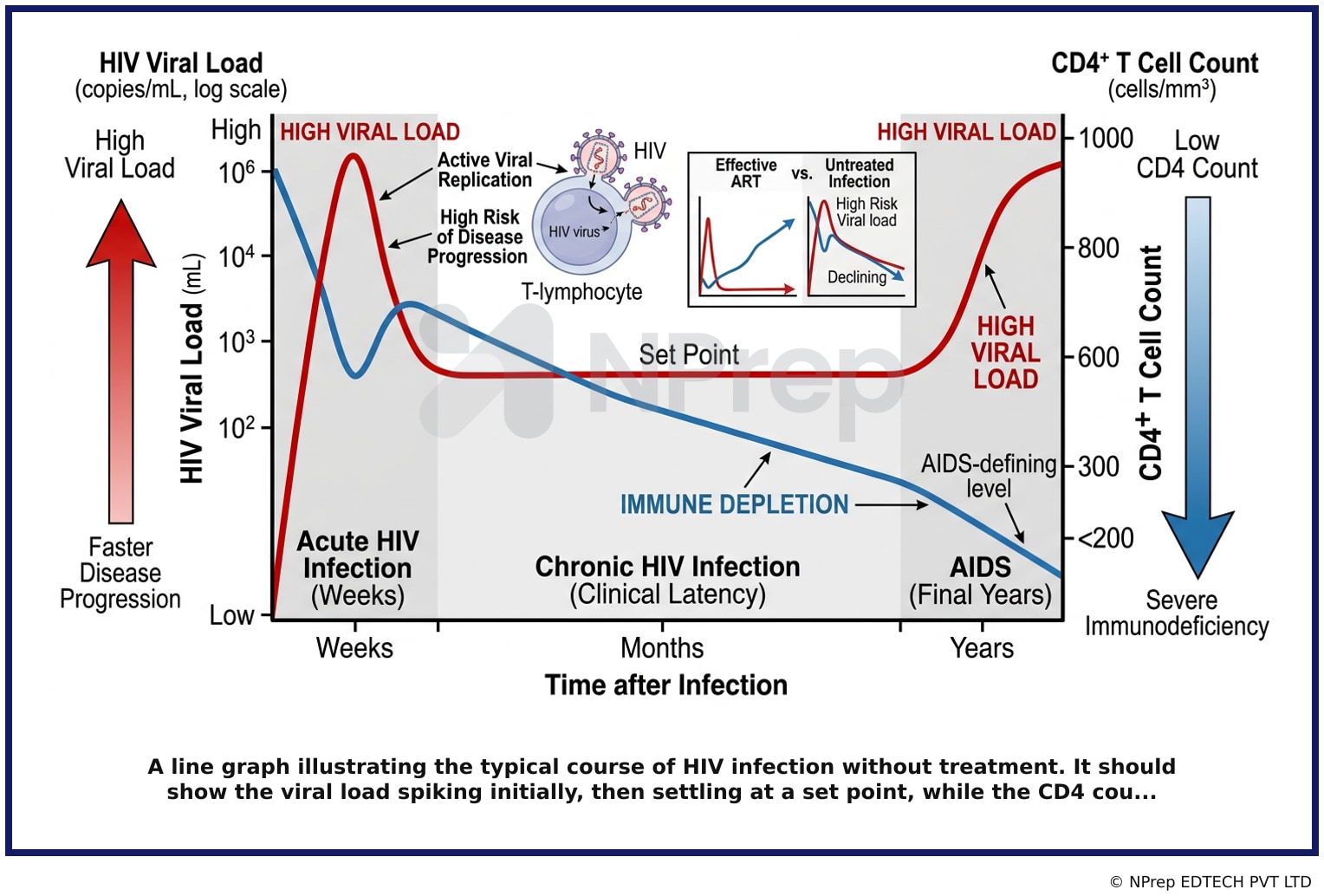
- Visual 1: Graph - A line graph illustrating the typical course of HIV infection without treatment. It should show the viral load spiking initially, then settling at a set point, while the CD4 count shows a corresponding inverse decline over time. This visualizes the relationship between high viral load and immune depletion.
- Visual 2: Infographic - An infographic comparing two scenarios: a patient with a high viral load (showing active virus, low CD4 cells, high risk of illness) versus a patient with an undetectable viral load on ART (showing suppressed virus, high CD4 cells, low risk of illness).
Clinical Relevance
- Nursing practice connection: Use the key finding related to Interpretation of HIV viral load and its clinical significance to guide bedside assessment, documentation, and the next nursing action.
- Monitoring viral load is a cornerstone of modern HIV management. It is the primary measure of ART effectiveness. A nurse must understand that a high or rising viral load is a red flag for treatment failure.
- Patient education is critical. Nurses must explain that an undetectable viral load makes HIV transmission to a sexual partner virtually impossible (Undetectable = Untransmittable, U=U), which is a powerful motivator for adherence.
- A high viral load significantly increases the risk of opportunistic infections because the immune system is weak. This prompts nurses to intensify infection prevention counseling and monitor for signs of illness.
How to Approach the Question
- First, identify the core concept of the question: the meaning of 'high viral load' in the context of HIV.
- Recall the basic pathophysiology of HIV: the virus attacks CD4+ T cells, and its replication level (viral load) is a direct measure of disease activity.
- Establish the relationship: High viral replication (high viral load) leads to more CD4 cell death, which weakens the immune system and worsens the prognosis.
- Evaluate each option based on this understanding. 'Effective ART' aims to lower the viral load, so option A is incorrect.
- 'Immune recovery' involves a low viral load and high CD4 count, so option C is incorrect.
- 'Latent infection' implies low activity, so option D is incorrect.
Concept Tested & Keywords
- Concept Tested: Interpretation of HIV viral load and its clinical significance.
- Stem keywords: high viral load, HIV-positive patient
- Lead-in keywords: indicate
Question ID
QD7TE8tsjBvLaKKAUJ19n1
Practise the full AIIMS CRE 2025
Attempt every question from this paper in a timed mock, then review the full solution for each one.
More Immune System Questions
- First sign of immunosuppressed patient is:
- Anaphylactic reaction after administering penicillin indicates?
- Which of the following is an indicator of AIDS?
- The most common cancer associated with AIDS?
- The positive diagnosis for HIV infection is made based on?
- SLE is an example of?
- Antibodies that cause pathogens to dissolve or break up are known as?
- Foods which need to be avoided with a latex allergy?
- Anaphylaxis is the term used in condition?
- The immunoglobulin present in colostrum is?
More AIIMS CRE 2025 Questions
- What is the preferred first-line ART regimen for HIV-infected adults?
- Which action reduces the risk of mother-to-child transmission of HIV during childbirth?
- Which antiretroviral regimen is recommended for newborns exposed to HIV?
- What is the duration of ARV prophylaxis for newborns exposed to HIV?
- What is the recommendation for ARV treatment in HIV-positive pregnant women during labor?
- PEP (Post-exposure prophylaxis) after needle-stick injury should be initiated within:
- How long should post-exposure prophylaxis (PEP) be continued after potential HIV exposure?
- Which body fluid is most likely to transmit HIV through a needle-stick injury?
- Recommended HIV follow-up testing schedule for healthcare workers after needle-stick injury is:
- Which statement about post-exposure prophylaxis is true?