
RRB Nsg. Superintendent-20 July 2019 (Shift-3rd)
Community Health Nursing
Easy
Water which is purified and fit for drinking is known as
Appeared in: RRB Nsg. Superintendent-20 July 2019 (Shift-3rd)
Explanation
- Potable water is the specific and correct term for water that has been treated or is naturally safe for human consumption.
- To be considered potable, water must be free from harmful microorganisms (pathogens) and toxic chemical substances.
- It should also be aesthetically acceptable, meaning it is clear, colorless, and odorless.
- This term encompasses any water source or type (e.g., tap water, bottled water) that meets the required safety standards for drinking.
Why Other Options Were Wrong
- Option A: Non-potable water is the direct opposite of the question's description. It refers to water that is unsafe for drinking.
- Option B: While distilled water is pure and safe to drink, it is a specific type of purified water. 'Potable water' is the broader, more general term for any water that is fit for consumption, regardless of the purification method.
- Option D: Contaminated water is unsafe for drinking because it contains harmful substances. This is a type of non-potable water.
Related Visual
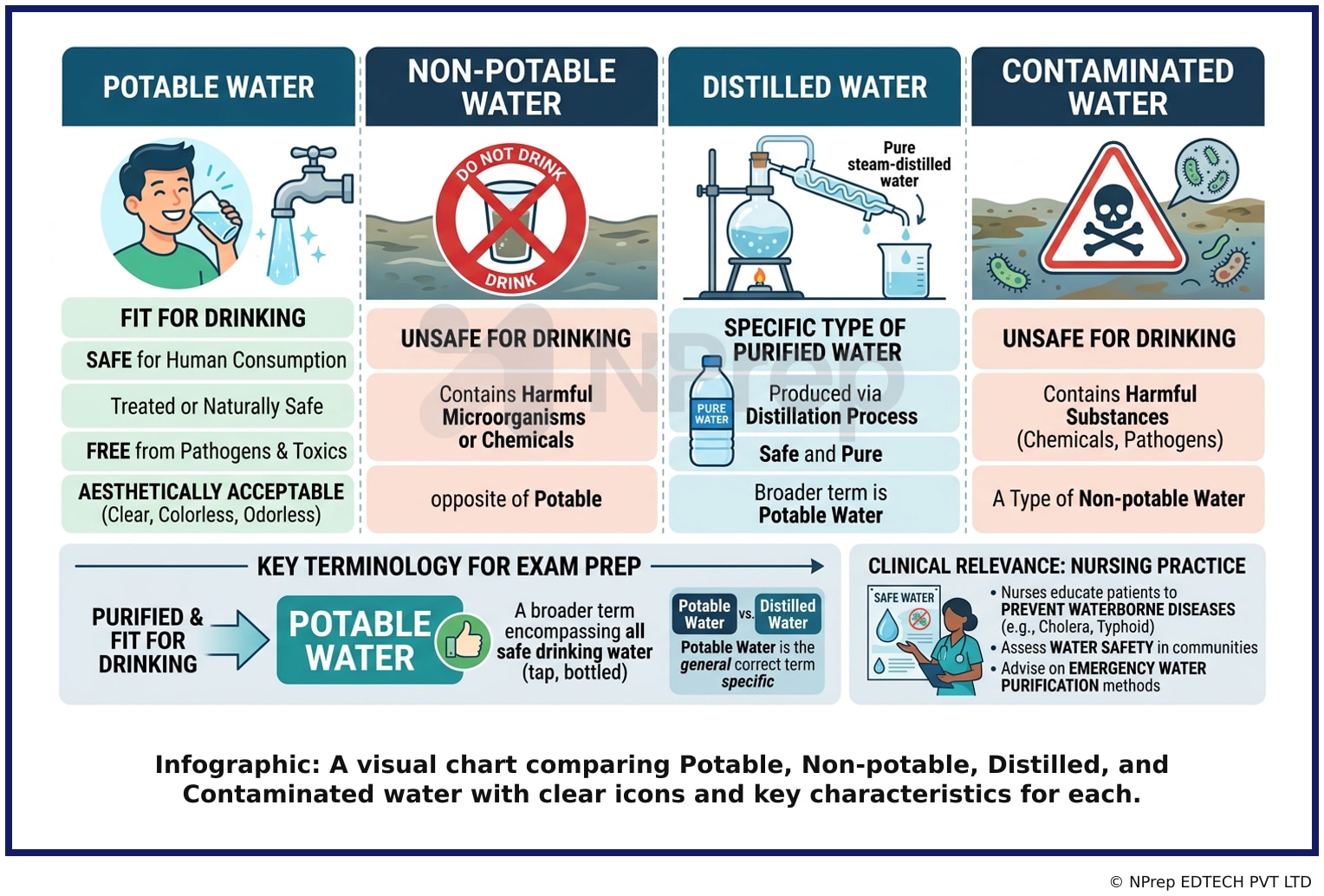
- Visual 1: Infographic: A visual chart comparing Potable, Non-potable, Distilled, and Contaminated water with clear icons and key characteristics for each.
- Visual 2: Flowchart: A diagram illustrating the steps of municipal water purification, from the raw water source (like a river) to the final potable water supplied to homes.
Clinical Relevance
- Nursing practice connection: This is primarily an exam-oriented knowledge point with limited direct bedside application, so retain Terminology of Water Safety and Quality as background academic context rather than a clinical decision trigger.
- A nurse's role includes educating patients and communities about the importance of using potable water to prevent waterborne diseases such as cholera, typhoid, dysentery, and hepatitis A.
- In community health nursing, assessing the safety of water sources is a critical public health function, especially in rural or underserved areas.
- What if? If a community experiences a flood, their regular water source may become contaminated. The nurse's priority is to advise residents on emergency water purification methods (like boiling for at least one minute or using chlorine tablets) until a safe supply is restored.
How to Approach the Question
- First, identify the key phrases in the question: 'purified' and 'fit for drinking'.
- This is a factual recall question that asks for a specific definition.
- Evaluate each option based on the keywords. 'Potable' is a direct synonym for 'drinkable' or 'fit for drinking'.
- Eliminate the options that are opposite to the definition (Non-potable, Contaminated).
- Differentiate between the general term (Potable Water) and a specific type (Distilled water). The most encompassing and accurate term is the correct answer.
Concept Tested & Keywords
- Concept Tested: Terminology of Water Safety and Quality
- Stem keywords: water, purified, fit for drinking
- Lead-in keywords: known as
Question ID
QT90AE-Tx62LdSkcWkWNaD
Practise the full RRB Nsg. Superintendent-20 July 2019 (Shift-3rd)
Attempt every question from this paper in a timed mock, then review the full solution for each one.
More Environmental Science, Environmental Health, and Sanitation Questions
- Which form of chlorine preparation is used to reduce the bacterial residue in water?
- ICDS (Integrated Child Development Services) program was launched in the year;
- Match the greenhouse gases with their sources: Greenhouse gases Source a. Methane 1. Landfills b. Carbon dioxide 2. Fossil fuel burning c. Nitrous ox…
- If the earth had no atmosphere, the sky would have appeared:
- What is the main cause of noncommunicable diseases?
- What is the dictionary definition of 'Sanitation' according to the National Sanitation Foundation of the USA?
- Temporary hardness of water is removed by?
- The optimum fluoride concentration in drinking water in India is recommended to be?
- Hardness of water is expressed as?
- What is the minimum contact time required for the chlorination of water to take place?
More RRB Nsg. Superintendent-20 July 2019 (Shift-3rd) Questions
- Where is oxytocin synthesized?
- What is the name of the muscle that extends from the sphenoid bone to the mandible?
- Complementary feeding should be initiated at the completion of \ \ \ \ \ \
- Where is kidney located?
- Psychosocial development stage for infants is \ \ \ \ \ \ \ \ \ \
- What immunization is given at birth?
- Functional nursing is a method of providing
- Which disease is the dementia associated with asymmetric atrophy of the frontal and temporal lobes?
- Thromboangiitis obliterans is also known as
- What is the other name of pyridoxine?