
PGIMER Chandigarh NO - 2015
Applied Microbiology & Infection control (E5)
Easy
Universal precautions should be used with?
Appeared in: PGIMER Chandigarh NO - 2015
Explanation
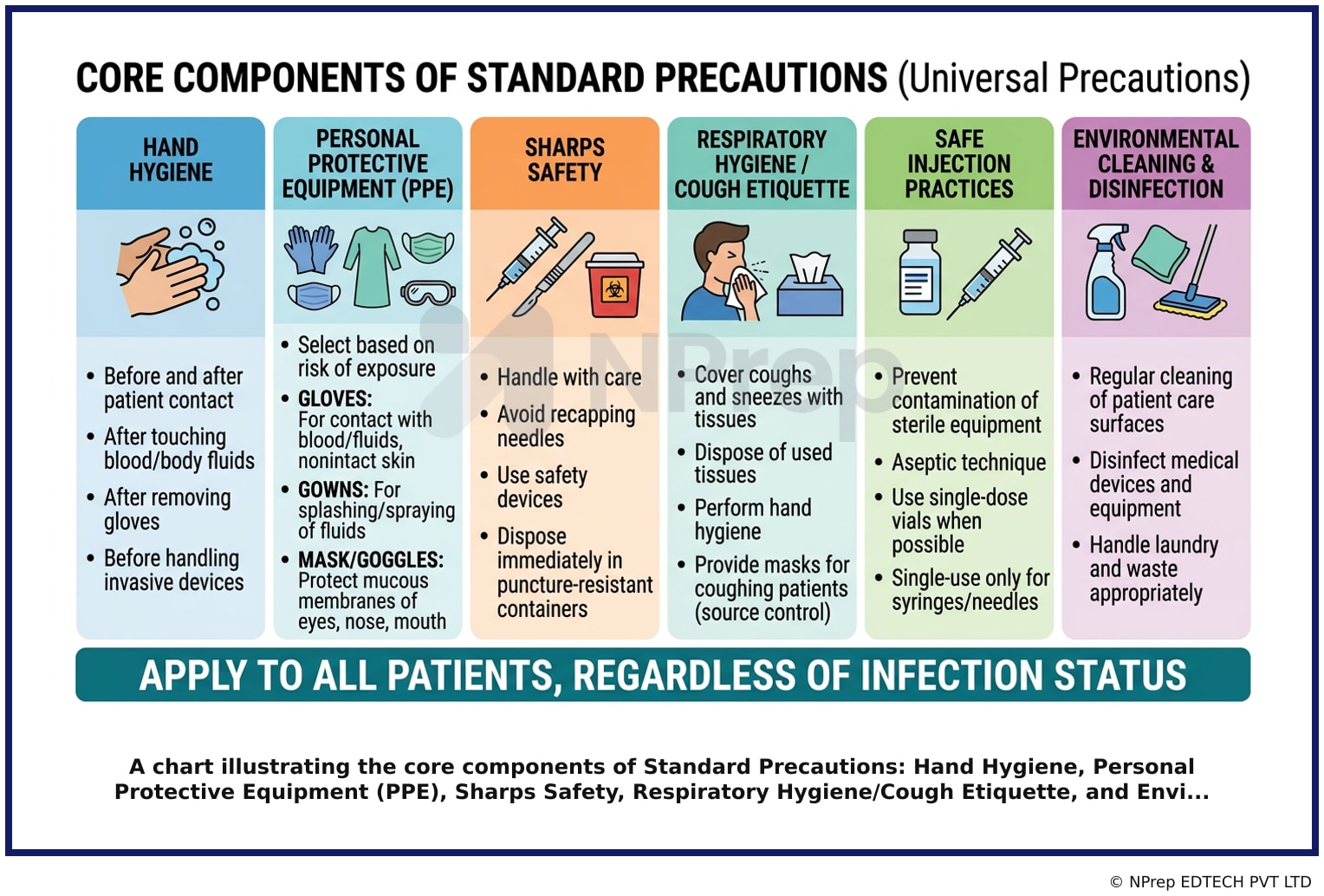
- Standard Precautions (formerly Universal Precautions) are the minimum infection prevention practices that apply to all patient care, regardless of suspected or confirmed infection status.
- The core principle is to treat blood, all body fluids, nonintact skin, and mucous membranes of all patients as potentially infectious.
- This universal approach is necessary because many patients may have infections without showing symptoms or without a confirmed diagnosis.
- Applying these precautions to 'all clients' is the only way to ensure a consistent and high level of safety for both healthcare providers and patients.
Why Other Options Were Wrong
- Option A: Limiting precautions to clients you don't know well is a dangerous assumption. Familiar patients can have undiagnosed or asymptomatic infections, posing a significant transmission risk.
- Option B: This is too specific. While precautions are critical for HIV-positive clients, they must be used for all clients to protect against a wide range of known and unknown pathogens, not just HIV.
- Option C: This is also too specific. Standard Precautions protect against Hepatitis B, but also Hepatitis C, HIV, and many other bloodborne pathogens. Limiting them to only those with known risk factors is insufficient and unsafe.
Related Visual
Clinical Relevance
- Nursing practice connection: This is primarily an exam-oriented knowledge point with limited direct bedside application, so retain Application of Standard (Universal) Precautions in healthcare settings as background academic context rather than a clinical decision trigger.
- Consistent use of Standard Precautions is the single most important practice to reduce the risk of healthcare-associated infections (HAIs) and protect healthcare workers from occupational exposures.
- Failure to adhere to these precautions can lead to disease transmission, patient harm, outbreaks within a facility, and legal liability for the healthcare provider and institution.
- What if? If a patient is known to have an airborne infection like Tuberculosis (TB), the nurse must apply Airborne Precautions (e.g., N95 respirator, negative pressure room) IN ADDITION to Standard Precautions. Standard Precautions are the foundation, and Transmission-Based Precautions are added when a specific transmission route is known.
How to Approach the Question
- First, identify the core concept in the question, which is 'Universal Precautions'.
- Recall the definition and purpose of this concept. The word 'universal' is a major clue, implying broad application.
- Analyze the options to see which one aligns with the 'universal' aspect of the precautions.
- Options A, B, and C describe specific, limited groups of patients (unfamiliar, HIV-infected, Hep-B risk).
- Option D, 'All clients', is the only choice that reflects a truly universal application.
- Conclude that these precautions are meant for everyone because the infection status of any given patient is not always known and must be assumed to be potentially positive.
Concept Tested & Keywords
- Concept Tested: Application of Standard (Universal) Precautions in healthcare settings.
- Stem keywords: Universal precautions
- Lead-in keywords: BEST, MOST RELEVANT CLUE
- Negative lead-in flag: false
Question ID
QEz_uZuZmLpjXPDhs5whNN
Reference Book
E6 Nursing Fundamentals Taylor p. 175-177
E6 Nursing Fundamentals Potter Perry 12e Part 2 p. 235-237
E6 Microbiology Applied AnjuDhir 3e Part 2 p. 145-147
Practise the full PGIMER Chandigarh NO - 2015
Attempt every question from this paper in a timed mock, then review the full solution for each one.
More Infection Control in Clinical Settings Questions
- Chain of infection is an interactive process that does not involve -
- Which is not an essential standard precaution used in the care of patients irrespective of the diagnosis?
- Which solution used for clean to spillage of blood on the floor?
- Which of the following options most appropriately describes the term 'inanimate object'?
- Which of the following interventions is not included in the prevention of urinary catheter infection?
- In case of needle stick injury, the first response of the nurse should be?
- Which of the following elements emphasizes the delivery of external air to each part of the space and the removal of the airborne pollutants generate…
- Needle stick injury most commonly occurs during which of the following procedure?
- What is the maximum length of time a nurse should allow an IV bag of solution to infuse?
- Health care provider had needle stick injury from a known HIV infected patient. He should certainly start post-exposure prophylaxis within how exposu…
More PGIMER Chandigarh NO - 2015 Questions
- The primary purpose of the schilling test is to measure?
- Priority nursing diagnosis for a client with ARDS?
- Which vaccine is used to prevent cervical cancer?
- Appropriate treatment for a patient with acute appendicitis?
- Most common complication of peritoneal dialysis?
- Which post operative activity does the nurse encourage the client to avoid, to prevent increased ICP?
- A Nurse is caring for a patient who has just been operated for Tonsillectomy surgery. Which of the following patient complaints indicates heavy bleed…
- Most effective method of treating radiodermatitis?
- "Choanal Atresia" is a congenital abnormality which is an abnormal opening between?
- Most common cause of liver cirrhosis is?