
RRB Nsg. Superintendent-20 July 2019 (Shift-3rd)
Non Nursing Subjects
Medium
Two bells ring at intervals of 63 seconds and 74 seconds. If they both ring at 10 O'clock in the morning together, after how many seconds will they ring together again?
Appeared in: RRB Nsg. Superintendent-20 July 2019 (Shift-3rd)
Explanation
- The problem asks for the next time two events, occurring at different regular intervals, will happen simultaneously. This requires finding the Least Common Multiple (LCM) of the intervals.
- The intervals for the two bells are 63 seconds and 74 seconds.
- To find the LCM, we can use prime factorization. The prime factors of 63 are 3 × 3 × 7.
- The prime factors of 74 are 2 × 37.
- Since the numbers 63 and 74 have no common prime factors (they are coprime), their LCM is simply their product.
- Calculation: 63 × 74 = 4662. Thus, they will ring together again after 4662 seconds.
Why Other Options Were Wrong
- Option A: This is an incorrect result of the multiplication. It may arise from a calculation error, such as multiplying 63 by an incorrect number like 71 or 72.
- Option C: This is a result of a calculation error. It is not the product of 63 and 74.
- Option D: This is an incorrect product of 63 and 74, likely due to a mistake during manual multiplication.
Related Visual
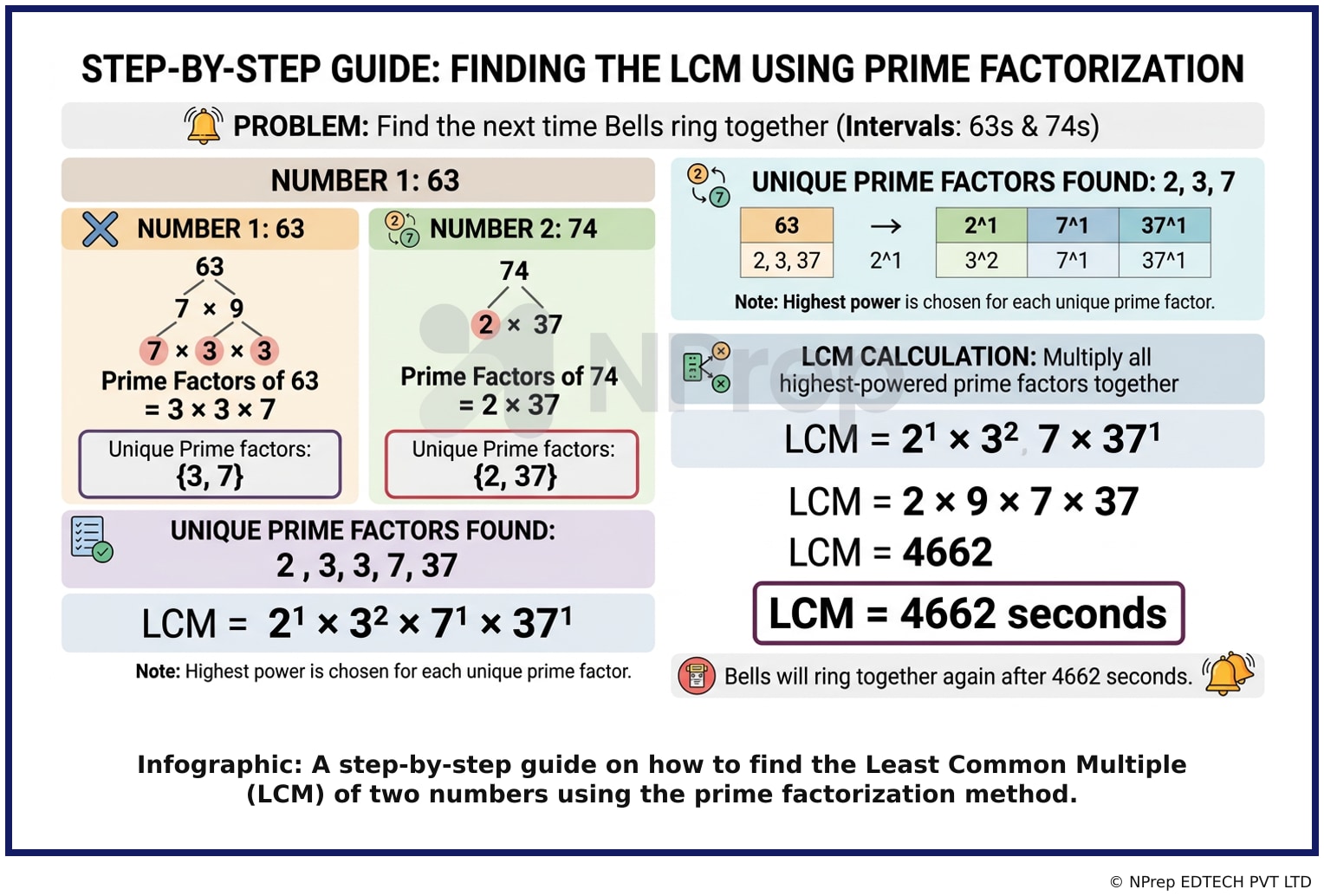
- Visual 1: Infographic: A step-by-step guide on how to find the Least Common Multiple (LCM) of two numbers using the prime factorization method.
- Visual 2: Flowchart: A decision-making flowchart that starts with 'Do the numbers have common factors?' and leads to the correct method for finding the LCM (either by listing multiples or by prime factorization).
Clinical Relevance
- Nursing practice connection: This is primarily an exam-oriented knowledge point with limited direct bedside application, so retain Calculation of Least Common Multiple (LCM) for a practical problem as background academic context rather than a clinical decision trigger.
- This is a general aptitude question designed to test mathematical reasoning and calculation skills, which are foundational for nurses.
- While LCM itself is not a common daily calculation in nursing, the underlying skill of precise mathematical computation is critical for tasks like medication dosage calculation, IV drip rate adjustment, and interpreting patient data charts.
- What if the intervals were 60 seconds and 75 seconds? The prime factors of 60 are 2² × 3 × 5, and for 75 are 3 × 5². The common factors are 3 and 5. The LCM would be 2² × 3¹ × 5² = 4 × 3 × 25 = 300 seconds. The answer would change because the numbers are not coprime.
How to Approach the Question
- First, read the question carefully to understand what is being asked. The keywords are 'ring together again', which points to a recurring event.
- Recognize that this is a problem about finding a common point in time for two different cycles. This is a classic application of the Least Common Multiple (LCM).
- Identify the two intervals given in the problem: 63 seconds and 74 seconds.
- Determine the best method to find the LCM of 63 and 74. Prime factorization is a reliable method.
- Find the prime factors of 63 (3 × 3 × 7) and 74 (2 × 37).
- Check if there are any common prime factors. In this case, there are none.
Concept Tested & Keywords
- Concept Tested: Calculation of Least Common Multiple (LCM) for a practical problem.
- Stem keywords: bells, intervals, 63 seconds, 74 seconds, ring together
- Lead-in keywords: after how many seconds
Question ID
QEAxeOMu_9vb0QKA4pjHit
Practise the full RRB Nsg. Superintendent-20 July 2019 (Shift-3rd)
Attempt every question from this paper in a timed mock, then review the full solution for each one.
More Mathematics Questions
- The ratio of number of girls to boys in a school of 2520 students is 27:29. How many more girls should be admitted to make the ratio 1:1?
- Three candidates contested an election and received 4500, 7500 and 8000 votes respectively. What percentage of votes did the winning candidates get?
- Two bells ring at intervals of 59 seconds and 70 seconds. If they both ring at 10 O'clock in the morning together, after how many seconds will they r…
- The average of four numbers is 61. The largest number among them is 85 and the smallest number is 21. What will be the larger of the remaining two nu…
- In what ratio should water be mixed with milk so that on selling the mixture at cost price a profit of 20% is made?
- A quality control analyst rejects 0.08% of the fabric produced, finding it defective. How many meters of fabric must he examine to reject 4 meters?
- A man traveled from his village to the post office at a speed of 25km/hr and returned at a speed of 4km/hr. If the entire journey took 5 hours and 48…
- A train is running at 60 km/hr. How much time will it require to cross a 2 km bridge?
- The average monthly income of R1 and R2 is Rs. 99,500. The average monthly income of R2 and R3 is Rs. 1,15,600 and the average monthly income of R1 a…
- If Rohan bought 20 books at the rate of Rs. 120 each, 30 books at the rate of Rs. 150 each, and 15 books at the rate of Rs. 100 each, then find the a…
More RRB Nsg. Superintendent-20 July 2019 (Shift-3rd) Questions
- Where is oxytocin synthesized?
- What is the name of the muscle that extends from the sphenoid bone to the mandible?
- Complementary feeding should be initiated at the completion of \ \ \ \ \ \
- Where is kidney located?
- Psychosocial development stage for infants is \ \ \ \ \ \ \ \ \ \
- What immunization is given at birth?
- Functional nursing is a method of providing
- Which disease is the dementia associated with asymmetric atrophy of the frontal and temporal lobes?
- Thromboangiitis obliterans is also known as
- What is the other name of pyridoxine?