
NORCET-7 Mains-2024
Obstetrics and Midwifery Nursing
Easy
The universal attitude of the fetus is:
Appeared in: NORCET-7 Mains-2024
Explanation
- Fetal attitude describes the relationship of the fetus's body parts to one another.
- The universal or normal fetal attitude is one of general flexion, where the fetus is curled into a compact, ovoid shape.
- In this flexed position, the head is bent forward with the chin on the chest, arms are crossed, and legs are bent at the knees and drawn up to the abdomen.
- This posture is crucial for a normal delivery because it presents the smallest possible diameter of the fetal head to the maternal pelvis, facilitating easier passage.
Why Other Options Were Wrong
- Option A: Extension is an abnormal fetal attitude where the head and neck are tilted back. This presents a larger diameter of the fetal head to the pelvis, which can lead to a difficult labor (dystocia) or require a cesarean delivery.
- Option C: Descent is a process, not a posture. It is one of the cardinal movements of labor, referring to the downward passage of the fetus through the birth canal.
- Option D: Crowning is a clinical sign that occurs late in the second stage of labor. It marks the point when the widest part of the fetal head is visible at the vaginal opening and no longer recedes between contractions. It is an event in the delivery process, not a fetal attitude.
Related Visual
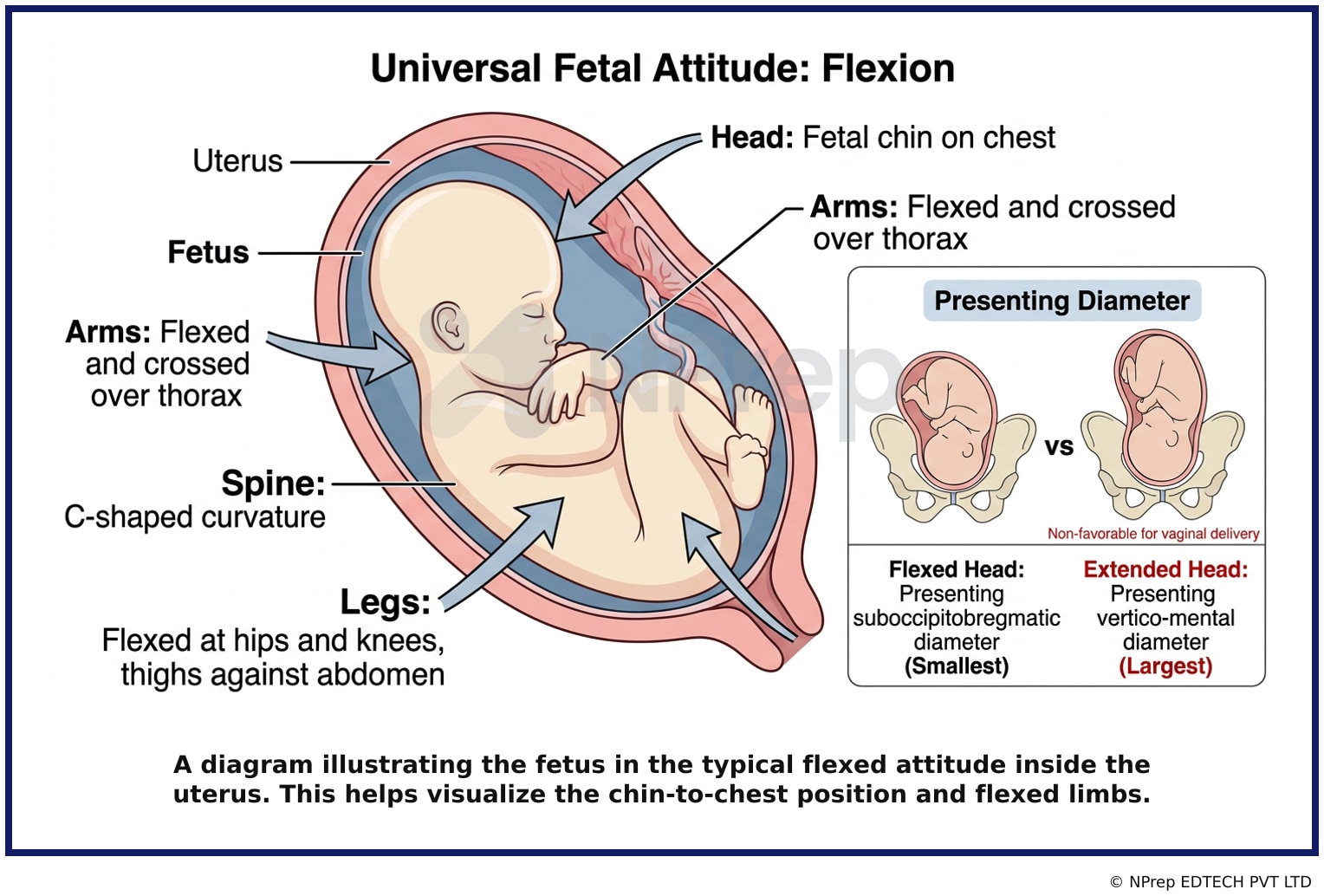
- Visual 1: Diagram - A diagram illustrating the fetus in the typical flexed attitude inside the uterus. This helps visualize the chin-to-chest position and flexed limbs.
- Visual 2: Comparison Diagram - An infographic comparing a flexed (vertex) presentation with an extended (face or brow) presentation, showing how the presenting diameter changes.
Clinical Relevance
- Nursing practice connection: This is primarily an exam-oriented knowledge point with limited direct bedside application, so retain Fetal attitude and terminology in obstetrics as background academic context rather than a clinical decision trigger.
- Understanding fetal attitude is fundamental for nurses and midwives to assess labor progress. An attitude of flexion is favorable for vaginal delivery.
- A non-flexed or extended attitude identified during labor assessment is a red flag for potential labor dystocia (difficult labor) and may require interventions or preparation for a cesarean section.
- What if the attitude is extension? An extended attitude leads to a face or brow presentation. This presents a much larger diameter to the pelvis, significantly increasing the risk of prolonged labor, maternal and fetal trauma, and the likelihood of requiring a cesarean delivery.
How to Approach the Question
- First, identify the keyword in the question: 'attitude'.
- Recall the specific definition of fetal 'attitude' in obstetrics, which is the relation of the fetal body parts to one another.
- Differentiate this from other key terms: 'lie' (fetal spine to maternal spine), 'presentation' (part entering the pelvis), and 'position' (presenting part to maternal pelvis).
- Analyze the options. 'Descent' and 'Crowning' are parts of the labor process (movements or stages), not a static posture. Eliminate them.
- Compare the remaining options: 'Flexion' and 'Extension'.
- Recall that the 'universal' or normal posture for a fetus is to be curled up compactly to fit in the uterus. This is flexion. Extension is an abnormal, stretched-out posture.
Concept Tested & Keywords
- Concept Tested: Fetal attitude and terminology in obstetrics
- Stem keywords: universal attitude, fetus
- Lead-in keywords: is
- Negative lead-in flag: false
Question ID
QCnmVqctuilCwyeBDXkkS_
Practise the full NORCET-7 Mains-2024
Attempt every question from this paper in a timed mock, then review the full solution for each one.
More Fetus Questions
- Urine formation usually begins towards the end of the and continues throughout fetal life?
- The part of fetal circulation which becomes fossa ovalis after birth?
- An umbilical cord contains?
- During which week does the fetal heart begin pumping its own blood?
- The obliterated umbilical vein is called?
- After birth, the umbilical vein collapses and forms?
- Oxygenated blood enters the fetal circulation from the umbilical vein via?
- Which structure is formed by the obliteration of the umbilical vein after the birth of a child?
- The umbilical cord otherwise known as
- The two umbilical arteries carry the ... from the fetus
More NORCET-7 Mains-2024 Questions
- What is the correct statement regarding pre-oxygenation in children before intubation?
- A pregnant woman is ready for caesarean section and transferred to labor room. Which is the best position for the woman during caesarean section?
- A woman comes in labor room with 3 cm cervical dilation, 80% effacement and energetic and excited. The women in which phase of labor?
- The ambient temperature of the labor room should maintain?
- The recommended dose of iron and folic acid for adolescent girls under Weekly Iron & Folic Acid Supplementation (WIFS) program?
- A 14-week Rh-negative pregnant woman presents with mild vaginal bleeding and abdominal pain. Ultrasound shows a viable intrauterine pregnancy. Her hu…
- A new newborn care unit is inaugurated in the hospital. The child health nurse known about iKMC. What mean I in iKMC?
- A nurse teaching to a woman regarding breast feeding. Which statement is incorrect about breast feeding?
- Swenson and Duhamel procedure used to correction of?
- Cohort study also known as?