
RRB Nsg. Superintendent-20 July 2019 (Shift-3rd)
Obstetrics & Gynecology
Easy
The umbilical cord contains
Appeared in: RRB Nsg. Superintendent-20 July 2019 (Shift-3rd)
Explanation
- A normal umbilical cord at term contains three vessels: two umbilical arteries and one umbilical vein.
- The two umbilical arteries are responsible for carrying deoxygenated blood and waste products away from the fetus to the placenta.
- The single, larger umbilical vein carries oxygenated, nutrient-rich blood from the placenta to the fetus.
- This arrangement is often remembered by the mnemonic 'AVA' (Artery-Vein-Artery).
Why Other Options Were Wrong
- Option A: This describes an abnormal condition known as a Single Umbilical Artery (SUA) or a two-vessel cord, not the normal anatomy.
- Option B: This anatomical configuration is not a recognized normal or abnormal variation of the human umbilical cord.
- Option D: While two umbilical veins are present in the very early stages of embryonic development, the right vein typically atrophies and disappears.
Related Visual
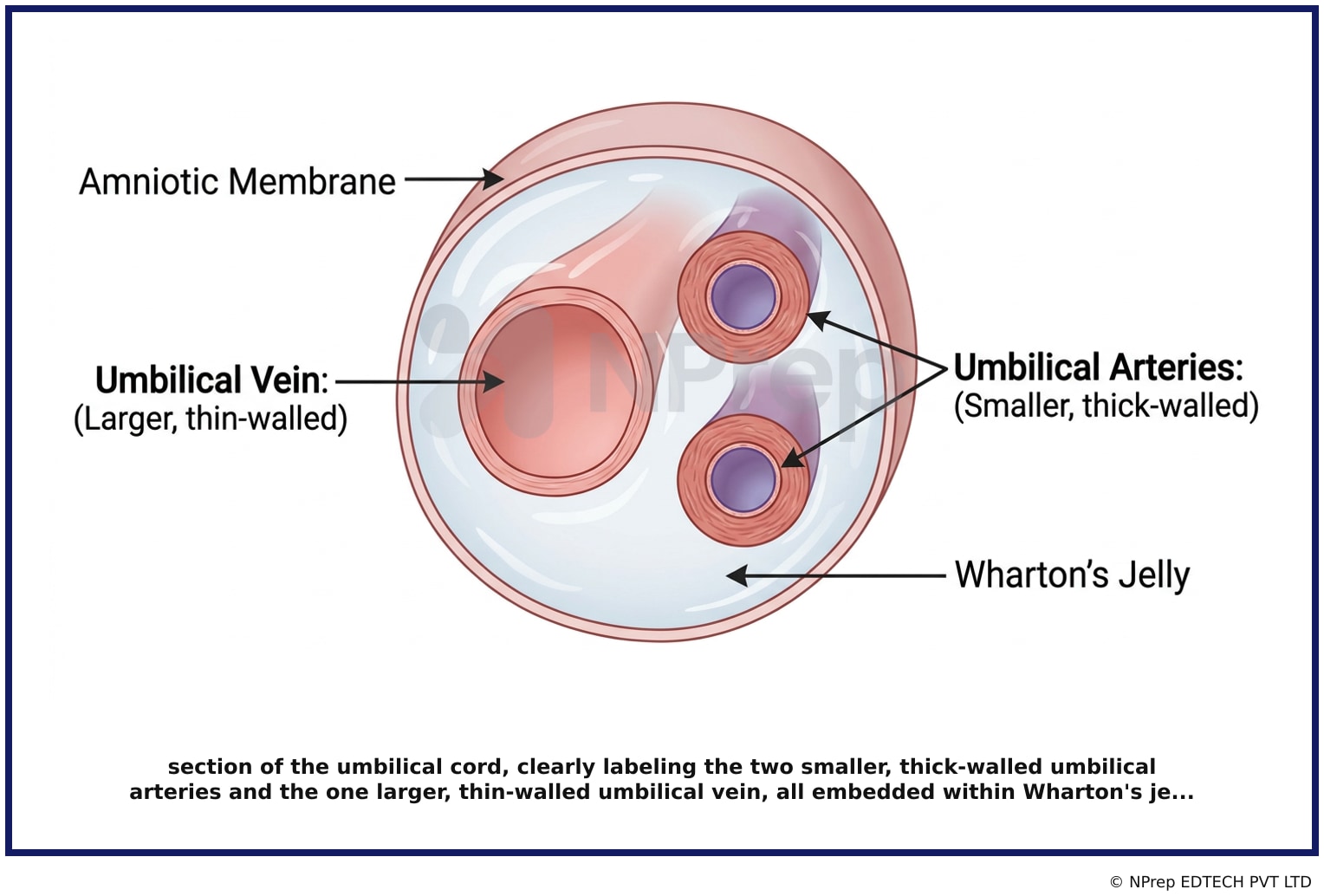
- Visual 1: Diagram - A cross-section of the umbilical cord, clearly labeling the two smaller, thick-walled umbilical arteries and the one larger, thin-walled umbilical vein, all embedded within Wharton's jelly.
Clinical Relevance
- Nursing practice connection: This is primarily an exam-oriented knowledge point with limited direct bedside application, so retain Anatomy of the umbilical cord as background academic context rather than a clinical decision trigger.
- It is a standard nursing practice to examine the cut end of the umbilical cord at birth to count the vessels. The presence of only two vessels (a single umbilical artery) must be documented and reported, as it can be a soft marker for underlying renal, cardiac, or chromosomal abnormalities.
- What if? If a single umbilical artery (SUA) is detected on a prenatal ultrasound, the fetus will be monitored more closely with detailed sonograms to screen for associated anomalies. However, it's important to note that many infants with an isolated SUA are born perfectly healthy.
How to Approach the Question
- This is a factual recall question about basic anatomy relevant to obstetrics and pediatrics.
- Identify the core subject of the question, which is the structure of the umbilical cord.
- Recall the standard composition of the umbilical cord. A helpful mnemonic is 'AVA,' which stands for Artery-Vein-Artery, representing the two arteries and one vein.
- Remember the unique circulatory pattern: the vein carries oxygenated blood (to the fetus), and the arteries carry deoxygenated blood (away from the fetus).
- Evaluate the options based on the 'two arteries, one vein' rule and eliminate the incorrect choices.
Concept Tested & Keywords
- Concept Tested: Anatomy of the umbilical cord
- Stem keywords: umbilical cord, contains
- Lead-in keywords: BEST, MOST RELEVANT CLUE
- Negative lead-in flag: false
Question ID
QOIzp2aqPJlQdFygqGpTwi
Practise the full RRB Nsg. Superintendent-20 July 2019 (Shift-3rd)
Attempt every question from this paper in a timed mock, then review the full solution for each one.
More Placenta and Fetal Membranes Questions
More RRB Nsg. Superintendent-20 July 2019 (Shift-3rd) Questions
- Where is oxytocin synthesized?
- What is the name of the muscle that extends from the sphenoid bone to the mandible?
- Complementary feeding should be initiated at the completion of \ \ \ \ \ \
- Where is kidney located?
- Psychosocial development stage for infants is \ \ \ \ \ \ \ \ \ \
- What immunization is given at birth?
- Functional nursing is a method of providing
- Which disease is the dementia associated with asymmetric atrophy of the frontal and temporal lobes?
- Thromboangiitis obliterans is also known as
- What is the other name of pyridoxine?