
KGMU 2023
Applied Anatomy
Easy
The patella (kneecap) is what type of bone?
Appeared in: KGMU 2023
Explanation
- The patella (kneecap) is classified as a sesamoid bone.
- Sesamoid bones are unique because they are embedded within a tendon or muscle, which is a defining characteristic.
- The patella is located in the tendon of the quadriceps femoris muscle, where it crosses the knee joint.
- Its primary role is to increase the leverage of the tendon, making the quadriceps muscle more effective in extending the knee. It also protects the surface of the knee joint.
- The patella is the largest sesamoid bone in the body.
Why Other Options Were Wrong
- Option A: Flat bones (e.g., sternum, ribs, scapulae) serve as protective shields for vital organs and provide broad surfaces for muscle attachment. The patella's function is mechanical leverage, not broad protection.
- Option C: Irregular bones (e.g., vertebrae, hip bones) have complex shapes that don't fit other categories and are designed for specific functions like protecting the spinal cord. The patella has a relatively simple, defined shape.
- Option D: Short bones (e.g., carpals in the wrist, tarsals in the ankle) are cube-shaped and provide stability and support with limited motion. The patella's function is related to movement and leverage, not primarily stability.
Related Visual
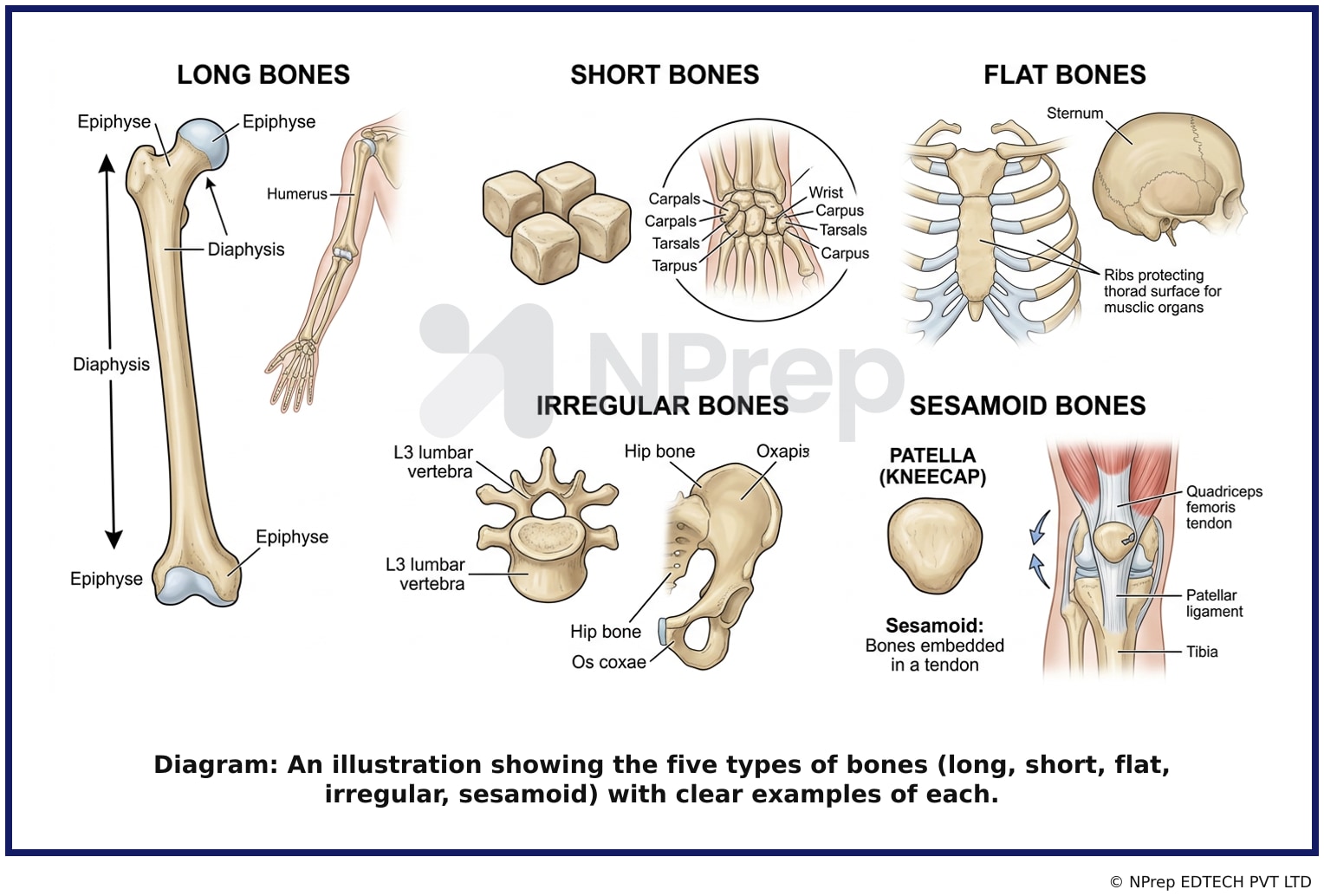
- Visual 1: Diagram: An illustration showing the five types of bones (long, short, flat, irregular, sesamoid) with clear examples of each.
- Visual 2: Anatomical Illustration: A detailed view of the knee joint, highlighting the patella embedded within the quadriceps tendon.
Clinical Relevance
- Nursing practice connection: This is primarily an exam-oriented knowledge point with limited direct bedside application, so retain Classification of bones based on shape as background academic context rather than a clinical decision trigger.
- Understanding bone types is fundamental for assessing fractures. A patellar fracture is a serious injury that can impair the ability to extend the knee, a direct consequence of its role as a sesamoid bone in the quadriceps mechanism.
- Nurses may care for patients post-patellectomy (removal of the kneecap). This requires specific knowledge of how the loss of this sesamoid bone affects leg mechanics, muscle strength, and rehabilitation protocols.
- What if the question asked about the sternum? The answer would be 'Flat bone,' as its primary function is to protect the heart and lungs in the thoracic cavity, fitting the definition of a flat bone.
How to Approach the Question
- First, identify the key anatomical structure in the question: 'patella (kneecap)'.
- Next, recall the anatomical classification system for bones, which is based on their shape (long, short, flat, irregular, sesamoid).
- Consider the unique location and function of the patella—it's a bone situated within a tendon (the quadriceps tendon).
- This characteristic is the specific definition of a 'sesamoid' bone.
- Evaluate the other options to confirm your choice: 'Flat' (protective plates), 'Irregular' (complex shapes), and 'Short' (cube-like for stability) do not accurately describe the patella's form or primary function.
- Therefore, select the option that correctly identifies a bone embedded in a tendon.
Concept Tested & Keywords
- Concept Tested: Classification of bones based on shape
- Stem keywords: patella, kneecap, type of bone
- Lead-in keywords: what type
- Negative lead-in flag: false
Question ID
QFx2F6pwhTl5MZ0j_V2fZh
Practise the full KGMU 2023
Attempt every question from this paper in a timed mock, then review the full solution for each one.
More Musculoskeletal System Questions
- The spinal cord is made up of 7 cervical vertebrae, 5 lumbar vertebrae, 4 or 5 fused sacral vertebrae, 4 or 5 coccygeal vertebrae and how many thorac…
- All of the following are sesamoid bone; EXCEPT:
- Which is the longest bone in the human body?
- All of the following bones are present in anatomical segment of leg; EXCEPT:
- The floor of mouth is formed by \ \ \ \ \ \ \ \ \ \ \ muscle.
- An example for sesamoid bone is:-
- The muscle that lies on the anterior thoracic wall is:-
- The human skeleton is divided into two main parts?
- Tarsals of the ankles are examples of which type of bone?
- How many bones are there in the lower extremities in a normal adult?
More KGMU 2023 Questions
- The teacher scalded Aruna in front of her classmates during Project submission. Conclusion I: Aruna was not as popular as her other classmates. Concl…
- Aruna leaves and goes 8 meters in the North direction from a certain point. Then she turns right and travels for 12 meters. She again turns right and…
- Kiran is Sister of Raj. Raj is Son of Suresh and Vinita is Mother of Suresh then what is relation between Vinita and Kiran?
- A person who lives at the same time with another?
- Select the most appropriate meaning of the below idiom. A black sheep?
- The train has arrived...the station.
- A vendor sold 20 kg of potato at 18 Rs. per kg. He bought 2-liter milk at the rate of 46 Rs./liter, 2 kg sugar at the rate of 35 Rs./kg and 10 packet…
- Which one is the perfect square?
- A is the smallest. C is taller than B and D. E is neither the tallest nor the smallest. Find which one is the tallest?
- From an entrance, a person walks 28 meters left, then turns right and walks 13 meters. They turn right again and walk 12 meters, and then walk 16 met…