
SGPGI Nursing Officer-2022
Applied Physiology
Easy
The pacemaker of the heart is:?
Appeared in: SGPGI Nursing Officer-2022
Explanation
- The Sinoatrial (SA) node is universally recognized as the natural or primary pacemaker of the heart.
- It possesses the highest intrinsic rate of spontaneous electrical depolarization, a property known as automaticity.
- The SA node's firing rate of 60-100 beats per minute is the fastest in the conduction system, which allows it to drive the heart rate and override slower, potential pacemakers.
Why Other Options Were Wrong
- Option B: The AV node is the secondary pacemaker, not the primary one. Its intrinsic rate is slower than the SA node.
- Option C: The Bundle of His is a critical part of the conduction pathway that transmits impulses to the ventricles, but it is not the primary site of impulse generation.
- Option D: Purkinje fibers are tertiary pacemakers with the slowest intrinsic rate. Their primary function is the rapid distribution of the electrical impulse to the ventricular muscle cells to ensure coordinated contraction.
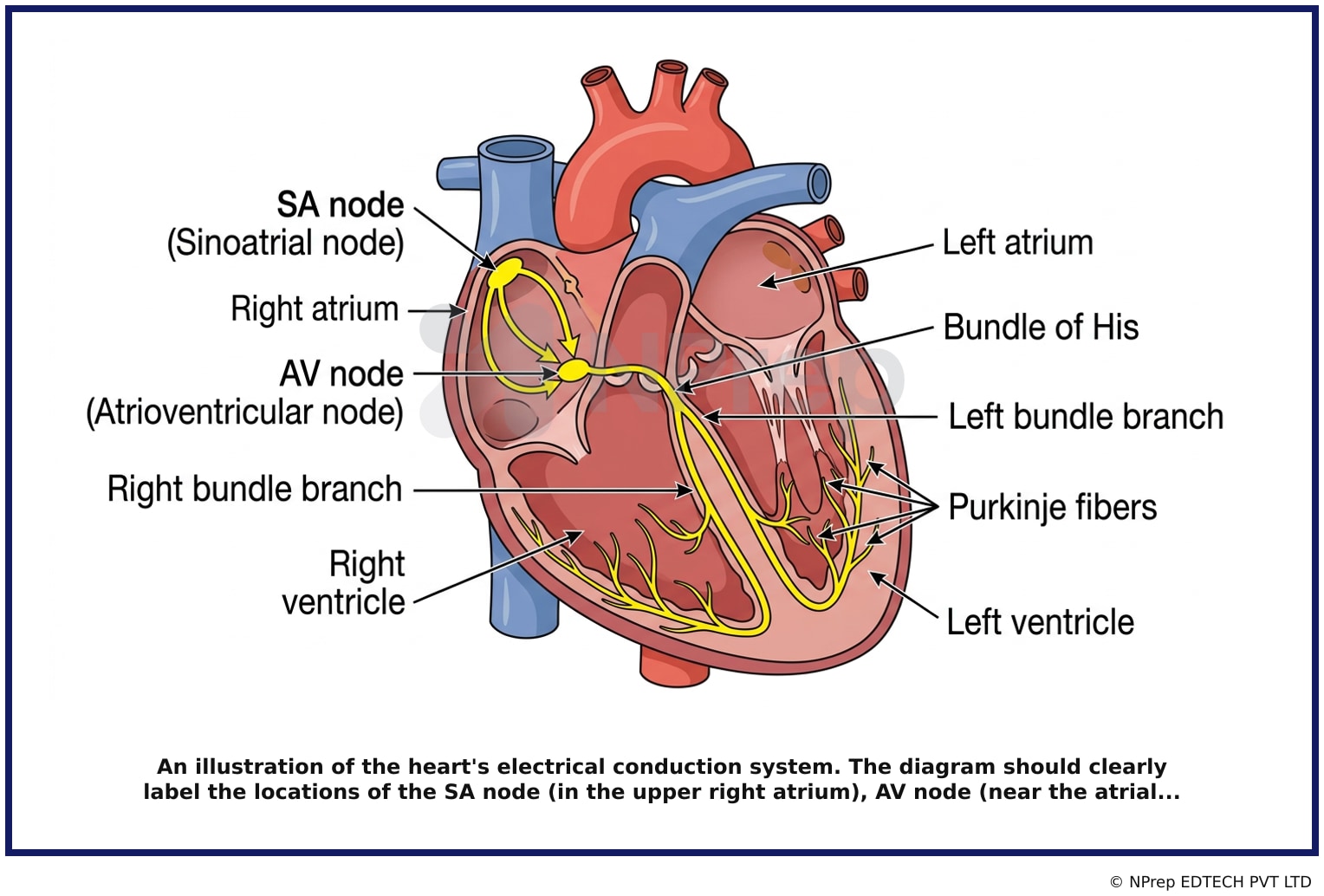
Related Visual
Clinical Relevance
- Nursing practice connection: This is primarily an exam-oriented knowledge point with limited direct bedside application, so retain Cardiac Conduction System and Primary Pacemaker as background academic context rather than a clinical decision trigger.
- Understanding the heart's pacemaker hierarchy is fundamental for interpreting ECGs and diagnosing arrhythmias like sick sinus syndrome or various degrees of heart block.
- A nurse must recognize the clinical signs of pacemaker failure (e.g., bradycardia, dizziness, syncope), which may indicate that a slower, secondary pacemaker like the AV node has taken over.
- What if? - If a patient's SA node fails and the AV node also fails to generate an impulse (a high-degree AV block), the Purkinje fibers would initiate a ventricular escape rhythm. The nurse would observe severe bradycardia (20-40 bpm) on the monitor, a life-threatening emergency requiring immediate intervention, possibly with an external or transvenous pacemaker.
How to Approach the Question
- First, identify the core question: it asks for the 'pacemaker' of the heart, which implies the primary site of impulse generation.
- Recall the components of the heart's electrical conduction system: SA node, AV node, Bundle of His, and Purkinje fibers.
- Remember the concept of automaticity and the hierarchy of intrinsic firing rates for each component.
- The structure with the fastest intrinsic rate is the primary pacemaker because it depolarizes first and drives the rest of the system.
- Compare the rates: SA node (fastest, 60-100 bpm), AV node (slower, 40-60 bpm), and Purkinje fibers (slowest, 20-40 bpm). This comparison clearly identifies the SA node as the correct answer.
Concept Tested & Keywords
- Concept Tested: Cardiac Conduction System and Primary Pacemaker
- Stem keywords: pacemaker, heart
- Lead-in keywords: BEST, MOST RELEVANT CLUE
- Negative lead-in flag: false
Question ID
Q0LRcn-YtJ5J9o9uL7DADN
Reference Book
E6 Pharmacology Nursing Lilley 11e Part 2 p. 84-86
E6 Physiology Essentials Sembulingam 10e Part 2 p. 168-170
Practise the full SGPGI Nursing Officer-2022
Attempt every question from this paper in a timed mock, then review the full solution for each one.
More Circulatory & Lymphatic system Questions
- Symptoms of acute blood loss are:
- Which among the following statements is correct regarding first heart sound?
- What is the action of vagus nerve stimulation on heart rate?
- Excessively high heart rate ( 170) can ?
- Difference between systolic and diastolic blood pressure is called?
- Difference between systolic and diastolic blood pressure is called?
- In a healthy individual, weighing 70 kg at rest, the stroke volume is about?
- The site of pulse in the neck is called?
- Pulse rate more than 100 bpm is called as?
- ECG is used for the assessment/functioning of .... Organ?
More SGPGI Nursing Officer-2022 Questions
- Drug of choice for organophosphate (OPS) poisoning?
- Normal potassium level in children?
- Which feeding therapy is used in a critically ill client admitted to the Intensive Care Unit (ICU)?
- Dengue disease is caused by?
- Which term is used for blood cancer?
- The most common cause of nosocomial infection is?
- Causative agent of peptic ulcer?
- What number should come next in the sequence: 8, 6, 12, 24, 48...?
- Which does not cause needle stick injury?
- The nurse assesses the water seal chamber of a closed chest drainage system and notes that fluctuations are absent in the chamber. What intervention…