
JIPMER Nursing Officer-2024
Nursing Foundation
Easy
The nurse is orienting a new nurse to the unit reviews source-oriented charting. Which statement by the nurse best describes source-oriented charting?
Appeared in: JIPMER Nursing Officer-2024
Explanation
- Source-oriented charting is a traditional documentation method where the patient's chart is divided into sections based on the department or discipline providing care.
- Each healthcare group, such as nursing, medicine, physical therapy, and laboratory, records its findings on its own separate forms.
- This method keeps all of a discipline's notes together, making it easy for members of that discipline to track their own entries.
- The main disadvantage is data fragmentation, which can make it difficult to see a complete, chronological picture of the patient's overall progress and care from all providers.
Why Other Options Were Wrong
- Option B: This statement describes the Problem-Oriented Medical Record (POMR), not source-oriented charting.
- Option C: This statement describes Focus Charting, which centers on patient-specific concerns or significant events using a Data-Action-Response (DAR) format.
- Option D: This statement describes the goal of methods like Charting by Exception (CBE) or PIE charting.
Related Visual
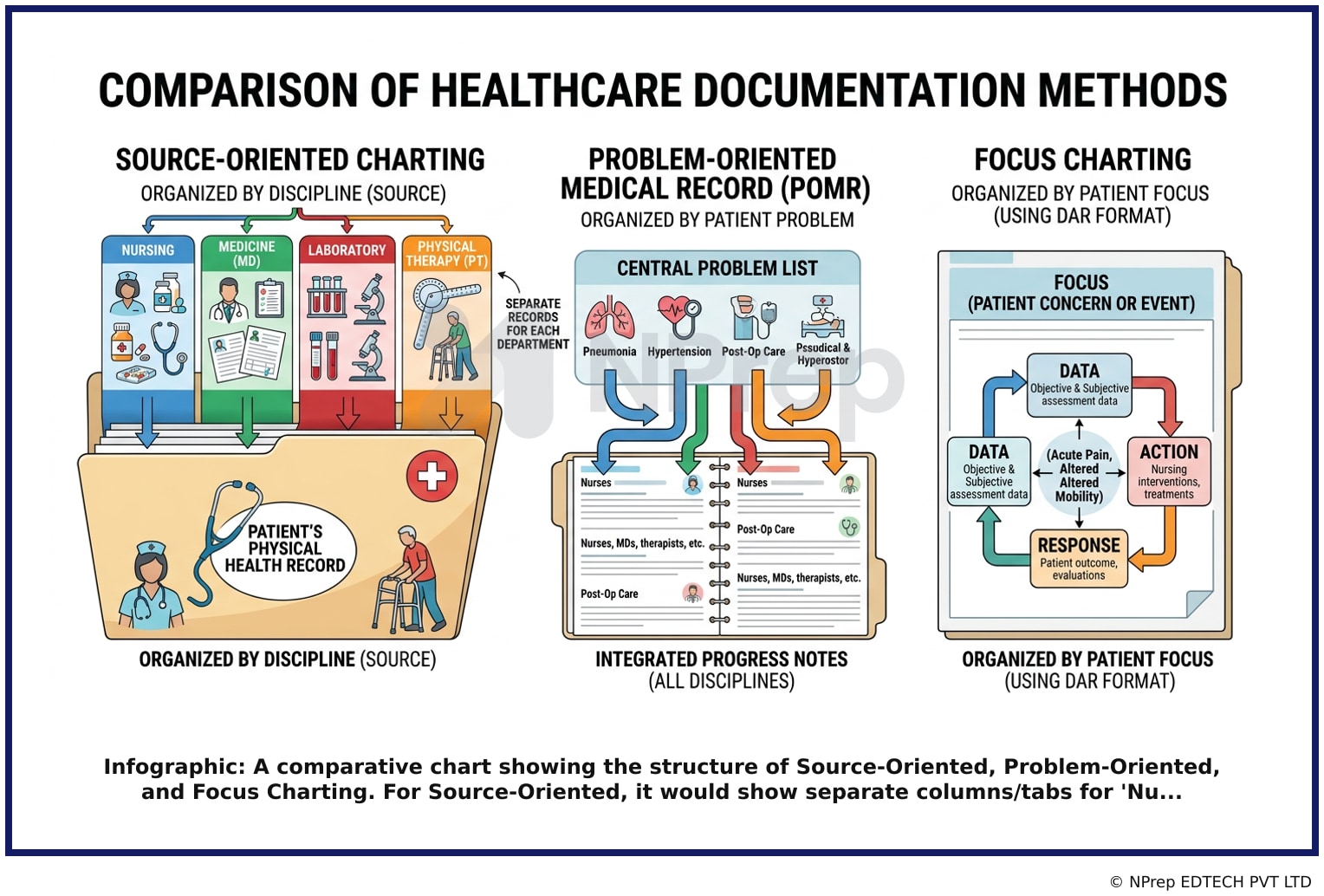
- Visual 1: Infographic: A comparative chart showing the structure of Source-Oriented, Problem-Oriented, and Focus Charting. For Source-Oriented, it would show separate columns/tabs for 'Nursing', 'MD', 'Lab', 'PT'. For Problem-Oriented, it would show a central 'Problem List' feeding into integrated progress notes. For Focus Charting, it would show a 'Focus' column with corresponding 'DAR' entries.
Clinical Relevance
- Nursing practice connection: Knowing Methods of Nursing Documentation helps nurses interpret findings accurately and avoid errors in routine assessment, medication administration, and patient teaching.
- Understanding different charting methods is crucial for nurses as it impacts communication, legal documentation, and continuity of care. Nurses must be able to adapt to the system used in their facility.
- While source-oriented charting is a traditional method, its major drawback is the potential for fragmented care. A physician might miss a crucial nursing observation because it's in a separate section, leading to delayed or uncoordinated treatment.
- What if? If a patient's condition is rapidly deteriorating and involves multiple systems, a source-oriented chart can be cumbersome. In this case, a problem-oriented or integrated electronic health record (EHR) would be superior, as it provides a more holistic and immediate view of the patient's status for the entire care team.
How to Approach the Question
- Identify the key term in the question: 'source-oriented charting'.
- Recall the definition of this specific documentation method. The word 'source' is a major clue, suggesting the information is organized by who provided it (the source).
- Evaluate each option against this definition.
- Option A directly matches the definition: 'Separates the health record according to discipline' (the source of the information).
- Analyze the other options to confirm they describe different charting methods. This reinforces the correctness of your chosen answer.
Concept Tested & Keywords
- Concept Tested: Methods of Nursing Documentation
- Stem keywords: source-oriented charting, health record, documentation
- Lead-in keywords: best describes
Question ID
QavFR7bXbWQY8eBJJSb_Ib
Practise the full JIPMER Nursing Officer-2024
Attempt every question from this paper in a timed mock, then review the full solution for each one.
More Documentation & Reporting Questions
- After administration of the medicine, the nurse does the documentation?
- Which of the following is not a purpose of reporting and recording? (Choose the most appropriate option from below)
- The method of case documentation in nursing that uses data, action, and response in the narrative is called
- The type of recording system in which the members of each discipline record their findings in a separately labeled section of the chart is?
- Which of the following factors must be kept in mind while documenting the patient's records during and at the end of the shift?
- In the context of recording and documentation, what does the acronym SOAP stand for?
- Which of the following principles of documentation ensures that documentation can be easily read by all healthcare providers?
- How should errors in nursing documentation be corrected?
- Which of the following would not promote trust in the nurse-patient relationship?
- The traditional source-oriented, narrative type of charting is characterized by all of the following forms, EXCEPT the
More JIPMER Nursing Officer-2024 Questions
- Which word cannot be formed from the letters of the word "dummarment"?
- Identify the grammatically correct sentence:
- Correct the following sentence into passive voice: "Teacher is teaching book to students."
- How many times do the hour and minute hands of a clock coincide in a 24-hour period?
- Panchayat Samiti is at which level of the Panchayati Raj system in India?
- What should come in place of "?" in the given series? 18 39 67 102 144 ?
- What sum (in ₹) will earn a simple interest of ₹480 in 3 years at 20% per year rate of interest?
- An example of an organism that takes nutrition from dead and decaying matter is known as
- Turner's sign is?
- Which of the following is the most important initial care when chemical burn is suspected?