
NORCERT 8 Mains-2025
Obstetrics & Gynaecology
Hard
The most critical time in the treatment of a woman suffering from heart disease is
Appeared in: NORCERT 8 Mains-2025
Explanation
- The immediate postpartum period (first 24-48 hours) is the most critical due to sudden, massive hemodynamic shifts that stress the cardiovascular system.
- Following placental delivery, the contracting uterus causes an 'autotransfusion' of 500–1000 mL of blood back into the systemic circulation.
- Simultaneously, the relief of vena cava compression and the mobilization of extravascular fluid dramatically increase venous return (preload) to the heart.
- This rapid surge in blood volume and cardiac output can overwhelm a compromised heart, leading to acute decompensation, such as congestive heart failure or pulmonary edema.
Why Other Options Were Wrong
- Option B: While the intrapartum period (labor) is stressful and increases cardiac workload due to pain and contractions, the most abrupt and largest volume overload occurs immediately after delivery.
- Option C: In the early weeks of pregnancy, cardiac output and blood volume begin to rise, but they do so gradually, allowing the cardiovascular system time to adapt and compensate.
- Option D: In the later postpartum period (weeks to months after delivery), the body's fluid volumes and hemodynamic parameters have begun to stabilize and return towards the pre-pregnancy state, significantly reducing the acute risk of heart failure.
Related Visual
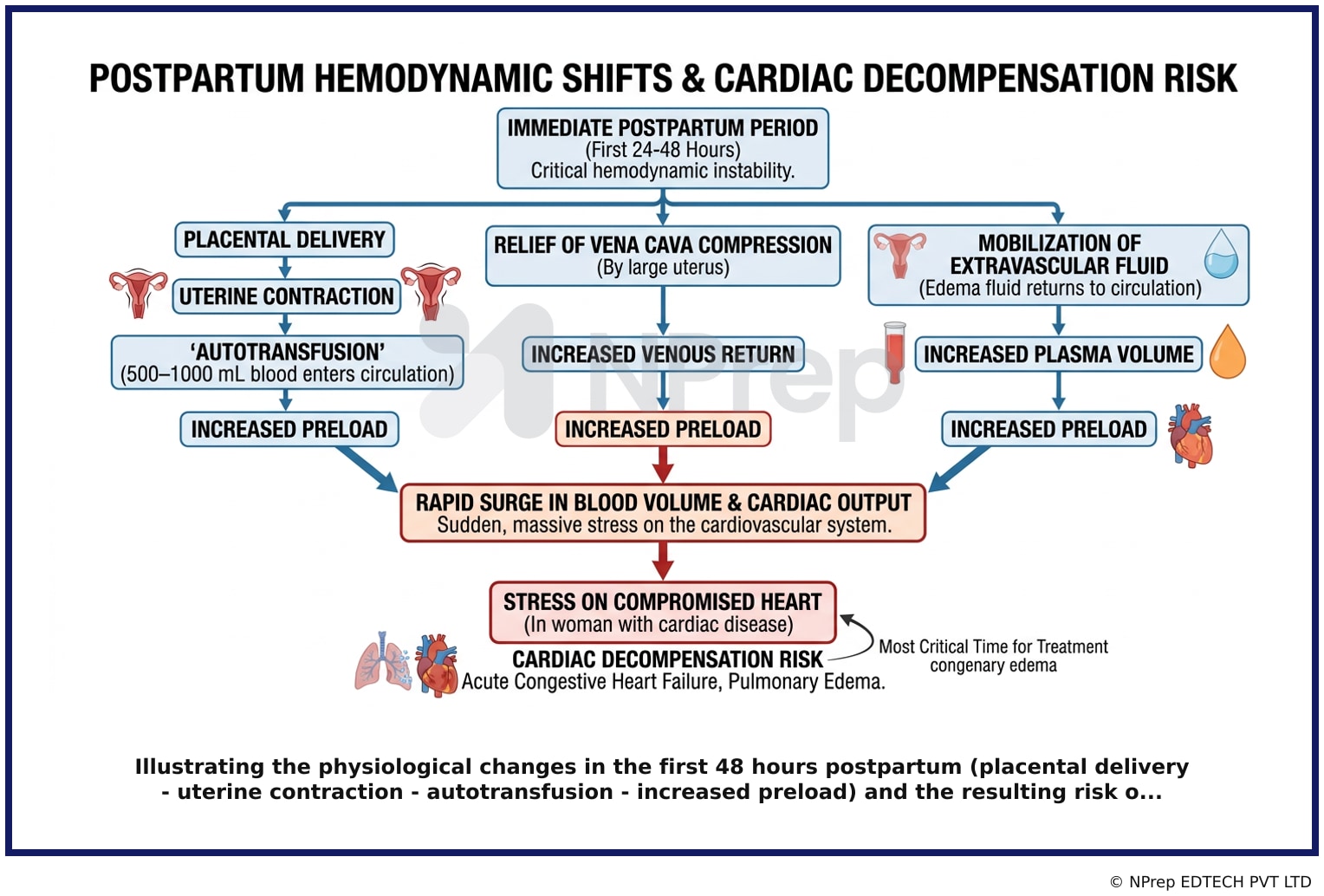
- Visual 1: Flowchart - Illustrating the physiological changes in the first 48 hours postpartum (placental delivery -> uterine contraction -> autotransfusion -> increased preload) and the resulting risk of cardiac decompensation.
- Visual 2: Graph - Showing the relative changes in cardiac output throughout pregnancy, peaking during labor, but highlighting the acute volume stress immediately postpartum.
Clinical Relevance
- Nursing practice connection: Prioritize focused assessment, early escalation, and real-time monitoring when managing Hemodynamic changes in the peripartum period for patients with cardiac disease in acute care settings.
- Nurses must perform intensive monitoring of vital signs (especially heart rate and respiratory rate), oxygen saturation, and for signs of pulmonary edema (cough, crackles) in any postpartum patient with known heart disease.
- Positioning the patient in a semi-Fowler's or high-Fowler's position can help reduce preload and improve breathing if signs of fluid overload appear.
- What if? - If the patient received large volumes of IV fluids during labor (e.g., for epidural-induced hypotension or oxytocin administration), the risk of postpartum fluid overload and heart failure is even higher, requiring more vigilant monitoring and potential diuretic use.
How to Approach the Question
- Identify the core of the question: it asks for the most critical time for a woman with heart disease during the peripartum period. This requires comparing the physiological stress of different phases.
- Recall the major hemodynamic changes of pregnancy, labor, and the postpartum period. Pregnancy involves a gradual increase in blood volume and cardiac output. Labor adds intermittent stress from contractions.
- Focus on the events immediately after delivery. The key event is the sudden return of a large volume of blood to the central circulation from the now-empty and contracting uterus (autotransfusion).
- Contrast this sudden postpartum volume surge with the more gradual changes of pregnancy and the intermittent stress of labor. The suddenness and magnitude of the postpartum fluid shift make it the most dangerous period for a compromised heart.
- Evaluate the options based on this understanding. The first 48 hours postpartum aligns perfectly with this peak risk period for acute decompensation.
Concept Tested & Keywords
- Concept Tested: Hemodynamic changes in the peripartum period for patients with cardiac disease.
- Stem keywords: heart disease, treatment, woman, pregnancy
- Lead-in keywords: most critical time
Question ID
QaZMfH4kxlA0AKjfOZ39Kh
Practise the full NORCERT 8 Mains-2025
Attempt every question from this paper in a timed mock, then review the full solution for each one.
More Medical and Surgical Illness Complicating Pregnancy Questions
- An antenatal mother came to OPD with Hb-8.5 g% which of the following is true?
- The vaccine that is contraindicated in pregnancy is (OBG):
- Which vaccine is used for the pregnant woman?
- Which immunization is contraindicated during pregnancy?
- Which of the following is commonly seen in fetus with congenital CMV infection?
- Most common type of Anemia in pregnancy?
- Assertion (A): Infants born with Intra Uterine Rubella Infection may have cardiac malformation and deafness.Reasons (R): Rubella Infection increases…
- Which vaccine is contraindicated in pregnancy?
- A pregnant woman has an Hb level of 8.5 gm%. What stage of anemia is this?
- Gestational diabetes increases risk for the following, EXCEPT
More NORCERT 8 Mains-2025 Questions
- A patient admitted in the ICU is receiving feeding through a Ryles tube. The nursing officer is about to give the next feed, which is scheduled for e…
- What clinical condition is shown in the image below?
- What is the most significant diagnostic test that needs to be done prior to a lumbar puncture?
- Identify the device shown in the image.
- The nurse is monitoring a child with burns during treatment. Which assessment provides the most accurate guide to determine the adequacy of fluid res…
- Which of the following assessment techniques should be avoided in a child with Wilms' tumor?
- In a conscious and stable patient, what instructions should be given while removing the central venous catheter to minimize complications?
- A nurse is caring for a schizophrenia patient who is experiencing auditory hallucinations. Which intervention is MOST appropriate?
- A belief that persists despite evidence to the contrary is characteristic of what?
- A schizophrenic patient with renal failure is admitted to the psychiatric ward for dialysis. When the time for the procedure arrives, the patient ref…