
AIIMS Delhi NO - 2018
Nursing Foundation
Easy
The items shown in the picture below are usually used in a client after surgery in the post-operative period to prevent?
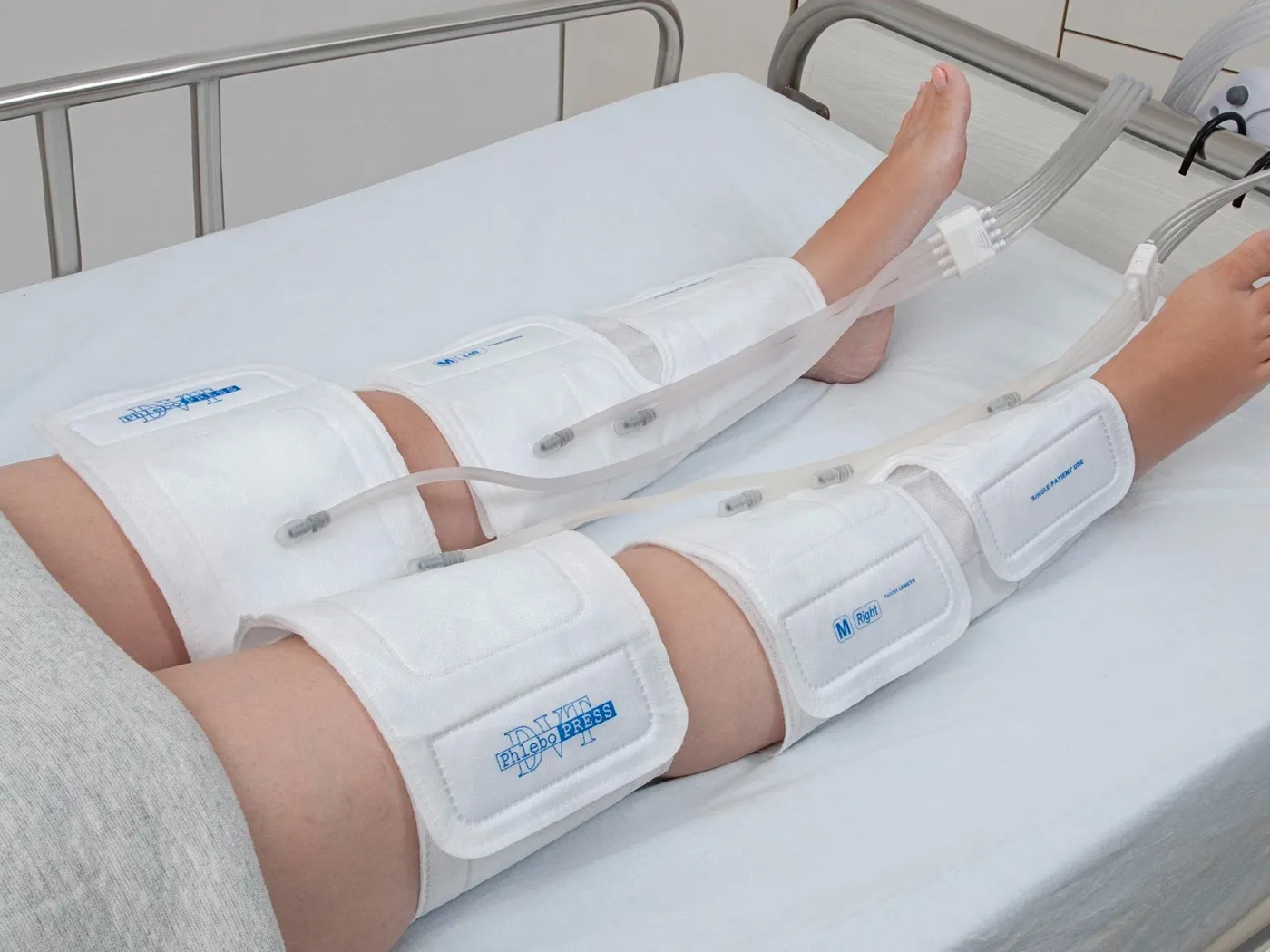
Appeared in: AIIMS Delhi NO - 2018
Explanation
- The equipment shown in the image is a Sequential Compression Device (SCD), a form of mechanical prophylaxis.
- The primary purpose of an SCD is to prevent Deep Vein Thrombosis (DVT), a common and dangerous complication of immobility.
- SCDs work by intermittently inflating with air to squeeze the legs, which enhances venous blood return and prevents blood from pooling in the deep veins (venous stasis).
- They are frequently used for patients after surgery who have limited mobility.
Why Other Options Were Wrong
- Option B: Shock is a life-threatening condition of inadequate tissue perfusion. SCDs are designed to promote venous return from the legs and do not directly treat or prevent the systemic circulatory collapse seen in shock.
- Option C: Arthritis is an inflammatory condition of the joints. SCDs apply pressure to the muscles and soft tissues of the legs, not the joints, and have no role in preventing or treating arthritis.
- Option D: SCDs do not prevent bone fractures. They are used to prevent a secondary complication (DVT) that can result from the immobility required for a fracture to heal.
Related Visual

Clinical Relevance
- Nursing practice connection: This is primarily an exam-oriented knowledge point with limited direct bedside application, so retain Prevention of post-operative complications using mechanical prophylaxis as background academic context rather than a clinical decision trigger.
- Nurses are responsible for applying SCDs correctly, ensuring a proper fit to maximize effectiveness and prevent complications like skin breakdown or nerve compression.
- Regular neurovascular assessment of the lower extremities is a critical nursing intervention when a patient is using SCDs.
- Patient education on the purpose of the device and safety precautions (e.g., fall risk due to tubing) is essential for compliance and safety.
How to Approach the Question
- First, identify the equipment shown in the image. Recognize the inflatable sleeves and tubing as a Sequential Compression Device (SCD) or Intermittent Pneumatic Compression (IPC) device.
- Next, recall the primary clinical indication for this device. Its main function is mechanical prophylaxis against blood clots.
- Consider the context provided in the question stem: 'after surgery in the post-operative period'. This period is associated with prolonged immobility.
- Link immobility to its most common vascular complication: the formation of blood clots in the deep veins of the legs.
- Evaluate the given options. 'DVT' (Deep Vein Thrombosis) directly matches the primary purpose of the SCD.
- Rule out the other options as they are not prevented by this device: Shock, Arthritis, and Fracture have different pathophysiologies and preventive measures.
Concept Tested & Keywords
- Concept Tested: Prevention of post-operative complications using mechanical prophylaxis.
- Stem keywords: post-operative period, after surgery, prevent
- Lead-in keywords: prevent
- Clinical cues: The context 'after surgery in the post-operative period' points towards complications related to immobility.
Question ID
QT_Pp_zu_cW2PNEeJErU6C
Reference Book
E6 Nursing Fundamentals Potter Perry 12e Part 4 p. 153-155
E6 Nursing Brunner Adult Health 3SA Vol 1 Part 2 p. 12-14
Practise the full AIIMS Delhi NO - 2018
Attempt every question from this paper in a timed mock, then review the full solution for each one.
More Comfort, Rest & Sleep & Pain Questions
- Identify the position in the following image:
- How many faces are there in Wong-Baker facial pain rating scale?
- Which position is mostly recommended for rectal examination?
- Out of the following, which comfort device prevents the external rotation of the hips of a bedridden patient?
- What is the position called that patient sits at the side of the bed with the head resting on the overhead table on top of several pillows?
- The process of Straight, deep and firm stroking type of back massage is called
- Hot application cause?
- In trying to relieve the pain of a patient, the Nursing sister asks him to identify a really happy scene he has experienced. This is called -
- Which intervention is the most appropriate to include in a care plan for improving sleep in an older adult?
- Which of the following is a type of pain that is protective, temporary and usually self-limiting and resolves with tissue healing?
More AIIMS Delhi NO - 2018 Questions
- Another tentative diagnosis made for the client is Wernicke's Encephalopathy. If the client has this, the nurse anticipates that the first physician'…
- A 35-year-old man was in an automobile accident with an admitting diagnosis of a head injury. He has a Glasgow Coma Scale score of 4. Upon MRI and CT…
- A 28-year-old male client is admitted to the hospital for a suspected brain tumor. While assessing this client, the nurse would keep in mind that the…
- Following admission to the hospital, a diagnosis of increasing intracranial pressure was made. The nursing intervention appropriate in the care of th…
- The nurse has orders to administer phenytoin (Dilantin) 100 mg IV as an anticoagulant. The priority action while administering this drug is to:
- The client is to take lithium regularly after she is discharged from the hospital. The nursing care plan includes discharge planning. The most import…
- A patient is taking a proper diet as prescribed for bulimia nervosa, but the patient's weight is not gaining. Which nursing action is appropriate?
- Identify the size of the cannula shown here?& x20;
- Identify the following image? & x20;
- Identify the instrument below?& x20;