
RUHS, Jaipur, M.Sc Nursing Entrance Exam-2024
Obstetrics & Gynaecology
Easy
The first sign seen in pregnancy is
Appeared in: RUHS, Jaipur, M.Sc Nursing Entrance Exam-2024
Explanation
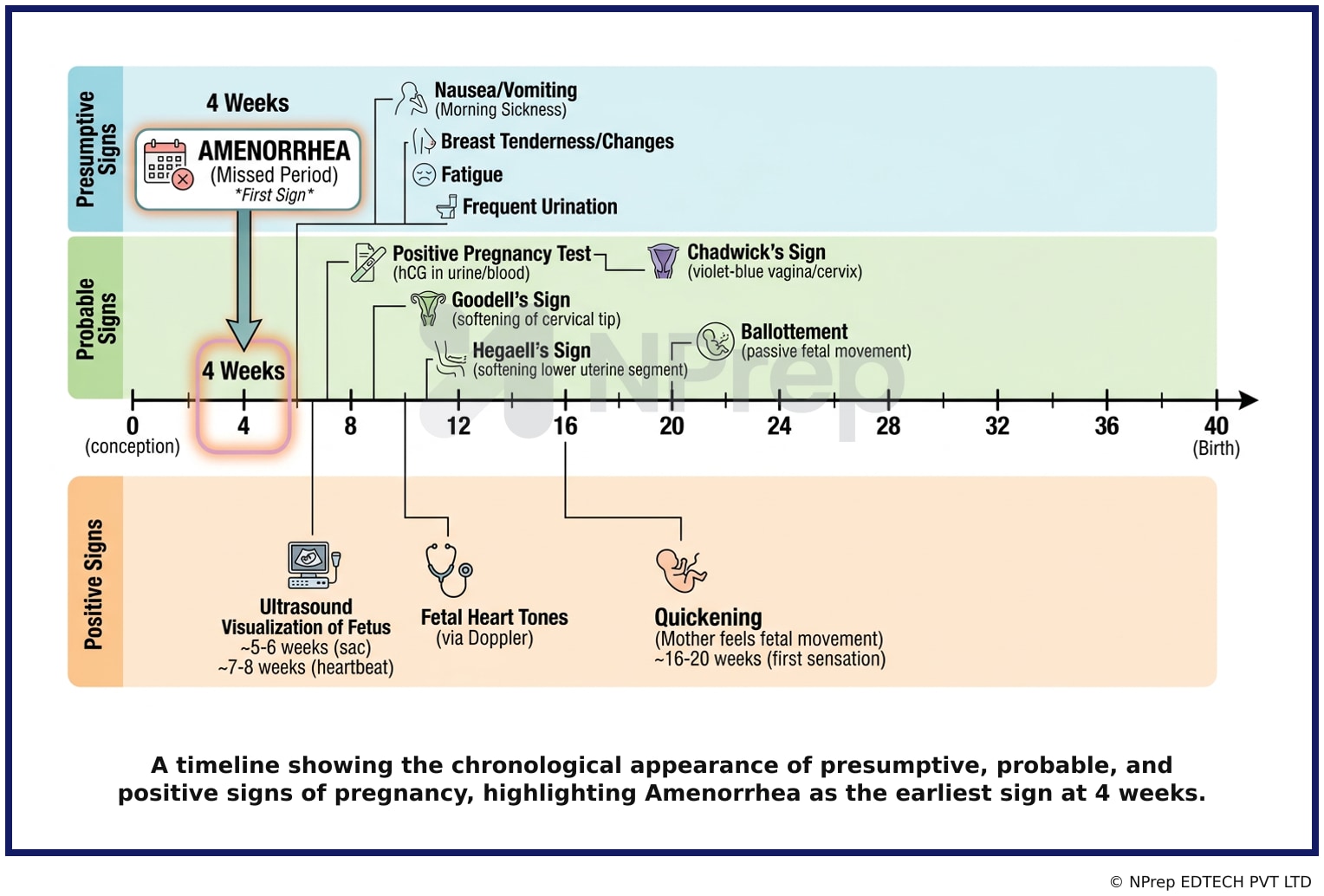
- Amenorrhea, the cessation of the menstrual period, is the earliest presumptive sign of pregnancy.
- It typically occurs around the 4th week of gestation, corresponding to the time of the first missed menstrual period.
- While other conditions can cause amenorrhea, it is the first sign that prompts most women to consider the possibility of pregnancy and seek confirmation.
Why Other Options Were Wrong
- Option A: Quickening is the mother's first sensation of fetal movement. It is a presumptive sign but appears much later in pregnancy.
- Option C: Hegar's sign is a probable sign of pregnancy detected by a clinician. It involves the softening of the lower uterine segment and appears later than amenorrhea.
- Option D: This option is incorrect because a correct answer, Amenorrhea, is available among the choices as the earliest sign of pregnancy.
Related Visual
Clinical Relevance
- Nursing practice connection: This is primarily an exam-oriented knowledge point with limited direct bedside application, so retain Chronology of Early Pregnancy Signs as background academic context rather than a clinical decision trigger.
- Recognizing amenorrhea as the first potential sign of pregnancy is crucial for initiating timely antenatal care. Early confirmation allows for important health interventions, such as starting folic acid supplementation to prevent neural tube defects and making necessary lifestyle adjustments (e.g., avoiding alcohol and smoking).
- Nurses play a key role in educating women about the early signs of pregnancy and the importance of seeking early prenatal care for a healthy pregnancy outcome.
- What if? If a woman has highly irregular menstrual cycles, amenorrhea becomes a less reliable early indicator. In such cases, other presumptive signs like nausea, breast tenderness, and fatigue, followed by a pregnancy test (which detects hCG), are more significant for early detection.
How to Approach the Question
- Identify the core of the question: it asks for the 'first' sign of pregnancy, which requires knowledge of the chronological order of signs.
- Analyze each option provided: Quickening, Amenorrhea, and Hegar's sign.
- Recall the typical timeline for each sign's appearance during gestation.
- Compare the timings: Amenorrhea (missed period) occurs around 4 weeks. Hegar's sign (uterine softening) is detected around 6-10 weeks. Quickening (fetal movement) is felt around 16-20 weeks.
- Based on this comparison, determine that amenorrhea is the earliest sign among the choices.
- Select the option corresponding to Amenorrhea.
Concept Tested & Keywords
- Concept Tested: Chronology of Early Pregnancy Signs
- Stem keywords: first sign, pregnancy
- Lead-in keywords: first
- Negative lead-in flag: false
Question ID
QI_zOTRqmRsSyBrx7jil5l
Reference Book
E6 Midwifery Obstetrics and Gynecology Nursing Sandeep Kaur pp. 6-11, 7-12
E6 Comprehensive Textbook of Community Health Nursing for BSc Nursing Students Part 2 — Subpart B (pp 276-535 of 550) p. 224-226
Practise the full RUHS, Jaipur, M.Sc Nursing Entrance Exam-2024
Attempt every question from this paper in a timed mock, then review the full solution for each one.
More Diagnosis of Pregnancy Questions
- Dark purplish discoloration and congestion of vulva and vaginal mucus membrane is termed:
- Calculate the Expected date of delivery (EDD) using Naegele's rule, if a woman's first day of last menstrual period was February 11th, 2018.
- The bluish discoloration of the cervix, vagina that is observed as early as 6-8 weeks after conception is called:
- Which is the primary assessment done when patients BP fall during labor?
- Which rule is used to calculate the Gestational age of a pregnant lady?
- A pregnant woman should start the IFA tablets from?
- In a pregnant woman, the hegar's sign occurs at?
- Braxton-hick's contraction would indicate to?
- What does "P2+1" signify?
- Pregnancy resulting from Assisted Reproductive Technology (ART) calculate gestational age from:
More RUHS, Jaipur, M.Sc Nursing Entrance Exam-2024 Questions
- Which nerve is responsible for transmitting pain sensation from the appendix to the brain
- The coronary arteries arise from which part of aorta
- The role of Hepatic Portal System is to
- Which hormone is secreted by adrenal medulla & is involved in fight & flight response
- Which process is responsible for synthesis of ATP in mitochondria
- Which of the following enzymes is responsible for the breakdown of starch into glucose
- Which of the following is considered a key element of the chain of infection
- Which characteristic is commonly used to classify bacteria
- Excess collection of fluid in peritoneal cavity is known as
- In acid base balance, a pH below 7.35 is indicative of