
JODHPUR AIIMS SNO-2018
Medical Surgical Nursing
Easy
The first action in case of a blood transfusion reaction is?
Appeared in: JODHPUR AIIMS SNO-2018
Explanation
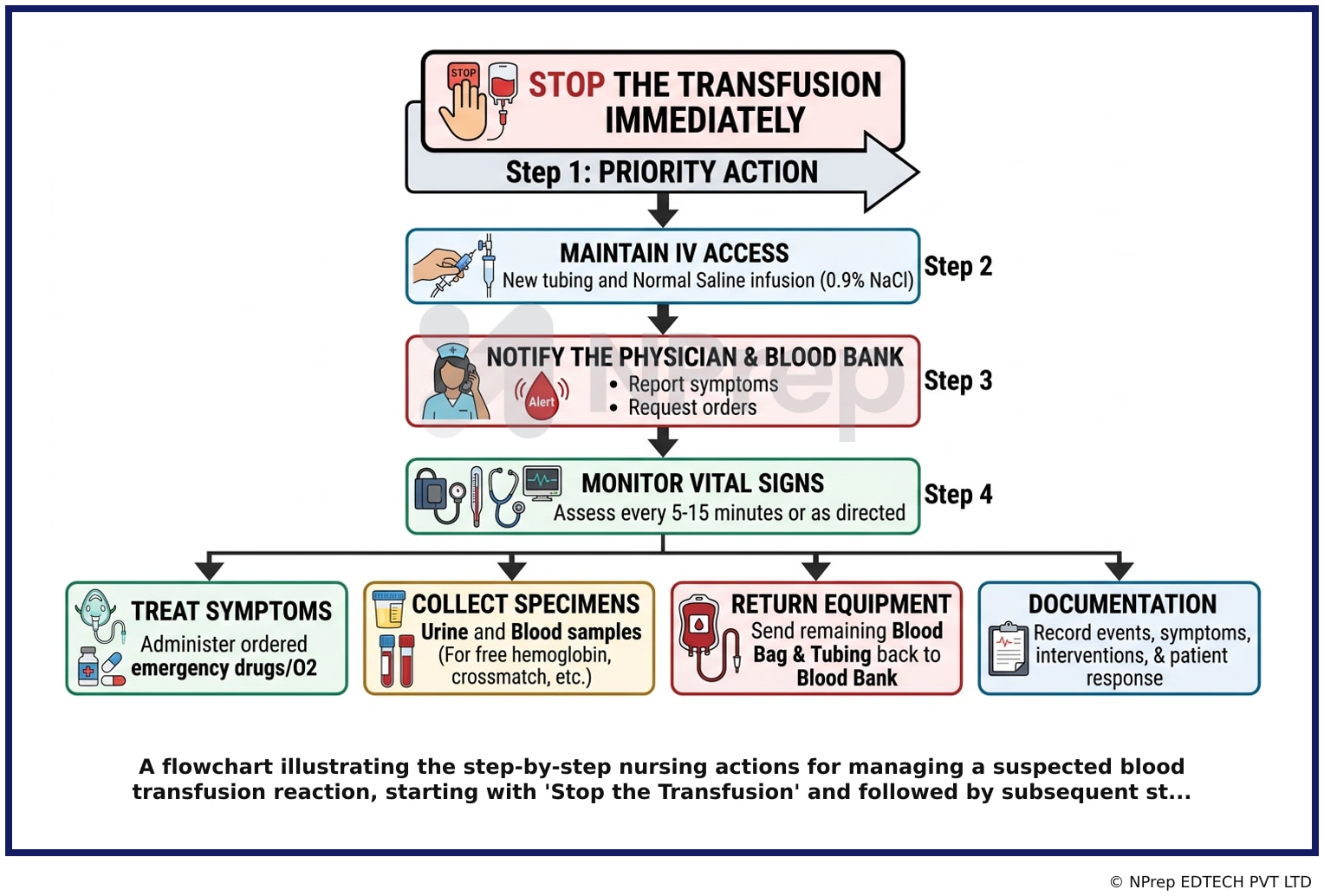
- The absolute first priority in a suspected transfusion reaction is to stop the transfusion immediately.
- This action prevents the patient from receiving more of the blood component that is causing the adverse reaction, which is critical to minimizing the severity and potential for life-threatening complications.
- All other actions, while important, are secondary to stopping the source of the problem.
Why Other Options Were Wrong
- Option A: Waiting for symptoms to subside is dangerous as transfusion reactions can be progressive and life-threatening. Delaying intervention can lead to severe complications like shock, renal failure, or death.
- Option C: While informing the physician is a crucial step, it is not the first action. The nurse must first stop the immediate source of harm (the transfusion) to protect the patient before notifying others.
- Option D: Maintaining the IV line with normal saline is the second step, not the first. It's done immediately after stopping the blood to keep the vein accessible for emergency drugs, but stopping the blood must happen first.
Related Visual
Clinical Relevance
- Nursing practice connection: Knowing Management of Blood Transfusion Reactions helps nurses interpret findings accurately and avoid errors in routine assessment, medication administration, and patient teaching.
- Rapid identification and intervention in a transfusion reaction are critical nursing responsibilities that directly impact patient safety.
- Most severe reactions occur within the first 15 minutes of the transfusion, underscoring the need for vigilant monitoring at the start of the infusion.
- What if? If the patient reports only mild itching with no other symptoms, the procedure remains the same: stop the transfusion first. It could be the initial sign of a severe allergic (anaphylactic) reaction, and it's not possible to know at the onset how severe it will become.
How to Approach the Question
- Identify the question type: This is a priority-based question asking for the 'first action'.
- Analyze the scenario: A patient is having a blood transfusion reaction.
- Recall the nursing process and safety principles: The primary principle is to 'do no further harm'.
- Evaluate the options based on this principle. The action that immediately stops the potential harm is the highest priority.
- Option A (waiting) increases harm. Options C (informing) and D (maintaining line) are necessary but do not stop the initial cause of harm.
- Conclude that stopping the blood is the only option that directly addresses and halts the cause of the reaction, making it the correct first action.
Concept Tested & Keywords
- Concept Tested: Management of Blood Transfusion Reactions
- Stem keywords: blood transfusion reaction, first action
- Lead-in keywords: first action
- Negative lead-in flag: false
Question ID
QGV-aBbIAcMGtcAnts0HHX
Reference Book
E6 Nursing Fundamentals Taylor p. 830-832
E6 Nursing Fundamentals Potter Perry 12e Part 5 pp. 76-78, 77-79
Practise the full JODHPUR AIIMS SNO-2018
Attempt every question from this paper in a timed mock, then review the full solution for each one.
More Blood Transfusion Questions
- Which gauze cannula is commonly used for blood transfusion?
- After the RTA, a patient was brought to the emergency department. After Massive blood transfusion, which electrolyte imbalance occurs in the patient?
- Patient needs a massive blood transfusion. Which IV flow catheter is used?
- A patient admitted in ICU. Blood transfusion is going on. Suddenly, an adverse reaction occurred. What is the first action of the nurse?
- Which blood group can be used in an emergency or when the desired blood group is not available?
- In which of the following conditions is blood transfusion contra-indicated?
- Initially after starting a blood transfusion, the client shows flushing on the face, tachycardia, and hypotension. All these clinical features indica…
- After just starting a blood transfusion, the patient experiences an anaphylactic reaction. What is the priority nursing action in this situation?
- If a patient complains of flank pain, chills, fever, and hematuria during a blood transfusion, these symptoms indicate the following complication?& x…
- Which gauge needle is used for blood transfusion?
More JODHPUR AIIMS SNO-2018 Questions
- Who is the 'Father of Psychoanalytical Theory'?
- Twitching of facial muscles when the facial nerve is tapped anterior to the earlobe is called?
- In a lecture on sexual functioning, a nurse will include the fact that ovulation occurs when the?
- Which of the following is used for passive immunization?
- Management of Wernicke's disease and Beriberi involves administration of?
- When toddlers move around on their hands keeping their abdomen off the floor, it is called?
- 'Do no harm' is which ethical principle?
- A nurse receives an order to give a patient two puffs of salmeterol and two puffs of beclomethasone dipropionate, by a metered dose inhaler. The nurs…
- Eugenics means?
- Parrot-like repetition of words spoken by another person is known as?