
RRB Nsg. Superintendent-20 July 2019 (Shift-3rd)
Applied Anatomy
Easy
The eyeball is approximately spherical in shape with a diameter of about
Appeared in: RRB Nsg. Superintendent-20 July 2019 (Shift-3rd)
Explanation
- The average diameter of an adult human eyeball is approximately 2.3 cm (23 mm).
- This specific dimension is crucial for the proper focusing of light onto the retina, which is the light-sensitive layer at the back of the eye.
- The eyeball maintains its shape due to the tough outer sclera and the pressure of the internal fluids, the aqueous and vitreous humor.
- While there are minor variations among individuals, 2.3 cm is the standard anatomical measurement used in medicine and ophthalmology.
Why Other Options Were Wrong
- Option A: A diameter of 3.0 cm is significantly larger than the average adult eyeball. An eye of this size would be highly myopic (nearsighted).
- Option B: A diameter of 1.0 cm is extremely small, less than half the size of an adult eye. This would result in severe hyperopia (farsightedness).
- Option D: A diameter of 1.8 cm (18 mm) is closer to the size of a newborn infant's eye, which is approximately 16-17 mm at birth and grows rapidly.
Related Visual
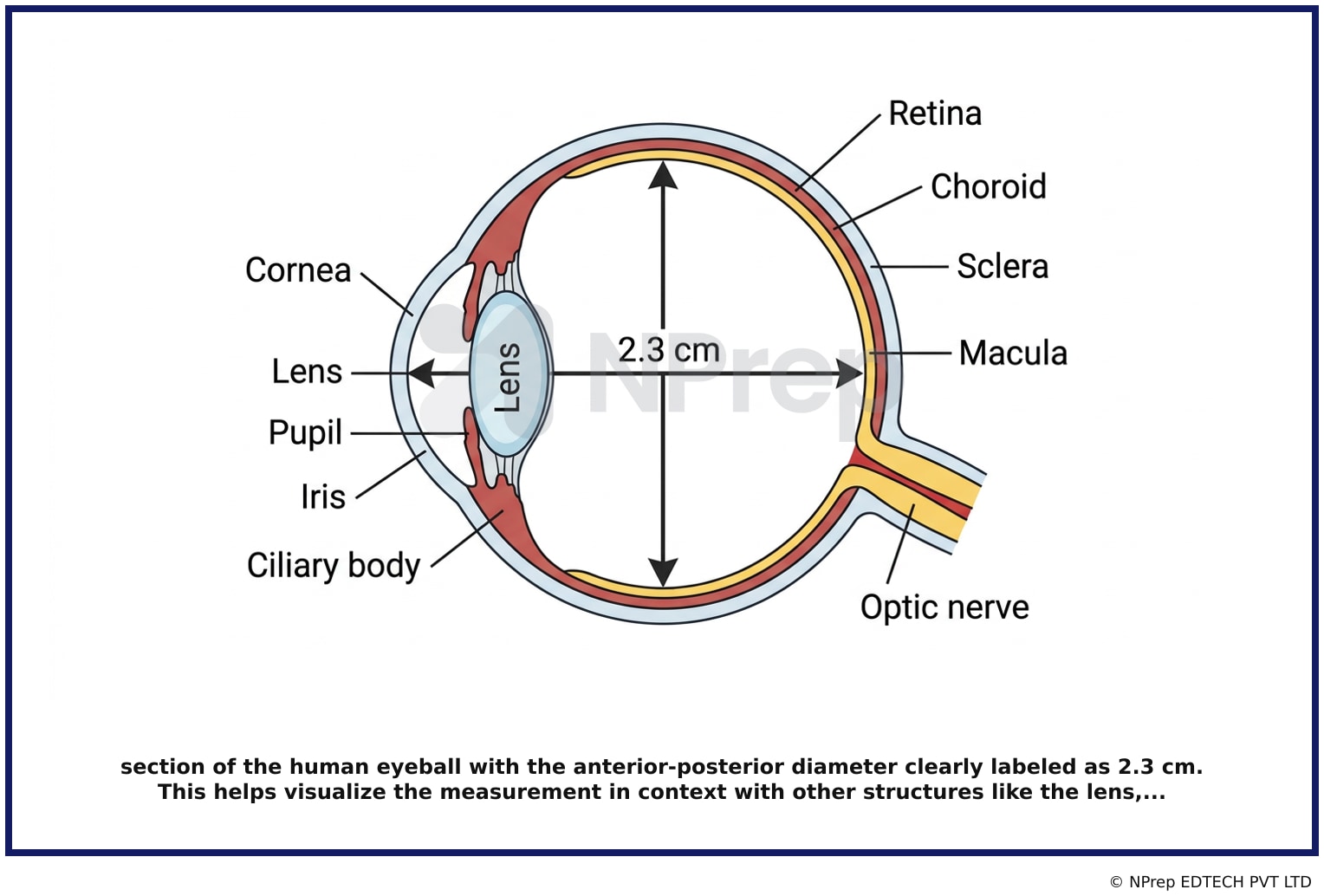
- Visual 1: Diagram - A cross-section of the human eyeball with the anterior-posterior diameter clearly labeled as 2.3 cm. This helps visualize the measurement in context with other structures like the lens, retina, and cornea.
- Visual 2: Infographic - A comparison of a normal-sized eyeball, a myopic (long) eyeball, and a hyperopic (short) eyeball, showing how the focal point of light changes in relation to the retina.
Clinical Relevance
- Nursing practice connection: This is primarily an exam-oriented knowledge point with limited direct bedside application, so retain Anatomy of the human eye, specifically its dimensions as background academic context rather than a clinical decision trigger.
- Understanding the standard size of the eyeball is fundamental for nurses to appreciate the pathophysiology of refractive errors like myopia and hyperopia.
- During health screenings, nurses may assess visual acuity. A significant change or poor acuity could indicate an underlying structural issue, including abnormal growth or changes in the eye's dimensions, warranting referral to an ophthalmologist.
- What if? - If a patient's medical record notes an axial length of 2.6 cm, the nurse should anticipate that the patient has moderate to high myopia and will require corrective lenses (glasses or contacts) for clear distance vision.
How to Approach the Question
- This is a factual recall question that tests your knowledge of basic human anatomy.
- First, identify the key term in the question: 'diameter' of the 'eyeball'.
- Recall the standard anatomical value for the adult human eyeball's diameter.
- Evaluate the given options. 2.3 cm is the accepted average.
- Eliminate the other options by considering their plausibility. 1.0 cm is too small, and 3.0 cm is too large for a human eye. 1.8 cm is closer to the size of an infant's eye, not an adult's.
Concept Tested & Keywords
- Concept Tested: Anatomy of the human eye, specifically its dimensions.
- Stem keywords: eyeball, spherical, shape, diameter
- Lead-in keywords: BEST, MOST RELEVANT CLUE
Question ID
QmR6LaMg2m6v4JUP6hDS6u
Practise the full RRB Nsg. Superintendent-20 July 2019 (Shift-3rd)
Attempt every question from this paper in a timed mock, then review the full solution for each one.
More Sensory Organs Questions
- A structure which is in the dermis layer of skin is:-
- Out of the following, the bony labyrinth of inner ear consists:
- Which of the following is a helping bone in hearing?
- A is a cell that manufactures and stores the protein keratin?
- It is the transparent membrane that focuses the light that enters the eyes to the retina?
- Blind spot is known as?
- Snellen chart is used for the assessment of ..... organ?
- Keratin, the simple protein, is present in?
- This instrument is used for the examination of?& x20;
- Inflammation of the tongue is known as?
More RRB Nsg. Superintendent-20 July 2019 (Shift-3rd) Questions
- Where is oxytocin synthesized?
- What is the name of the muscle that extends from the sphenoid bone to the mandible?
- Complementary feeding should be initiated at the completion of \ \ \ \ \ \
- Where is kidney located?
- Psychosocial development stage for infants is \ \ \ \ \ \ \ \ \ \
- What immunization is given at birth?
- Functional nursing is a method of providing
- Which disease is the dementia associated with asymmetric atrophy of the frontal and temporal lobes?
- Thromboangiitis obliterans is also known as
- What is the other name of pyridoxine?