
NORCERT 8 Mains-2025
Child Health Nursing (Pediatrics)
Medium
The clinical condition shown is associated with which vitamin deficiency?
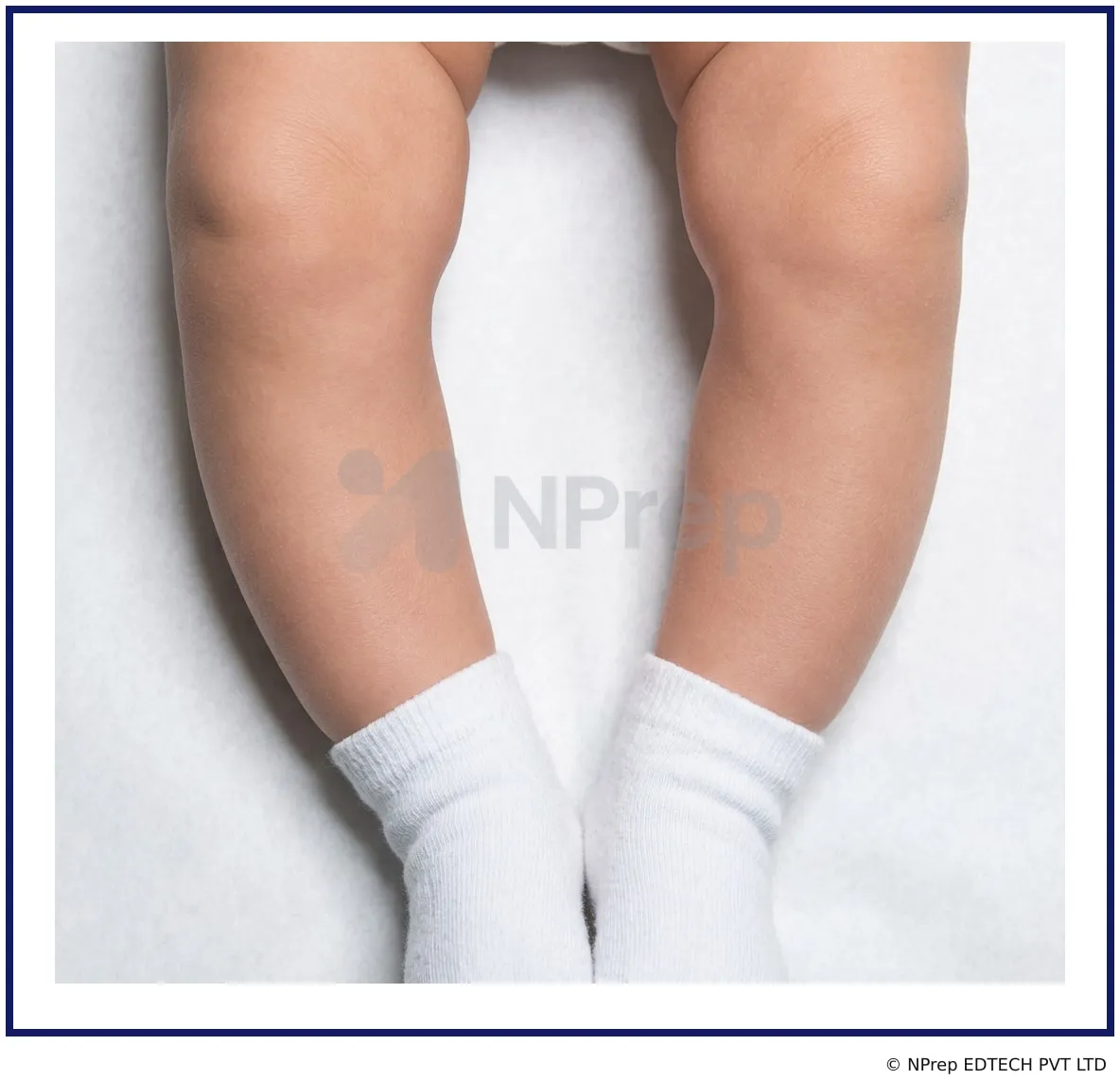
Appeared in: NORCERT 8 Mains-2025
Explanation
- The image displays Genu Varum (bow-legs), a characteristic deformity of Rickets.
- Rickets is a disease of growing bones caused by inadequate mineralization, primarily due to Vitamin D deficiency.
- Vitamin D is crucial for calcium and phosphate absorption, which are essential for bone hardening. Its deficiency leads to soft, pliable bones that bend under pressure.
- Other signs of Rickets include Rachitic Rosary (beading at costochondral junctions), Harrison's groove, and widening of wrists and ankles.
Why Other Options Were Wrong
- Option A: Vitamin K is involved in blood coagulation by aiding the synthesis of clotting factors II, VII, IX, and X. Its deficiency causes bleeding disorders, not skeletal deformities like bow-legs.
- Option C: Vitamin A deficiency primarily affects vision (leading to night blindness and xerophthalmia), immune function, and epithelial cell integrity. It is not associated with the bone-bending deformities seen in Rickets.
- Option D: Vitamin C (ascorbic acid) deficiency causes Scurvy. Scurvy affects collagen synthesis, leading to fragile capillaries, poor wound healing, bleeding gums, and subperiosteal hemorrhages. While it involves bone pain, it does not cause the characteristic bowing of long bones seen in Rickets.
Related Visual

- Visual 1: Diagram: Comparison of normal leg alignment, Genu Varum (bow-legs), and Genu Valgum (knock-knees). This helps differentiate the specific deformity.
- Visual 2: Clinical Image: Rachitic Rosary, showing the beaded appearance of the costochondral junctions on the chest, another key sign of Rickets.
- Visual 3: X-ray Image: Radiograph of a child's knee with Rickets, showing metaphyseal cupping, fraying, and splaying to illustrate the underlying bone changes.
- Visual 4: Infographic: Summary of the signs and symptoms of Rickets, covering skeletal (bow-legs, frontal bossing) and non-skeletal (delayed milestones, muscle weakness) features.
Clinical Relevance
- Nursing practice connection: Knowing Identification of clinical signs of vitamin deficiencies, specifically Rickets helps nurses interpret findings accurately and avoid errors in routine assessment, medication administration, and patient teaching.
- Nurses play a vital role in identifying children at risk for Vitamin D deficiency, such as exclusively breastfed infants without supplementation, children with dark skin, and those with limited sun exposure.
- Patient education is a key nursing intervention. This includes teaching parents about the importance of Vitamin D supplements for infants, safe sun exposure, and dietary sources of vitamin D and calcium.
- During physical assessments, nurses should look for early signs of Rickets, such as craniotabes (soft skull bones), wrist widening, and delayed motor milestones, to facilitate early diagnosis and treatment.
How to Approach the Question
- First, carefully analyze the image provided. Identify the key clinical sign being displayed. In this case, it's the outward bowing of the legs.
- Name the clinical sign. The outward bowing is known as Genu Varum or bow-legs.
- Recall the most common disease associated with this sign in a child. Genu Varum is a classic feature of Rickets.
- Access your knowledge of nutritional deficiencies. What is the primary cause of nutritional Rickets?
- Connect the disease to its cause: Rickets is caused by Vitamin D deficiency.
- Finally, select the option that matches your conclusion. Compare your answer with the other options to ensure they are incorrect for this specific presentation.
Concept Tested & Keywords
- Concept Tested: Identification of clinical signs of vitamin deficiencies, specifically Rickets.
- Stem keywords: clinical condition, vitamin deficiency
- Lead-in keywords: which
- Clinical cues: Image showing outward bowing of the legs (Genu Varum)
Question ID
QP5yrRm_-2D3qi_Rr9St8o
Practise the full NORCERT 8 Mains-2025
Attempt every question from this paper in a timed mock, then review the full solution for each one.
More Micronutrients in Health and Disease Questions
- Which of the following is the earliest symptom of vitamin A deficiency in a young child?
- Dose of Vitamin-A for a 2-year-old child?
- How many mega doses of vitamin A are given in the vitamin A prophylaxis programme?
- What is the recommended dose of Vitamin A at 9 months of age?
- At nine months (9 months), how much Vitamin-A Dose is given to an infant?
- How much dose of Vitamin A is given to a 16 month old child?
- The vitamin supplement that is administered soon after birth is?
- What dose of Vitamin-A is given at 9 months?
- Following are the causes of behavior problems among children, except?
- What dose of Vitamin A should be given orally to a 3-year-old child every 6 months?
More NORCERT 8 Mains-2025 Questions
- A patient admitted in the ICU is receiving feeding through a Ryles tube. The nursing officer is about to give the next feed, which is scheduled for e…
- What clinical condition is shown in the image below?
- What is the most significant diagnostic test that needs to be done prior to a lumbar puncture?
- Identify the device shown in the image.
- The nurse is monitoring a child with burns during treatment. Which assessment provides the most accurate guide to determine the adequacy of fluid res…
- Which of the following assessment techniques should be avoided in a child with Wilms' tumor?
- In a conscious and stable patient, what instructions should be given while removing the central venous catheter to minimize complications?
- A nurse is caring for a schizophrenia patient who is experiencing auditory hallucinations. Which intervention is MOST appropriate?
- A belief that persists despite evidence to the contrary is characteristic of what?
- A schizophrenic patient with renal failure is admitted to the psychiatric ward for dialysis. When the time for the procedure arrives, the patient ref…